Archive for category: Guitar Essentials

How does a guitar pick affect your guitar sound

Short summary

Many guitarists underestimate how much a guitar pick influences their tone, attack, speed, and playing comfort.
The thickness, material, shape, and beveled edges of a pick all affect the way the string vibrates and how efficiently energy is transferred from your hand to the guitar.
Thicker picks generally produce a fuller, warmer sound with greater precision, while thinner picks often create a brighter, more flexible attack.

Whether you play acoustic, electric, rock, jazz, blues, country, or metal, choosing the right guitar pick can noticeably improve your sound, accuracy, and overall playing experience.


Does a guitar pick affect your guitar sound?

Everyone has noticed it at some point; your guitar doesn’t sound as full and loud as you wanted.
On the one hand, your amplifier and pedals and of course, their settings have a major influence,

As a guitarist, you know that many things influence your sound; It is a whole chain of components that matter.
First of all, you yourself and the way you strike your strings have a major influence on your sound.

Why are “you” the most important cause of your sound?

Let’s assume for a moment that your strings are relatively new and don’t sound “dead.”
In principle, all strings (brands) are fine to work with.
After that, it comes down to how you strike the strings and, therefore, how you hold your pick.

How should you hold your guitar pick?

There is actually no wrong way how to hold your guitar pick. Every method and every person creates their own personal style/sound. There are many famous guitarists who hold their picks in the most diverse ways.

Eddie van Halen’s guitar pick

Eddie van Halen for instance, used extremely thin guitar picks (0.6mm).
And he sometimes held his pick in a peculiar way; if he played with a pick at all.
And we can’t say that his sound wasn’t good! On the contrary, Eddie always sounded great!

But perhaps you yourself are not yet satisfied with your sound.

Take a look at the blogs below, that we previously posted about guitar picks and other guitar related items as well.
All information provided are just basic guidelines and take anything to you that you need.
But above all, have fun playing guitar; that’s all that matters.

Fatter tone with thicker picks

The thickness of your pick definitely influences the tone that strikes your guitar.
Many guitarists use a fairly thin pick with a thickness somewhere between 0.73 – 1.0 mm.

This is because many guitar stores actually do not provide information about the differences in picks.
They also don’t think these picks will sell, but they’re wrong.
In contrast, “regular” picks that are thicker than, for example, 2.0mm lack a certain balance that ensures comfort.
Many people therefore do not like thicker picks.

Most guitar stores don’t sell quality picks

At least 90% of all guitar stores don’t sell thicker quality “boutique” picks, so part of their customers only know about the top selling thin plastic picks as well.
Although a boutique pick may cost more than a cheap Dunlop pick, it’s still affordable and lasts a long time.

That said, improving your guitar sound with a good guitar pick may offer you a more than reasonable return on investment.
So just try different picks and judge for yourself.

Flexible picks do not provide that massive tone

We already said it; many people use thin picks gauged somewhere between 0.73 – 1.0mm and even thinner.
The flexibility causes a delay in your playing.
Of course, it’s a minor delay of several milliseconds, but it’s definitely there.
Besides the delay, a thin pick causes some sort of thinner tone as well.

Thick picks deliver more low-end and mid-frequencies to your tone than thin picks do.

Boutique picks are the solution.

As far as I’m concerned, the name “boutique” isn’t entirely accurate for most thicker picks.
In my opinion these are simply thicker picks, often made of plastic, but also other materials are used by different brands.
And besides being thicker, the edges are often rounded differently for more precision picking.

Beveled edges definitely matter

Beveled edges guitar pick

The beveled edges of the pick ensure that the part of the pick that touches your string isn’t actually very thick.

ChickenPicks guitar picks

On our “about” page, you can read how I tried to find a solution to the “thick pick problem” during my teenage years.
This was around 1986, and to this day, I play on picks I designed myself.
We launched the picks in 2010, and we sell tens of thousands of them annually in over 100+ countries worldwide.

Below are various blogs that you might also find interesting.

  1. How to avoid pick noise
  2. Guitar pick size chart
  3. These picks are easy to play with
  4. Guitar picks flexible
  5. Thick guitar picks
  6. Boutique guitar picks
  7. Beveled guitar picks
  8. Small guitar picks
  9. Best guitar picks for acoustic
  10. Bass guitar picks
  11. How to hold a guitar pick
  12. Mandolin picks
  13. Best guitar picks for beginners
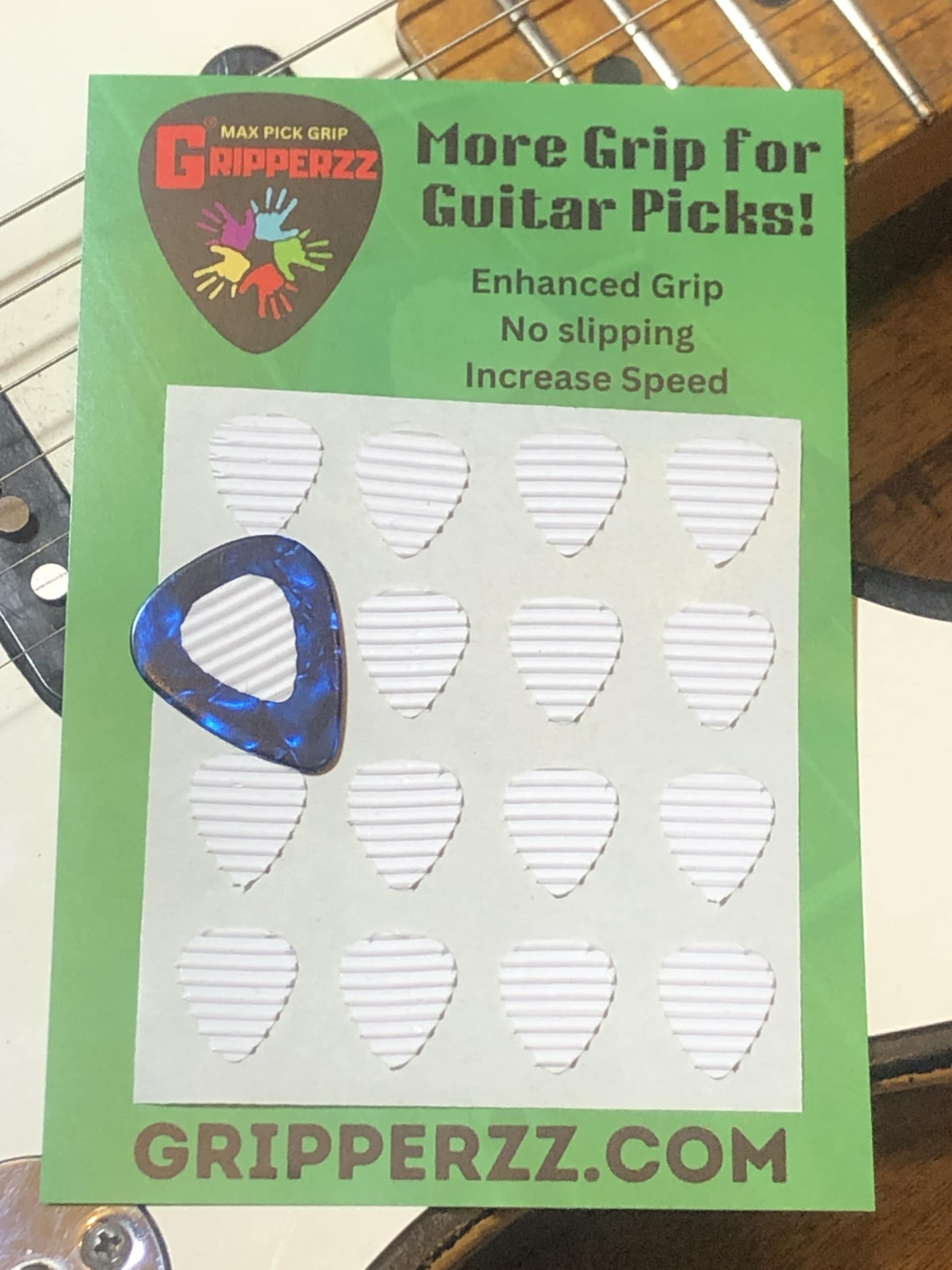
  14. Max pick grip with Gripperzz

What others say about ChickenPicks guitar picks

Musikhaus Thomann
Chicago Music Exchange
Guitarpickreviews.com
Anatomy of guitar tone

F.A.Q.

Why use a thick guitar pick?

Thick guitar picks provide greater control, improved articulation, fuller tone, and less flex compared to thin picks

Are thick guitar picks better for lead playing?

Many lead guitarists prefer thick picks because they offer more precision, cleaner alternate picking, and improved note definition

Do thick picks reduce pick noise?

Yes, thick picks with smooth beveled edges generally create less unwanted pick noise and friction than thin flexible picks.

Does the material of a guitar pick matter?

Absolutely. Different materials have different hardness, grip characteristics, and wear resistance.
These properties influence brightness, attack, durability, and the overall feel of the pick while playing.

Guitar essentials:

In ChickenPicks guitar picks guitar essentials we write about interesting things every guitarist should know a bit of, especially when you’re new to (electric) guitar.
We definitely don’t dig deep into theories or technical aspects.
You will find many scientific documents about anything somewhere on the internet.

About the author

Hi, my name is Eppo Franken and I started to make my own picks in the mid ’80’s.
In 2010 my wife Jolanda and I started ChickenPicks guitar picks, because we’d like to see if others would enjoy them as well.

I play guitar since 1980 and my favorite style is country chicken picking and some kinds of rockabilly and americana.
Send us an e-mail and let’s talk about guitar tone and picks.

Modulation- vs. Time-based guitar effects

Short summary

Modulation and time-based effects are two essential categories of guitar effects, but they serve different purposes. Modulation effects such as chorus, phaser, flanger, tremolo, and rotary speaker alter the character and movement of your guitar signal.

Time-based effects, including delay and reverb, create echoes and ambience that add depth and space to your sound. Understanding how these effects work—and how they complement one another—helps guitarists build better pedalboards and create more expressive tones.
Whether you play rock, blues, metal, country, jazz, or ambient music, knowing when to use modulation or time-based effects will improve your overall guitar sound.


Modulation- vs. Time-based guitar effects

Explore the world of modulation- and time-based effects to transform your guitar sound into a rich and dynamic sonic experience.

Modulation- and time-based effects are essential for any guitarist looking to add texture and depth to their playing.
From subtle chorus tones to mind-blowing phasers and from delays to reverb and more.

Modulation effects explained

Modulation guitar effects create movement, depth, and spatial character in the sound by constantly varying the guitar signal.

Virtually all guitar modulation effects rely on an oscillator, specifically a Low-Frequency Oscillator (LFO). This is the “engine” behind the effect.
They work by copying the original, dry guitar signal, manipulating this copy (pitch, time, or phase), and then mixing it with the original sound.

Modulation effects are used to add movement and dimension to your guitar sound. They can create everything from subtle shifts in tone to dramatic, swirling sonic landscapes, enhancing both live performances and studio recordings.

Time-based effects explained

Time-based guitar effects manipulate the time of the guitar signal by storing it and playing it back later. They create echoes, spaciousness, and repetition, making the guitar sound fuller, wider, or more atmospheric.

Overview of common Modulation Effects:

Chorus: Copies the signal and delays it slightly, creating the sound of multiple guitars playing together.

Phaser: Creates a swirling or rotating effect by shifting portions of the signal out of phase.

Flanger: Similar to phaser, but with a shorter delay and repetitive, jet-like sweeps.

Tremolo: Quickly and rhythmically varies the volume of the signal.

Vibrato: Varies the pitch of the signal for an undulating sound. Rotary: Simulates the rotating effect of a classic Leslie speaker cabinet.

Graphics for modulation effects

Graphic wise you could show how modulation effects work. Below you will see the situation of completely “in phase” and this means that you will hear a nice clear sound without any out of phase sounds.

modulation in phase

Slightly out of phase it may look like this below:

modulation out of phase

Completely out of phase should be look like this here below

modulation out of phase

Important aspects:

Placement: For best results, place modulation effects after distortion (overdrive), but often before delay and reverb, known as time-based effects. Read about the right effects pedal order for the best sound out of your FX-pedals.

Overview of common time-based effects

Delay (or echo) is an essential effect in every guitarist’s toolkit. It adds echo to your sound.
Think of it as Tone-Tone-Tone-Tone-Tone… And you can adjust the length between the “Tones” and how many there are in the chain.

Reverb: An effects pedal that adds spaciousness, depth, and ambiance to the sound. It simulates the natural reverberation of sound in a physical space. Many guitar amps provide a reverb channel within the, whether it’s a Tube- or Solid-State amp.

Reverb works by creating hundreds (or thousands) of small, rapid reflections of the original sound, which slowly decay.

FX-loop / Send & Return

Time-based effects do their job even better when connected through a so-called FX-loop on your amp. You may recognize this on your amp with the words “Send & Return”.

Effects pedals overview

Although this special mainly is about modulation- and time-based effects pedals, there is more in the world of guitar effects pedals. Globally these are classified in 4 different groups.

  • Modulation pedals (chorus, phaser, and flanger)
  • Time-based effects pedals (reverb, delay), and volume-based effects.
  • Gain effect pedals (distortion, compressor, booster etc.)
  • Multi-effects pedals. These are pedals with multiple effects. We won’t discuss the multi-effect pedal not here.

Gain pedals explained

Gain pedals like overdrive, distortion, fuzz distort the guitar signal by increasing the volume above the “headroom,” creating harmonic overtones, compression, and a rougher sound.

The core function of these pedals is to “flatten” the signal waveform, resulting in a distorted sound.
These pedals may be a perfect way to make your guitar sound better.

Wah-Wah pedal

While technically a movable filter or “envelope filter,” the “sweeping” tone change places it within the broader category of modulating effects.

The pedal alters the frequency response (tone) of your guitar, resulting in a sound similar to a human voice saying “wah-wah.”

Learn more about the frequency spectrum where the guitar does its job best.

Delay pedals explained

Different delay pedals use different parameters to modify their sound, but there are generally 4 essential parameters used by all delay effects:

Time – The time it takes for the repeat to occur. This is also called “frequency.”

Feedback – How many repeats are played? This is sometimes referred to as “regen.”

Mix – The degree to which the effect signal is mixed with the original signal.

Level – This determines the overall output level of the mix of dry (normal instrument) and wet (delayed) signals.

Tempo

The tempo, or beats per minute (BPM), of a song is crucial for the timing of echo and delay effects. You want your delay to be in sync with the song.

Tap Tempo

Some delay pedals provide a Tap Tempo knob, which you may vary the time of the delay per different song. This is very useful when you use pronounced delay sounds.

Slap-back delay

In country- and rockabilly music guitar players mainly use a very subtle and extremely short delay with just 1 repeat.
This is called a slap-back delay and the time varies somewhere between 80 – 140 BPM.
The repeat is fairly loud, but not “too much”.

With rotary knob delays it can be quite an advantage to find the right BPM for your needs.

There is more to gain pedals

Think of the distortion/overdrive, equalization (EQ), compressor, clean booster and octaver. These are gain pedals as well, as they’re pumping up the volume of the whole signal before entering the amplifier. Normally they increase the volume within the “headroom” limits.

Learn more about what headroom means in guitar sound.

Internal amplifier

As said before, there are many so called gain pedals and these all have a built-in amplifier. So, it is possible to pump up the volume to higher levels than the volume of your guitar amp alone.

Increasing the input gain btw may distort the clean sound of your amplifier though, so cranking up the volume would be best by turning up the amplifier volume.

Buffered- vs. True Bypass pedals

Most guitar players prefer a combination of both Buffered- and True Bypass pedals to avoid “Tone suck”.

Whereas True Bypass pedals basically do not color the sound, they may cause tone suck with large cable set ups.
Along the whole FX-pedal chain there may be loss of the original guitar signal.
Buffered pedals have some sort of mini amplifier to boost the signal along the whole cable length.

Guitar Pedal Accessories

Almost all pedals can be powered with a guitar effects power adapter. Some pedals also run on 9-volt batteries.
There are power adapters that can power multiple pedals simultaneously.

When looking for a cheaper option, you should check a so called “Daisy Chain” power cable, which you can find under $10.00.
Most (9V) Daisy chain cables provide several sockets to mostly run 5 – 6 pedals.

What more would you need to know about guitar playing

While there’s a lot to tell about all aspects of guitar playing, we try to provide you with the most important things.
That said, we will explain in a very accessible explanation.

We have written several specials including technical aspects about the guitar itself like the radius of the fret board as well as the difference between humbuckers and single coil pickups and the type of frets your guitar is equipped with.
Even the lacquer on your guitar influences the sound of your guitar.
Some specific effects pedals were described as well as learning about the FX-loop on your Tube- or Solid-State amp and how to mic your amp for the best results.

There are also lessons on specific styles of guitar playing that you might like.

The best ROI for great guitar sound may be something totally different

Many people buy expensive gear like guitars, amps and FX-pedals etc. But the guitar pick is something less important.
And while maybe spending a few thousands of Dollars on gear, the guitar pick may not cost more than let’s say $1.00.

It’s like driving a Porsche 911 or a Ferrari SF90 Stradale on cheap and small $ 55.00 tyres.

Material, thickness and shape really make a huge difference

Guitar picks can be made out of different materials, but most of them are made a cheap standard quality of plastic.

It was around 1985 and I was making guitar picks out of different materials because I wondered what would be the difference. And I wasn’t happy with my flimsy 0.60 Scotty’s (now Dunlop) Nylon pick.

So, there it was… a piece of thermosetting plastic that I managed to file in the shape of a 2.6mm thick guitar pick.

My first words were… WHAT THE…. is this…!! The sound was great and the thickness seemed to be perfect for me. The playability is outrageous and everything seemed to be much easier to play. Much less pick noise due to the material and beveled edges.

My own personal pick

Since then I made my own picks and only played these, while friends asked me to make them for them as well.

It was the time that there only were thin flexible picks, which I did not like at all. I needed a thicker pick for better sound and better balance

The only heavy picks on the market were the Dunlop 2.0mm Delrin purple picks. With these I missed a certain balance in my picking hand that I needed.

Now world renowned for its quality

In 2010 my wife Jolanda and I tried to sell the picks as a hobby, while we both had a good job at a large bank in The Netherlands.
Long story short, now we sell worldwide to more than 100 countries.

9 reasons why these are the best picks on the planet

People love the playability, because due to the beveled edges, the picks slide on and off the strings very easily.
The sound produced by these picks has more low-end and mids, which gives you a fuller sound, even when playing near the bridge. Not those annoying high frequencies.

We collected opinions why people have chosen for ChickenPicks guitar picks, so find out why these are the best picks available.

More than 1 year with just 1 pick

The thermosetting plastic is extremely hard, so the wear is reduced to a minimum even with steel strings.
Also due to the beveled edges ChickenPicks guitar picks stay in shape, even with rough guitar playing styles.

Read the whole story on our “About” page.

Better picks, better tone, better playing.

What others say about ChickenPicks guitar picks

Musikhaus Thomann
Chicago Music Exchange
Guitarpickreviews.com
Anatomy of guitar tone

Product descriptions:

  1. Bermuda XL:
  2. Bermuda III-P:
  3. Badazz III:
  4. Bermuda III:
  5. Light:
  6. Regular:
  7. Shredder:
What is the difference between modulation and time-based guitar effects?

Modulation effects change the character of your guitar signal by adding movement, pitch variation, or rhythmic changes. Time-based effects repeat or sustain your signal to create echoes, ambience, and a greater sense of space.

Is reverb a modulation effect?

No. Reverb is a time-based effect. It simulates the natural reflections of sound in a room, hall, or other environment, making your guitar sound more spacious and realistic.

Is delay considered a time-based effect?

Yes. Delay records your guitar signal and plays it back after a short period of time. Depending on the settings, it can create anything from subtle echoes to complex rhythmic patterns.

Should modulation effects come before delay and reverb?

In most guitar rigs, modulation effects such as chorus, phaser, and flanger are placed before delay and reverb. This allows the repeats and ambience to capture the already-modulated sound, producing a more natural and polished result.

Can I use modulation and time-based effects together?

Absolutely. Many professional guitarists combine both effect types to create rich, dynamic tones. For example, a chorus or phaser paired with delay and reverb can add movement, depth, and atmosphere without overwhelming your original guitar tone.

Guitar essentials:

In guitar essentials we write about interesting things every guitarist should know a bit of, especially when you’re new to (electric) guitar.
We definitely don’t dig deep into theories or technical aspects.
You will find many scientific documents about anything somewhere on the internet

About the author

Hi, my name is Eppo Franken and I started to make my own picks in the mid ’80’s.
In 2010 my wife Jolanda and I started ChickenPicks guitar picks, because we’d like to see if others would enjoy them as well.

I play guitar since 1980 and my favorite style is country chicken picking and some kinds of rockabilly and americana.
Send us an e-mail and let’s talk about guitar tone and picks.

Which frets are best for you?

Short Summary

Choosing the best guitar frets depends on your playing style, technique, and personal preference.
Different fret sizes—such as vintage, medium jumbo, jumbo, and extra jumbo—can affect comfort, bending, speed, intonation, and overall playability.

While fret material and shape influence how a guitar feels, your guitar pick also plays an important role in tone, attack, and control. Understanding how frets and picks work together helps you get the most from your instrument.
This guide explains the advantages and disadvantages of each fret type, making it easier to choose the right frets for you.

frets

Which frets are best for you?

Are you refretting your guitar or bass? Or even when you are looking for a new guitar; ask yourself “which kind of frets are best for me?”

Choosing fret wire can seem daunting. There are many different types of wire on the market, and they all differ slightly.
It’s a personal choice and some guitarists prefer certain frets because they play better.

Jumbo frets are ideal for fast, modern playing and easy bending, while medium or low/narrow ones offer a traditional feel, better intonation, and warmer tone.

Terms

Choosing the best fret wire for you is easy if you know what to look for.
There are a few terms you should understand before choosing wire.

Crown Width and Crown Height

The crown is the head of the fret. The image below shows a cross-section of it. The width and height of the crown are important factors in choosing frets.

Crown Thickness/Width, what is the best of size

Narrow Frets

Narrow frets are primarily used on ukuleles and banjos etc. And on guitars made before World War II.
These are no longer common on guitars today.

Narrow frets have a crown thickness between 1.35mm and 2.0mm.

Medium Frets

Medium frets are the ideal choice for many guitarists. They provide a comfortable playing feel and have sufficient mass for good sustain.

Mediumshave a crown thickness between 2.0mm and 2.4mm.

Wide Frets

If you’re a heavy metal shredder or rock player, you’ll probably get the most out of wide frets. They provide plenty of sustain and are ideal for string bending and tapping.

Wide frets (also Jumbos) are often used on electric guitars and basses. When flattened properly, the intonation with new frets should be just as good as with medium frets.

Mediums have a crown thickness between 2.55mm and 3.0mm.

frets

I

Crown Height

Low Frets

Low frets are generally used when replacing old ones. In most cases where the existing frets are already worn and need to be leveled with the new.

These may be perfect for those whose don’t bend their strings too much. In this case think of jazz guitarists, who in most cases, use extremely thick guitar strings; 0.13” and up.

Usually low ones have a crown height of 0.9mm or lower.

In between or Medium Frets

For many guitarists, medium-height frets are the ideal choice. They provide enough material for several polishings and allow for comfortable playing. They are high enough that your fingers don’t touch the fretboard when pressing down on strings.

Medium frets have a crown height between 1mm and 1.15mm.

High Frets

High frets are higher and therefore offer the most material for leveling and polishing. Some guitarists prefer higher because they believe it requires less pressure to produce a clear tone, as their fingers touch the fretboard less.

Highs have a crown height of 1.15mm or higher.

Frets on a Telecaster

Tang (and stud)

The tang is the part of the fret wire that is inserted into the slots in the fretboard. It should fit snugly in the fret slot and not easily pull out. The tang consists of the tang itself and the “studs” to grab into the fretboard.

Tang height

Anchorage

The tang has studs (also barbs) that attach to the wood. The height partly determines how firmly the fret sits in the slot.

Depth of the slot

The depth of the fretboard slot should be greater than the height of the tang to prevent it from “bouncing” (not sitting properly on the fingerboard).

Glue clearance

The slot is usually slightly deeper than the tang, allowing room for excess glue under the fret, which helps ensure a tight fit.

Important about the tang

Always use the exact same wire tang as before, because you can really damage your guitar when using a different thickness or height.

Different Fret Wire Materials

1951 Telecaster neck & frets

Nickel (Silver)

Nickel (also called nickel silver) is a popular choice for guitarists because of their durability and sound quality. Most guitars and basses come standard with nickel frets. They are prone to pitting and denting, so it’s important to be careful when playing and perform regular maintenance. These frets are easiest to maintain with a fret polishing kit or fret polishing rubbers.

Some guitarists prefer nickel silver over other materials like stainless steel because of their more “vintage” look and traditional playing feel. Nickel silver frets are a reliable and popular choice for guitarists seeking a bright tone and durability.

These are made of 18% nickel alloy that delivers a clear tone. No real silver involved anyway.

Stainless Steel

Stainless steel frets are becoming increasingly popular among guitarists because of their durability and bright tone. These are made of a steel and chrome alloy, making them resistant to wear and corrosion.

The main advantage of stainless-steel is that they last much longer than other materials.

Phosphor bronze

Phosphor bronze fret wire is known for its durability and resistance to wear and corrosion.

They also offer a balance between sustain and brightness.

Phosphor bronze is generally harder and more durable than traditional nickel-silver, which can make it more difficult to work with when installing or leveling frets.

EVO Gold

Actually, there’s no gold at all involved in these. It’s a tin copper-, titanium- and iron alloy. These are perfect for people with nickel allergy. The material is harder than nickel btw. So the sound may be somewhere between nickel- and stainless-steel frets

True temperament frets

true temperament frets

True Temperament frets are designed to solve intonation problems. Recognizable by their “snaky” or wavy appearance.

The main advantages of True Temperament (TT) are:

Superior intonation (better tuning): The biggest advantage is that the guitar sounds much clearer across the entire neck. The TT correct the inherent inaccuracies of traditional straight frets, making chords and notes sound much more harmonious, similar to a piano or orchestral instrument.

With TT intonation is correct, because each fret’s position is calculated per string. Not only at the 12th position, but anywhere.

True Temperament frets are often made of stainless steel. These are more durable because they’re mostly made out of stainless-steel.

What should a refret with True Temperament cost?

A refret of TT is significant more expensive that a “standard” refret.
Where a standard refret may be between let’s say $ 300 – $500, a refret of a True Temperament guitar may easily cost $ 800 or more.

Thanks to Thatguitarlover.com for the beautiful image of this Strandberg True Temperament fret guitar.
For deeper diving into TT, please visit their website.

What more to look after for creating great sound

Please note that many things are important for creating your favorite guitar sounds. We cannot mention everything, but besides a good guitar with the right frets and lacquer it could be as follows;

What guitar amp do you need?

A good guitar amp, whether it is a solid-state or tube amplifier and why an attenuator can help you in certain situations.
Want to know more about how tube amps work? And when you always wanted to know what “headroom” means, please read the Headroom special.

Guitar effects pedals explained

Not only the brand or type of pedals (buffered pedal or true-bypass), but the way you place them in the guitar effects pedals chain is important as well. As an example; Did you know this about compressor pedals?

Open- or closed back guitar speaker

Read about the advantages of those 2 types of guitar speakers. Both have a huge impact on guitar sound, whether it’s an FRFR or analog speaker cabinet system.

The right guitar picks

Many people think that a guitar pick is just a simple piece of plastic; the thinner & cheaper the better.
I thought exactly the same for probably 10 years since I started playing guitar. Until a certain moment I went experimenting with different materials and thicknesses.

Well, guitar picks make a huge difference on your sound and on your playing style.
Thicker picks have more mass and definitely sound different than thin flexible picks.
When using extra thick picks, you might want beveled edges for gliding on and off strings with less effort.

You may read the story of ChickenPicks guitar picks at the About page on our website and there you will also find information on all of our different models.

What others say about ChickenPicks guitar picks

Musikhaus Thomann
Chicago Music Exchange
Guitarpickreviews.com
Anatomy of guitar tone

Product descriptions:

  1. Bermuda XL:
  2. Bermuda III-P:
  3. Badazz III:
  4. Bermuda III:
  5. Light:
  6. Regular:
  7. Shredder:

F.A.Q.

What are the different types of guitar frets?

The most common fret sizes are vintage, narrow tall, medium jumbo, jumbo, and extra jumbo. Each size offers a different feel, affecting comfort, bending, speed, and playing accuracy.

Are jumbo frets better than vintage frets?

Not necessarily. Jumbo frets make string bending easier and are popular with rock and blues players, while vintage frets offer a lower playing feel that many rhythm and classic guitarists prefer. The best choice depends on your playing style.

Which fret size is best for beginners?

Medium jumbo frets are often recommended for beginners because they provide a comfortable balance between easy fretting, accurate intonation, and smooth bends without feeling too large.

Does fret size affect guitar tone?

Fret size has only a subtle influence on tone. It mainly changes the playing feel, sustain, and ease of bending. Your guitar, amplifier, strings, and especially your guitar pick generally have a much greater impact on your overall sound.

Can the right guitar pick improve the feel of different fret sizes?

Yes. A high-quality, rigid pick with a smooth bevel provides greater precision and control, making it easier to adapt to different fret sizes. Many players find that a thicker beveled pick improves accuracy, reduces pick resistance, and enhances playing consistency regardless of the fret size they use.


Guitar essentials:

In guitar essentials we write about interesting things every guitarist should know a bit of, especially when you’re new to (electric) guitar.
But we definitely don’t dig deep into theories or technical aspects, as you will find many scientific documents about anything somewhere on the internet.

About the author

Hi, my name is Eppo Franken and I started to make my own picks in the mid ’80’s.
In 2010 my wife Jolanda and I started ChickenPicks guitar picks, because we’d like to see if others would enjoy them as well.

I play guitar since 1980 and my favorite style is country chicken picking and some kinds of rockabilly and americana.
Send us an e-mail and let’s talk about guitar tone and picks.

Why have some amps an effects loop (send & return)?

Short Summary

An amplifier effects loop allows guitarists to connect certain pedals between the preamp and power amp sections of their guitar amplifier. This can improve the clarity and quality of time-based effects such as delay, reverb, and modulation, especially when using an amp’s overdrive or distortion channel.
Understanding when to use the Send and Return jacks helps you get the best possible tone from your pedalboard.

Whether you play rock, blues, metal, country, or jazz, knowing how an effects loop works makes it easier to build an efficient signal chain and achieve more professional guitar sounds both on stage and in the studio.


Why have some amps an effects loop (send & return)?

The effects loop, in short FX-loop is very useful in specific situations.
It’s two jack connectors on (mostly) the back of many guitar amps, labeled “Send and Return”.
We’ll explain which effects pedals you should place inside or outside the FX-loop, and why.

What is the advantage of an FX-loop?

The main advantage of an FX-loop is that it enhances the sound of some of the effects pedals.
It is especially noticeable with modulation and time-based effects placed within the loop.
These effects aren’t colored by the preamp, resulting in a clearer, more defined sound.
Would you prefer a tube amp and want to know how tube amps work, check this blog about tube amps.

Where in the amp is the FX-loop located?

The FX-loop in a guitar amplifier is located between the preamp and the power amp.
It’s designed to activate effects after the preamp, but before the power amp. This is important because certain effects—like delay and reverb—sound much better when applied after the gain (distortion).

Instead of placing your effects directly between your guitar and the amplifier’s input, you split the signal:

The preamp section provides the tone and distortion of your amplifier.
An FX-loop sends the signal to your effects and back again.
The resulting signal goes through the power amp and then to your speaker.

send & return fx-loop

Which effects should you place in the FX-loop?

We have a few tips here. No hard and fast rules. Use them to your advantage!

Within the FX-loop: modulation- and time effects

Place modulation effects like chorus, flanger, and phaser within the FX-loop.
These effects create a spacious sound that works best when applied to the amplified signal after the preamp.

Time-based effects, such as delay and reverb, are also placed in the FX-loop for this reason. This produces the most natural sound.

Guitar-FX special

Learn more about the advantages and differences of modulation- and time-based effects in our guitar-FX special.

Before the FX-loop: gain effects

Gain effects, such as overdrive, distortion, booster, compressor and fuzz etc., are often placed before the preamp.

This is because they work best when applied directly to the unamplified signal. These effects can also give the amplifier’s preamp an extra boost and contribute to the overall tone of the amplifier.

Is modulation also time-based?

Yes, kind of.
Modulation feeds a slightly delayed copy of the incoming signal into itself and varies the size over time in short.

Time-based effects take the original sound and delay it. Often mixing it back with the original to simulate rooms, halls, or echoes etc. 

Compressors and equalizers?

Compressors and equalizers are mostly placed before the preamp to achieve a more reliable response.
However, equalizers are also placed within the FX-loop to specifically influence certain frequencies of the final signal.
For example, think of a mid-boost to help your guitar solo cut through the mix better.

Serial vs. parallel FX-loop

1. Serial FX-loop

This is the most common. The entire signal goes through the effects chain and returns.
The disadvantage: if an effects unit adds noise, you’ll hear it throughout the signal.

2. Parallel FX-loop

This mixes the dry (unprocessed) signal with the wet (effects) signal. This preserves the punch of your direct tone. This is especially useful with time-based effects like delay and reverb.

Not every guitar amp offers this option—some more expensive models do. With a parallel loop, you need to be able to set the effects to 100% wet to prevent phase issues.

Are there specific amps that provide FX-loops?

You really only need to use it if you’re getting your distortion from your amp itself (instead of a pedal) – it allows you to place effects after the amp’s distortion for a more natural reverb and delay sound.

No FX-loop for clean sounding amp?

Essentially, this means that if you keep your amp sounding clean, you don’t really need an FX-loop.

This is why, for example a Fender Twin Reverb doesn’t have an FX-loop, nor does the Deluxe Reverb Amp.

With these types of amps, all FX pedals go through both the preamp and the power amp.

How do you connect everything?

The guitar signal goes to one or more gain- effects and then to the input of the guitar amplifier.
The signal then goes through the preamp inside the amp and then out through the Send jack.
After passing through the modulation- and time-based effects, the signal returns to the amplifier via the amplifier’s Return jack.

The signal is further amplified by the power amp inside the amplifier, after which the final sound is heard.

The right guitar effects pedal order

You will find all information about this interesting topic in our blog about guitar pedals.

What else is important when you are looking for great sound

Please note that many many things are substantial for creating great guitar sounds. We cannot mention everything, but besides a good guitar it could be as follows;

Guitar amps explained

A good guitar amp, whether it is a solid-state or tube amplifier. Think of effects pedals, cables and guitar picks as well.
Want to know more about how tube amps work? And when you always wanted to know what “headroom” means, please read the Headroom special.

Guitar effects pedals explained

Not only the brand or type of pedals (buffered pedal or true-bypass), but the way you place them in the guitar effects pedals chain is important as well. As an example; Did you know this about compressor pedals?

Open- or closed back guitar speaker

Read about the advantages of open- or closed back guitar speakers. Both have a huge impact on guitar sound.

The right guitar picks

Many people think that a guitar pick is just a simple piece of plastic; the thinner & cheaper the better.
I thought exactly the same for probably 10 years since I started playing guitar. Until a certain moment I went experimenting with different materials and thicknesses.

Well, guitar picks make a huge difference on your sound and on your playing style.
Thicker picks have more mass and definitely sound different than thin flexible picks.
When using extra thick picks, you might want beveled edges for gliding on and off strings with less effort.

You may read the story of ChickenPicks guitar picks at the About page on our website and there you will also find information on all of our different models.

What others say about ChickenPicks guitar picks

Musikhaus Thomann
Chicago Music Exchange
Guitarpickreviews.com
Anatomy of guitar tone

Product descriptions:

  1. Bermuda XL:
  2. Bermuda III-P:
  3. Badazz III:
  4. Bermuda III:
  5. Light:
  6. Regular:
  7. Shredder:

F.A.Q.

What is an effects loop on a guitar amplifier?

An effects loop is a pair of jacks labeled Send and Return that places effects between the amplifier’s preamp and power amp. This allows compatible effects to remain clearer, especially when using amplifier distortion.

Which guitar pedals should go in an effects loop?

Time-based and modulation effects such as delay, reverb, chorus, flanger, phaser, tremolo, and some equalizers usually perform best in an effects loop. Gain pedals like overdrive, distortion, fuzz, compressors, and wah pedals are generally placed before the amplifier input.

Do I need to use the effects loop?

No. Many players plug all their pedals into the front of the amplifier and achieve excellent results. An effects loop becomes most useful when you rely on your amplifier’s overdrive or distortion and want delay or reverb to remain clean and well-defined.

Does every guitar amplifier have an effects loop?

No. Many practice amps and vintage-style amplifiers do not include an effects loop. It is most commonly found on mid-range and professional amplifiers, particularly those designed for high-gain or multi-channel use.

Does my guitar pick affect the sound when using an effects loop?

Yes. While the effects loop determines where certain pedals are placed in your signal chain, your guitar pick still has a significant influence on attack, articulation, dynamics, and note definition. A rigid, beveled pick can improve picking precision and help effects such as delay and modulation sound more detailed and expressive.


Guitar essentials:

In guitar essentials we write about interesting things every guitarist should know a bit of, especially when you’re new to (electric) guitar.
We definitely don’t dig deep into theories or technical aspects.
You will find many scientific documents about anything somewhere on the internet.

About the author

Hi, my name is Eppo Franken and I started to make my own picks in the mid ’80’s.
In 2010 my wife Jolanda and I started ChickenPicks guitar picks, because we’d like to see if others would enjoy them as well.

I play guitar since 1980 and my favorite style is country chicken picking and some kinds of rockabilly and americana.
Send us an e-mail and let’s talk about guitar tone and picks.

10 reasons why your guitar won’t stay in tune

Short Summary

If your guitar won’t stay in tune, the cause is often easier to fix than you might think.
Common reasons include old strings, improper string installation, friction at the nut, worn tuning machines, bridge issues, temperature changes, or incorrect string stretching.
Identifying the real cause of tuning instability helps improve your guitar’s playability, tone, and reliability during practice, recording, and live performances.

This guide explains the ten most common reasons a guitar goes out of tune and offers practical solutions to keep both electric and acoustic guitars playing consistently. Regular maintenance and proper setup are the keys to stable tuning and better overall performance.

Why won’t my guitar stay in tune? 10 reasons why

You happily tuned your (electric-) guitar, but within minutes it’s out of tune again.
In desperation, you almost wanted to cry: “Why won’t my guitar stay in tune?”
We have 10 answers to the reasons and to solve the problem.
Maybe you’ll solve the problem in a flash, or maybe your instrument is due for professional maintenance.

Either way, you will find the solution to all your tuning problems here.
But first off, we will tell about how to tune your guitar the easiest way.

Two Methods for Tuning Your Guitar

To start at the beginning, there are basically two ways to tune your guitar: by ear or with a tuner.

Tuning Your Guitar by Ear

Tuning by ear requires a fair amount of practice. You can use a reference note, such as a tuning fork or pitch pipe. How do you know which way to turn the tuners of your guitar?

If you were to look at a tuning peg from above, you usually turn it counterclockwise to raise the note. If the note then becomes lower, you turn it clockwise. It can take some getting used to depending on the guitar, as the configurations often vary. Many electric guitars have six tuners in a row on one side of the headstock, while other guitars, like most acoustic guitars, have three on each side.

Tuning Your Guitar with a Tuner

An easier and more accurate option is using a tuner. Because tuning with a tuner has nothing but advantages.
A clip-on tuner is the most accessible. But any sort of guitar tuner is OK, whether it is microphone- or jack-cable equipped.

Tuning your guitar with a tuner is not only the simplest but also the most accurate option.

Pluck a string, the tuner will indicate which note it is and if it is in tune. Try to play one string at a time, plucking it repeatedly to maintain a consistent tone, but not too hard.

Using moving lights, it will then indicate whether the string is too low, too high, or just in tune. You then turn the tuner in the correct direction until the tuner indicates the string is in tune.

10 reasons why your guitar won’t stay in tune?

Always tune before playing

A reason your guitar won’t stay in tune could be not having tuned it recently; Before you start playing, tune your guitar.
It’s not at all surprising that your guitar is no longer perfectly in tune the next time you play.
There’s quite a bit of tension on the strings. This is especially important with new strings: a new string needs some time to adjust to its position in the beginning. The wood of a new guitar also needs an adjustment period, and that affects the tuning.

Old, dirty strings

Another reason your guitar won’t stay in tune is due to old strings. Every time you play, your fingers leave a residue on the strings. Even ‘clean’ hands leave a little residue. If you wipe the strings with a cloth after each play, they’ll stay in tune for a little longer. Also, remember that strings become less tunable as they near the end of their lifespan.

New strings? Stretching

When your guitar won’t stay in tune it may be caused by new strings. If you’ve put a new set of strings on your guitar, make sure they’re properly stretched. Grasp a string and gently pull it upwards, along the entire length of the string.
Then, bring the stretched string back into tune. Repeat these two steps until the guitar string stays in tune, and continue until you’ve done all the strings.

Check if the strings are properly tightened

When your guitar constantly is out of tune, check if your strings are tightened properly.
When stringing your guitar, make sure you secure the strings properly. On the tuner side, use two to three turns to prevent the strings from slipping due to the high tension. The strings at the bridge also need to be properly tightened.

Shown above is the perfect way to wind your strings. With 2 to 3 turns, you will have the least chance of tuning problems.

The wrong way of attaching strings

Never wind your strings like this here below, because you will definitely have tuning problems when strings lie over each other.

The quality of the guitar

A reason why some guitars won’t stay in tune is simply because they’re cheaper.
More expensive models generally has better quality parts and materials. Higher-quality tuners, for example, keep your guitar in tune better.

The nut also affects tuning stability. Upgrading these parts can help. Cheaper guitars are often made of younger wood and less quality parts. Young wood still flexes relatively frequently, which affects the tuning.
Nuts made of cheap materials may cause tuning problems, as well as the the nut slots.

They ensure the correct string position, spacing, and height, which is crucial for tuning stability and playability.
Sometimes they are simply called slots or grooves.

New strings the same gauge as the old ones?

Do different gauges of strings affect the tunability of your guitar? Yes, it does and even as only the brand is different, there may be tuning problems.

For example, when your old strings were 0.09 and the new set is a 0.10-gauge set.
Now you need to intonate the guitar, which will be done by changing the the length of the strings. You need to move the bridge saddles forward or backwards. This need to be done by a professional, unless you are not a beginner at guitar.

Be careful not to skip the “intonation” process.
The guitar might sound in tune on open chords, but still be out of tune higher up the neck.
If you’re having trouble adjusting, or simply don’t feel comfortable doing it, contact an experienced guitar technician.

bridge saddles

Extreme temperature fluctuations and humidity

Try to avoid extremes in temperature and humidity in case you want to stay your guitar in tune.
Extremes in temperatures can cause the guitar’s wood to warp considerably, which affects its tuning.
If the environment feels comfortable to you, it probably does for your guitar too.
Therefore, never place your guitar near a radiator, in a damp room, or in a hot or cold car for extended periods. It’s also normal for your guitar to be a little harder to tune after transport. The wood needs time to adjust to its new environment.

Ideally, a humidity between 40 and 50% will be OK.

  • Too high? Place a dehumidifier in the room.
  • Too low? Place a humidifier in the room.

You can find (de-)humidifiers and humidity meters at home improvement stores.

Are the nuts and bolts tight?

Check all contact points and screw-connected parts. You want to make sure there’s no unwanted movement anywhere. Tighten the nuts, bolts, and screws by hand, so don’t overtighten;
This will prevent you from breaking anything or making it difficult to loosen later.

Check the glued parts

Does your guitar have a glued nut, neck, and/or bridge? To check the stability of each part, pluck your strings. Now listen for a difference in pitch when you move the relevant part. If you feel like you’re hearing too much pitch difference, but still feel a lot of movement when checking one of these glued joints, then release the tension on all strings and take your guitar to a luthier or technician with sufficient experience.

A guitar will never be perfectly in tune

Even if you’ve carefully followed all the points above, no guitar is perfectly in tune. You might have noticed that certain chords sound perfect, while others are just a little off. In short, this means that for perfect tuning, each note on each string should actually have its own fret, set at exactly the right pitch.

But instead, guitars have a compromise: one long fret for each position, resulting in minor imperfections in various places. We have to live with that, unless you want to pay for a guitar with “True Temperament” frets. Due to the level of this blog, we don’t want to dive deeper into this.

Which kind of frets are best for you

The type of frets on a guitar are important. Check which frets are best for you in the special about all kinds of frets.

What else is important when you are looking for great sound

Please note that many many things are substantial for creating great guitar sounds. We cannot mention everything, but besides a good guitar it could be as follows;

Guitar amps explained

A good guitar amp, whether it is a solid-state or tube amplifier. Think of effects pedals, cables and guitar picks as well.
Want to know more about how tube amps work? And when you always wanted to know what “headroom” means, please read the Headroom special.

Guitar effects pedals explained

Not only the brand or type of pedals (buffered pedal or true-bypass), but the way you place them in the guitar effects pedals chain is important as well. As an example; Did you know this about compressor pedals?

Open- or closed back guitar speaker

Read about the advantages of those 2 types of guitar speakers. Both have a huge impact on guitar sound. More information about this will be explained here.

The right guitar picks

Many people think that a guitar pick is just a simple piece of plastic; the thinner & cheaper the better.
I thought exactly the same for probably 10 years since I started playing guitar. Until a certain moment I went experimenting with different materials and thicknesses.

Well, guitar picks make a huge difference on your sound and on your playing style.
Thicker picks have more mass and definitely sound different than thin flexible picks.
When using extra thick picks, you might want beveled edges for gliding on and off strings with less effort.

You may read the story of ChickenPicks guitar picks at the About page on our website and there you will also find information on all of our different models.

What others say about ChickenPicks guitar picks

Musikhaus Thomann
Chicago Music Exchange
Guitarpickreviews.com
Anatomy of guitar tone

Product descriptions:

  1. Bermuda XL:
  2. Bermuda III-P:
  3. Badazz III:
  4. Bermuda III:
  5. Light:
  6. Regular:
  7. Shredder:

F.A.Q.

Why won’t my guitar stay in tune?

The most common causes are new strings that haven’t been stretched, old or worn strings, friction in the nut slots, tuning machine problems, bridge movement, or changes in temperature and humidity.

How can I keep my guitar in tune longer?

Install strings correctly, stretch new strings thoroughly, keep the nut lubricated if necessary, maintain proper string winding around the tuning posts, and store your guitar in a stable environment with consistent temperature and humidity.

Can old guitar strings cause tuning problems?

Yes. As strings wear, they lose elasticity and develop weak spots, making them more difficult to tune accurately and causing them to drift out of tune more quickly.

Does the guitar bridge affect tuning stability?

Absolutely. A poorly adjusted tremolo bridge, worn saddles, or incorrect bridge setup can all contribute to tuning instability. A properly adjusted bridge is essential for reliable tuning, especially on guitars with vibrato systems.

Can my guitar pick affect tuning?

Not directly. A guitar pick does not change your guitar’s tuning, but a high-quality, rigid pick provides more consistent attack and control, making your playing feel more precise. If your guitar sounds out of tune while playing aggressively, using a stable picking technique and a consistent pick can improve overall accuracy and note definition.


Guitar essentials:

In guitar essentials we write about interesting things every guitarist should know a bit of, especially when you’re new to (electric) guitar.
We definitely don’t dig deep into theories or technical aspects.
You will find many scientific documents about anything somewhere on the internet.

About the author

Hi, my name is Eppo Franken and I started to make my own picks in the mid ’80’s.
In 2010 my wife Jolanda and I started ChickenPicks guitar picks, because we’d like to see if others would enjoy them as well.

I play guitar since 1980 and my favorite style is country chicken picking and some kinds of rockabilly and americana.
Send us an e-mail and let’s talk about guitar tone and picks

Speakers and Ohms, is it important?

speaker & Ohms and is it important?

Short Summary

Understanding speaker impedance (Ohms) is essential for getting the best performance from your guitar amplifier and speaker cabinet.
Matching the correct impedance helps your amplifier deliver power efficiently while reducing the risk of overheating or damage. Whether you’re using 4Ω, 8Ω, or 16Ω speakers, or connecting multiple cabinets in series or parallel, knowing how impedance affects volume, headroom, and amplifier load allows you to build a safe and reliable guitar rig.
This guide explains Ohm’s Law in simple terms, shows how speaker impedance influences amplifier performance, and helps you choose the right speaker configuration for rehearsals, recording sessions, and live performances.

Speakers and Ohms, is it important?

4, 8, 16 Ohm(Ω) speakers and high or low impedance speakers… Wow…!!

If you’re playing guitar, you’ve undoubtedly encountered these terms.
These data will be found on the back of speakers (cabs) and amplifiers, but is it important?
I’ll explain what these things mean and what the numbers associated with it tell.

What does ‘Ohm’ mean?

Electrical resistance is expressed in Ohm. This is the simple definition of Ohm’s Law.

Ohm is the electrical resistance between two points of a homogeneous conductor when a constant current of 1Ampere flows between those points under a constant potential difference of 1 Volt.

So, what is the standard definition of Ohm’s Law

Ohm’s Law is a fundamental principle in electronics and electrical engineering.
It defines the relationship between three essential electrical quantities: voltage (V), current (I), and resistance (R).

Arithmetically it is as follows, Resistance = voltage/current.
Symbolically, this is R = V / I.

‘V’ = Voltage;
‘I’ = Ampere;
‘R’ = Resistance.

You can also recognize “ohm” by the symbol: Ω.
Often the letter U is used for Ampere instead of the I we are showing here.

Of course, I = V/R and V = I x R

What does impedance mean for amplifiers and speakers?

It means that the lower the resistance (R or Ohm) you find on the amplifier, the more power it can deliver to the speaker.
This means that if you have an amplifier that can deliver a certain amount of watts at 4 ohms and your speakers also have 4 ohms, you’ll get the most out of both your amplifier and speakers.
It also means that the headroom increases as the resistance decreases.

Is there a relationship between impedance and sound reproduction?

The sound produced won’t differ between 4- and 8-Ohm speakers.

Otherwise, if you connect an 8-Ohm speaker to a 4-Ohm amplifier, you’ll notice a half of the volume as when connecting 4-Ohm speakers.
This makes sense, because at 4-Ohm the amplifier can deliver its full power, and the speakers can then fully utilize this power.

Therefore, it’s important to match the amplifier and speakers as closely as possible in terms of impedance.

8 Ohms amplifier

What is the difference between connecting speakers in Parallel or Serial?

It’s important to understand these terms as you can definitely harm your amp using the wrong connectio.

In short for Parallel:

2 speakers (both 8-Ohm) connected in parallel results in a 4-Ohm total impedace.

This reduces half the resistance and increases the power draw.
It makes them louder but requiring an amplifier rated for at least a 4-ohm load.
The amp could be overheated and damaged when it is subjected to the greater load, while it only works at 8-Ohms (for example).

A mnemonic device for Parallel = Deviding (/) by the number of speakers (with 2 speakers rated as (8 Ohm / 2) = 4 Ohm)

In parallel ensures lower impedance, which provides:

  • More volume out of the speakers
  • May cause damaging the amp
Speakers connected in parallel.

Serial connecting speakers:

When connecting two 8-Ohm speakers in series, the total resistance is 16-Ohms.

The total impedance (resistance) becomes 16 ohms, effectively halving the power the amplifier. This results in a quieter sound but a safer load for amps not rated for lower impedances like 4 ohms

A mnemonic device for Serial = multiply (* or X) the number of speakers (with 2 speakers rated at (8 Ohm * 2) = 16 Ohm)

In serial ensures increased impedance, which provides:

  • Lower volume
  • Safer for the amp
Speakers connected in series

Calculation methods

There are calculation methods to calculate the configuration of speakers in Parallel or Series.
We will keep it simple in this blog.
You will find these methods on the internet when you want to dig deeper into calculations.

Budget vs. High-End Amplifiers

It’s also important to be aware that budget amplifiers sometimes have issues properly driving low-impedance speakers (4 ohms). Therefore, choose higher-end amplifiers if you want to drive 4-ohm speakers.
This way, you’ll be sure you won’t run into problems and you’ll get the most out of your system.

Simply choose an amplifier that delivers 8 ohms and speakers with the same impedance, which is very common in the world of guitar amplifiers, so you’ll find such combinations in every segment.

Connecting an external speaker to your amp or combo

Look for a good device when you like to add an extra speaker to your, let’s say 1 x 12″ combo.
This important as you definitely don’t want to harm your amp and wanted the best sound out of both speakers.

Several brands offer so called “cab mergers”.
With a cab merger you will be able to add speakers in both parallel or series, whatever you need.

On my Fender ’68 Custom Deluxe Reverb Amp I sometimes add an additional 1 x 12″ at 8 Ohm cabinet using the Palmer cab merger.

Cab Merger

As I definitely don’t want to connect in parallel, so I covered the parallel input jack.

cab merger

Other ways to make your guitar sound better.

How to make your guitar sound better is one of the things all guitar players deal with.
Every guitar player is on the search for better tone.
Especially for those who are new to guitar we wrote a blog about “how to make your guitar sound better”.

Related articles for you

Why you should consider thick guitar picks for better sound and comfort

You might be overwhelmed by the amount of different guitar picks.
Should you choose a thin or thick guitar pick?
In an easy to read blog we’ll let you know 9 reasons to consider thick guitar picks.

About ChickenPicks guitar picks

The reason for me to make my own picks was diverse.

Somewhere in the mid 80’s I played those famous red Nylon Scotty’s 0.60mm picks. I needed a better tone, so there was the need for a thicker pick, that wasn’t flexible.

At that time you only could find black Gibson Heavy picks and Dunlop 2.0mm (the purple one).
They sounded OK to me but the playability was bad. I had to work too hard, because I missed a well balanced pick.

I experimented with different materials, thicknesses and beveled edges etc. Read more about ChickenPicks guitar picks.

More about picks

Guitar pick sizes chart: compare different picks to each other

The history of guitar picks

These picks are so easy to play and your sound will be awesome

The best boutique picks on the market

Which small guitar picks will be worth checking out

What others say about ChickenPicks guitar picks

Musikhaus Thomann
Chicago Music Exchange
Guitarpickreviews.com
Anatomy of guitar tone

F.A.Q.

What does speaker impedance (Ohms) mean?

Speaker impedance, measured in Ohms (Ω), is the electrical resistance a speaker presents to an amplifier.
Matching the speaker’s impedance to the amp’s specifications helps ensure safe operation and optimal performance.

Is it important to match the amplifier and speaker impedance?

Yes. Using the correct impedance allows the amplifier to operate efficiently. Connecting a speaker with too low an impedance can overload some amplifiers, while a higher impedance generally reduces the available output power. Always follow the amplifier manufacturer’s recommended speaker load.

What happens when speakers are connected in series or parallel?

Connecting speakers in series increases the total impedance, while connecting them in parallel decreases it. The wiring method affects the load seen by the amplifier, making it important to calculate the total impedance before connecting multiple speakers.

Does a 4-Ohm speaker sound better than an 8-Ohm speaker?

Not necessarily. The impedance itself does not determine sound quality. The most important factor is that the speaker impedance matches what your amplifier is designed to drive. A properly matched system delivers the best combination of performance, reliability, and available power.

Can my guitar pick improve my overall guitar tone even if my amp and speakers are correctly matched?

Yes. A correctly matched amplifier and speaker system ensures efficient power transfer, but your guitar pick still has a significant influence on tone, attack, dynamics, and articulation. A rigid, beveled pick provides consistent string release and improved note definition, helping you get the most from your amplifier and speaker setup.


Guitar essentials:

In guitar essentials we write about interesting things every guitarist should know a bit of,
especially when you’re new to (electric) guitar.
We definitely don’t dig deep into theories or technical aspects.
You will find many scientific documents about anything somewhere on the internet.

About the author

Hi, my name is Eppo Franken and I started to make my own picks in the mid ’80’s.
In 2010 my wife Jolanda and I started ChickenPicks guitar picks, because we’d like to see if others would enjoy them as well.

I play guitar since 1980 and my favorite style is country chicken picking and some kinds of rockabilly and americana.
Send us an e-mail and let’s talk about guitar tone and picks

The best lacquer for guitars

Short Summary

Choosing the best lacquer for a guitar depends on the balance between tone, durability, appearance, and maintenance. Popular finishes such as nitrocellulose lacquer, polyurethane, and polyester each have unique characteristics that influence how a guitar ages, feels, and withstands everyday use.
While the finish can have a subtle effect on resonance, its biggest impact is often on protection and long-term wear. Understanding the differences between these guitar finishes helps you make an informed decision when buying, refinishing, or restoring an electric or acoustic guitar.

This guide explains the advantages and disadvantages of the most common guitar lacquers so you can choose the finish that best suits your playing style and preferences.

What is the best lacquer for guitars?

This is a question that may be answered different by many people.
One will say that Nitrocellulose lacquer is the best, while another disagrees on that.
So, is there a “best lacquer” for guitar? Maybe, maybe not…
Mainly guitars will be sprayed in Polyurethane lacquer or Nitrocellulose lacquer. Both are different ways of lacquer.

Is there a difference between Polyurethane- or Nitrocellulose lacquer?

Yes absolutely, polyurethane lacquer is highly resistant to chemicals, moisture and wear, which makes it perfect for heavy use. It can be applied in thinner- or thicker lays. While a thin coat allows good resonance, a thicker coat can inhibit it. 

Nitrocellulose lacquers aren’t resistant to a lot of chemicals, so you don’t want to use these lacquers when you need to protect your instrument to things from outside.

But when you need the guitar to look “new” for a long time, you should use these Polyurethane lacquers.

Is there a difference in sound between Polyurethane- or Nitrocellulose lacquer?

Yes, usually there is a difference in sound between these 2.
A Nitrocellulose finish mostly is softer and is usually sprayed in thin layers. This helps the guitar to sound more open, rich and more resonant.

Thick nitrocellulose finishes will choke the wood’s vibration more, which gives, let’s call it, a more neutral sound.

Pricewise

Polyurethane lacquers are typically cheaper than nitrocellulose lacquers due to its less labor-intensive apply.
Besides that, it cures faster and requires fewer coats.

According to this and definitely not willing to generalize, you may see cheaper guitars mostly with a Polyurethane finish, while more expensive guitar have Nitrocellulose finishes.

Verdict about the best lacquer for guitar

In general, if you want a great looking guitar and you want it to look it like new all the time and you play it “heavy use” style, you would choose a Polyurethane finish.

Well, looking for a great “open” sounding guitar, with lots of resonance and a scratch on it isn’t a problem? You would, in that case, choose for Nitrocellulose finish.

Other ways to make your guitar sound better.

How to make your guitar sound better is one of the things all guitar players deal with.
Whether you are new at guitar or an advanced player, everybody is on the search for better tone.
Especially for those who are new to guitar and want to know how to make the guitar sound better, we wrote a blog about “how to make your guitar sound better”.

And when you wonder why your guitar does not stay in tune, we have some tips for tuning.

Which frets are best for you

The right frets are very important for your style of playing. Learn more which frets are best for you in our special we wrote for you.

Why you should consider thick guitar picks for better sound and comfort

You might be overwhelmed by the amount of different guitar picks.
Should you choose a thin or thick guitar pick?
Even though you are a beginner at guitar.
In an easy to read blog we’ll let you know 9 reasons to consider thick guitar picks.

About ChickenPicks guitar picks

The reason for me to make my own picks was diverse.

Somewhere in the mid 80’s I played those famous red Nylon Scotty’s 0.60mm picks. But I needed a better tone, so there was the need for a thicker pick, that wasn’t flexible.

At that time you only could find black Gibson Heavy picks and Dunlop 2.0mm (the purple one).
They sounded OK to me but the playability was bad. I had to work too hard, because I missed a well balanced pick.

So I experimented with different materials and thicknesses with beveled edges etc. Read more about ChickenPicks guitar picks here.

More about picks in particular

Guitar pick sizes chart: compare different picks to each other

The history of guitar picks

These picks are so easy to play and your sound will be awesome

The best boutique picks on the market

Which small guitar picks will be worth checking out

What others say about ChickenPicks guitar picks

Musikhaus Thomann
Chicago Music Exchange
Guitarpickreviews.com
Anatomy of guitar tone


F.A.Q.

What is the best lacquer for a guitar?

There is no single “best” guitar lacquer. Nitrocellulose, polyurethane, and polyester all have advantages. Nitrocellulose is valued for its vintage feel and aging characteristics, while polyurethane and polyester are known for their durability and resistance to scratches and moisture.

Does guitar lacquer affect tone?

The finish can have a subtle influence on a guitar’s resonance, particularly on acoustic guitars, but the effect is generally much smaller than factors such as the wood, construction, pickups, amplifier, strings, and playing technique.

What is the difference between nitrocellulose and polyurethane finishes?

Nitrocellulose lacquer is thinner, develops a natural vintage patina over time, and is easier to repair. Polyurethane is harder, more resistant to wear, chemicals, and humidity, and typically requires less maintenance.

Can you refinish a guitar with a different type of lacquer?

Yes. Many guitars can be refinished with a different type of lacquer, although the process requires proper preparation and should often be performed by an experienced guitar technician or luthier for the best results.

Does my guitar pick have more influence on my tone than the guitar’s finish?

In most cases, yes. While the guitar finish may have a subtle effect on resonance, your guitar pick has a much greater impact on attack, articulation, dynamics, and note definition. A high-quality, rigid, beveled pick provides consistent string release and allows you to hear more of your guitar’s natural character.


Guitar essentials:

In guitar essentials we write about interesting things every guitarist should know a bit of,
especially when you’re new to (electric) guitar.
We definitely don’t dig deep into theories or technical aspects.
You will find many scientific documents about anything somewhere on the internet.

About the author

Hi, my name is Eppo Franken and I started to make my own picks in the mid ’80’s.
In 2010 my wife Jolanda and I started ChickenPicks guitar picks, because we’d like to see if others would enjoy them as well.

I play guitar since 1980 and my favorite style is country chicken picking and some kinds of rockabilly and americana.
Send us an e-mail and let’s talk about guitar tone and picks

9 Gründe für dicke Plektren

Warum sind dicke Plektren (Picks) sinnvoll – besonders für Einsteiger

Gerade als Gitarrenanfänger:in kann die riesige Auswahl an Plektren ganz schön überwältigend sein.
Dünn oder dick? Flexibel oder fest? Rund oder spitz?
9 Gründe für dicke Plektren ist die Antwort auf dieser Frage.

In diesem Beitrag zeigen wir dir 9 Gründe, warum dicke Plektren – besonders von Anfang an – viele Vorteile haben können.

thick guitar picks

Wann gilt ein Plektrum als „dick“?

Die Stärke eines Plektrums wird in Millimetern (mm) angegeben und beeinflusst maßgeblich, wie es sich beim Spielen anfühlt und klingt:
– < 0,6 mm – sehr dünn: flexibel, ideal für Akkordspiel, aber wenig Kontrolle
– 0,6–0,9 mm – mittlere Stärke
– 0,9–1,4 mm – dick
– > 1,4 mm – extra dick (z. B. ChickenPicks beginnen bei 2 mm)

Bei ChickenPicks nennen wir unsere Picks zwar „leicht“ – das bezieht sich aber nicht auf das Gewicht, sondern auf das überraschend leichte Spielgefühl trotz der hohen Stärke. Viele Spieler-(innen) sind erstaunt, wie angenehm sich ein 2 mm dickes Pick anfühlen kann – wenn es gut ausbalanciert ist.

Dicke Plektren

9 Gründe für dicke Picks

  • Mehr Kontrolle

Ein dickes Pick gibt dir direkteres Feedback und reagiert präziser auf deine Anschläge – du hast einfach mehr Kontrolle über deinen Ton und dein Timing.

  • Besseres Spielgefühl

Viele Spieler-(innen) berichten, dass dicke Plektren beim Spielen sicherer in der Hand liegen und das „Herumflattern“ vermeiden, das bei dünnen Plektren schnell entsteht.

  • Sauberer Ton

Ein steiferes Pick sorgt für einen klareren, definierteren Klang. Gerade bei schnellen Soli oder präzisem Picking sind dicke Picks oft die bessere Wahl.

  • Weniger Kraftaufwand

Du brauchst beim Spielen weniger Druck.
Dadurch ermüdet deine Hand langsamer.

  • Langlebigkeit

Dicke Plektren nutzen sich deutlich langsamer ab – vor allem, wenn sie aus hochwertigen Materialien gefertigt sind.

  • Ideal für schnelle Läufe und Solospiel

Wenn du das Pick leicht schräg zur Saite hältst, gleitet es mühelos über die Saiten. Besonders bei Picks mit abgeschrägten oder polierten Kanten funktioniert das hervorragend – dein Spiel wird flüssiger und schneller.

  • Besserer Anschlag bei verzerrten Sounds

Gerade bei High-Gain-Sounds im Rock- oder Metalbereich kommst du mit einem dicken Pick viel besser durch den Mix. Der Ton wirkt direkter, definierter und aggressiver.

  • Mehr Dynamik – wenn du willst

Ein gutes dickes Pick reagiert trotzdem auf deine Dynamik. Du kannst sowohl sanft als auch kräftig anschlagen – das Pick lässt dir die Kontrolle.

  • • Soundkarakter

Dicke Plektren klingen oft voller, runder und durchsetzungsfähiger – besonders bei Einzeltönen. Wer das erste Mal ein Solo mit einem ChickenPick spielt, merkt sofort den Unterschied.

abgeschrägten Kanten

Bei Picks mit abgeschrägten Kanten funktioniert das hervorragend – dein Spiel wird flüssiger und schneller. Das ist 1 von 9 Gründe für dicke Plektren.

Das Material ist wichtig

Die Materialwahl eines Picks beeinflusst nicht nur das Spielgefühl, sondern auch den Klang. Hier ein kleiner Überblick:

MaterialEigenschaftenKlangIdeal für
ZelluloidFlexibel, klassischHell, wenig SustainAkkordspiel, Anfänger:innen
NylonSehr weich und rutschigDünn, wenig KörperRhythmusgitarre, Strumming
DelrinEtwas steifer, griffigWeniger BassanteilSolides Allround-Material
AcrylHart, glatt, gleitet gutAusgewogen, klarLeadspiel, Soli
UltemSehr steif, langlebigDurchsetzungsstarkPräzises Picking, Metal
DuroplastExtrem hart und haltbarLaut, klar, „crispy“Anspruchsvolles Solospiel

Fazit: Qualität schlägt Quantität

Ein hochwertiges, dickes Plektrum kann dein Spiel auf ein neues Level heben – besonders wenn du Wert auf Kontrolle, Klang und Langlebigkeit legst.
Statt ständig neue dünne Picks zu kaufen, lohnt es sich, in ein langlebiges, gut verarbeitetes Exemplar zu investieren.

Wenn du mehr über unsere Geschichte erfahren willst – wie die Idee zu ChickenPicks 2010 entstand – und warum wir glauben, dass dein Pick genauso wichtig ist wie deine Gitarre: Mehr über ChickenPicks erfahren (auf English).

Kaufe dein ChickenPicks guitar picks in Deutschland bei:

Optimaler, rutschfester Halt für deine Gitarrenplektren

Obwohl viele Marken von Gitarrenplektren mit griffiger Oberfläche besten Halt versprechen, erfüllen sie letztendlich nicht die Anforderungen.
Das Plektrum bleibt nicht so gut zwischen den Fingern, wie man es sich wünscht.

Gripperzz

Nach langem Experimentieren mit den besten Griffmöglichkeiten für maximalen Halt habe ich die Gripperzz entwickelt.
Gripperzz sind selbstklebende Sticker, die speziell für Gitarristen entwickelt wurden und den Plektren maximalen Halt verleihen.

Wir haben weitere blogs für Gitarristen, aber die sind jedoch auf Englisch.

Gitarren-Grundlagen:

In „Gitarren-Grundlagen“ schreiben wir über interessante Dinge, die jeder Gitarrist wissen sollte, insbesondere für Anfänger auf der (E-)Gitarre.
Wir gehen nicht zu sehr in Theorien oder technische Aspekte ein.
Im Internet finden Sie zahlreiche wissenschaftliche Dokumente zu allen möglichen Themen.

Über den Autor

Hallo, mein Name ist Eppo Franken und ich habe Mitte der 80er Jahre angefangen, meine eigenen Plektren herzustellen.
2010 gründeten meine Frau Jolanda und ich ChickenPicks Gitarrenplektren, weil wir sehen wollten, ob sie auch anderen gefallen.

Ich spiele seit 1980 Gitarre und meine Lieblingsmusik ist Country Chicken Picking sowie verschiedene Rockabilly- und Americana-Stile.
Schicken Sie uns eine E-Mail und wir sprechen über Gitarrenklang und Plektren.

How do tube amps work?

Short Summary

Tube amplifiers have shaped the sound of electric guitar for decades thanks to their warm tone, dynamic response, and natural overdrive. They work by amplifying your guitar signal through vacuum tubes in the preamp and power amp stages before sending it to the speaker.
As the tubes are driven harder, they produce the rich harmonic distortion and touch sensitivity that many guitarists love. Understanding how tube amps work helps you choose the right amplifier, improve your tone, and get the most from your guitar, effects, and playing technique.

This guide explains the basic operation of tube amplifiers in a simple, easy-to-understand way for guitarists of every experience level.

How do tube amps work

Many people ask themselves “how do tube amps work” in relation to a transistor (or Solid-State amp if you like) amp
It can be hard to understand how they work, but I will try to keep it simple.

To start with it, you have to understand that a tiny signal is created by your guitar’s metal strings to oscillate the pickups. Guitar pickups are a magnet wrapped with a coil of wire. Read more about Single coil- v.s. humbucker pickups.
Driving the amp speaker is basically the opposite of how the signal started: The speaker exists of a coil of wire moving within a magnet, which drives a speaker cone that moves air.
It may be interesting to learn about the difference between open- and closed back cabinets. And of course connecting the right speaker (Ohms & impedance like 4- and 8 Ohm) to your amp may prevent you for amp damage

What is the role of the tubes

The role tubes play is turning the quiet, tiny guitar signals into big sound.
There are various types of vacuum tubes, but in the guitar amp world, three types are most common:

  1. Preamp tubes
  2. Rectifier tubes
  3. Power amp tubes
How do tube amps work

Tubes shown above are typically used as preamp tubes. Please note that ECC83(S) is the European equivalent of the 12AX7.

How preamp tubes work:

When learning about how do tube amps work, you have to start with the preamp stages. Its job is to take the signal from the guitar and amplify it to a level that can drive the output section.
This is done in stages because the guitar signal is very weak.
The first tube (called V1) will take the guitar signal and amplify it by about 100 times before we do anything with it in the amp. This process repeats in the other preamp (V2, V3… etc.) tube positions as well.

How does a tube make a signal 100 times bigger?

The V1 tube has about 300V DC on its plate.  
The small guitar signal creates electrical movement on the screen of the tube, which causes movement on the plate. This gets significantly amplified due to its high-voltage potential.

Because these are still small signals, the tubes are small. A 12AX7-type tube has two sections. In this case, V1 can also be used as a second gain stage or the first stage for another channel input of the amp. Let’s call it multifunctional.

What does a rectifier tube do?

Rectifier tubes helps converting the AC from the wall into DC.

A rectifier is not some sort of transformer, but rather a device that converts alternating current (AC) to direct current (DC) using semiconductor devices like diodes or thyristors.
The amp’s power transformer only runs on AC, so it’s up to the rectifier tube to create DC, which is needed by the other tubes.
The tubes that we use in this part of our amp are specialty tubes, designed to do this one particular task and they’re are not interchangeable with preamp and power amp tubes.

Rectifier tubes usually do not affect the tone in your tube guitar amp.
Most commonly you will find a 5AR4/GZ34, 5U4, 5Y3 or EZ81 as tube rectifiers in guitar amps.

Rectifier tubes usually do not affect the tone in your tube guitar amp.

Most commonly you will find a 5AR4/GZ34, 5U4, 5Y3 or EZ81 as tube rectifiers in guitar amps.

Shown here on the right is a 5AR4/GZ34 which comes from a Fender Deluxe Reverb Amp

How do tube amps work

What do Power Tubes do?

Power tubes exist of a single stage inside.
They do more work than the preamp- and rectifier tubes. In fact, they’re the engine of the amplifier.

The power tubes drive the output transformer, which pushes the speaker cone to move air.
The overall function is the same as for the preamp tubes, but at a higher level.
Power tubes globally run at usually 400–500V DC; More voltage means more pedal to the metal.

The power tubes need a high-voltage DC to operate, but a speaker only needs 10–30V AC work properly.
The output transformer separates the AC guitar signal from the DC power supply.

In some (tube-) amps you will find an FX-loop (send & return), which is situated after the preamp and before the power amp.
Check here how the FX-loop works. And based on that learn more about Modulation- and Time-based guitar effects pedals in our FX-special.

So, in simple words we now know more about how do tube amps work.

What is the difference between all different power tubes in tone.

We all know the EL34, EL84, 6V6, and 6L6 tubes.
Each has its tonal characteristics and power output, of course in combination with the preamp tubes.

Key differences between EL34 / EL84 / 6V6 / 6L6:

  • EL34 is a power pentode, meaning it’s designed to handle a significant amount of power and has five electrodes:
    (cathode, control grid, screen grid, suppressor grid, and plate)
  • EL84 is a “medium” power tube and contains five internal elements: (cathode, control grid, screen grid, suppressor grid, and plate)
  • 6V6 is a beam power tetrode. This is a type of vacuum tube containing four electrodes: (cathode, control grid, screen grid and anode)
  • 6L6 is a tetrode, but with special “beam-forming plates”. The tone is more scooped than an EL34.
How do tube amps work

Typical power tubes. From left to right: EL84 / EL34 / 6L6

What is scooped tone?

A scooped tone is typically a sound where the mid-range frequencies are reduced.
The tone looks equalization wise “V-shaped”.
It is big, bold and heavy, with crisp highs and a thundering bottom-end.

What are the elements of power tubes?

  • Cathode: Emits electrons when heated.
  • Control Grid: The primary grid that controls the flow of electrons from the cathode to the anode.
  • Screen Grid: Positioned between the control grid and the anode, it’s held at a positive voltage and acts as an electrostatic shield.
  • Suppressor Grid: Kills secondary emission*. This effect can adversely affect the output of the tube. In order to get rid of this effect, another grid, the suppressor grid, is inserted between the screen grid and the plate.
  • Anode (Plate): Collects the electrons and forms the output of the tube. 

The difference between Pentodes and Tetrodes is as follows:

Pentodes have five elements: cathode, control grid, screen grid, suppressor grid, and plate. 
Tetrodes have four elements: cathode, control grid, screen grid, and plate. 

In general, EL34 and 6L6 tubes are typically used in higher wattage amps. Usually amps that are over 50 watts. 
EL84 tubes are used for lower wattage amps from 20 – to 30 Watts.
But EL84 have essentially the same sonic flavor/characteristics as EL34 tubes.

What means secondary emission*:

Secondary emission is when electrons pulled from the cathode, knocking other electrons off the plate.

Digging deeper on the specifications on all of this will go too far in my opinion.
So, if you want to know more specific details on Pentodes and Tetrodes, please check the internet.  

Do power tubes have to be paired

Yes, power tubes have to be paired (or matched) for optimal longlife- and balanced performance.

Matched tubes ensure that each tube in a pair (or quad) contributes equally to the amplifier’s output.
This leads to a more balanced and even sound.

When tubes are matched, they share the workload, preventing one from being overstressed.
You might be interested in our blog about the difference between a Solid-State- and Tube amps. In this blog you will read more specific information about tube amps as well.

Unmatched tubes can cause unevenness in the output, potentially leading to distortion and a less clear soundstage, especially in the bass frequencies. 

Proper Bias:

Many amplifiers require a specific bias setting for optimal performance. Matched tubes help ensure that the bias setting is correct for both tubes, leading to better performance and potentially longer tube life.

How to bring the best amps sound to the audience?

Of course, having a great amp (and tube amps may be preferred) is important besides a good guitar & effects pedals.
But placing the right microphone and placing it correctly in front of your speaker as well as the lacquer on your guitar and many other things will help to let you sound like a pro.

Tube namePower output (pair)Plate voltageFound in amps like
EL34< 30 – 50 Watt400 – 800 VMarshall, Hiwatt
EL84< 15 – 20 Watt300 – 400 VVox AC30 – AC15, Dr.Z Stang Ray, Dr.Z Z-Wreck
6V6< 12 – 20 Watt300 – 400 VFender DR amp, Princeton
6L6< 30 – 50 Watt400 – 500 VFender Twin Reverb, Bassman, Peavey 5150, Soldano SLO-100

Tonal characteristics

TubeTonal Qualities
EL34Aggressive mids, crunchy and punchy, tight low end, classic British rock/Marshall tone
EL84Bright, chimey, glassy highs, sweet compression, midrange sparkle — classic Vox “British Invasion” sound
6V6Warm, smooth overdrive, round highs, creamy breakup — vintage American low-watt tone
6L6Clean headroom, big low end, scooped mids, punchy and clear — classic American high-headroom sound (Fender)
How do tube amps work

6V6-S power tubes in a Fender Deluxe Reverb Amp, with on the far left a rectifier tube (5AR4 from Sovtek).

Usage in Music Styles;

TubeBest For
EL34Hardrock, classic rock, metal
EL84Indie, classic rock, blues, country (i.e. Brad Paisley)
6V6Blues, jazz, classic rock, country (i.e. Brent Mason)
6L6Clean genres (jazz, country), but also great for rock and blues when pushed

In short about preamp tubes

The 12AX7 and 12AT7 are usually used as preamp tubes.
Of course there some more like the EF86 etc.
Both are dual triode vacuum tubes, but they have different electrical characteristics.
This will affect how they behave in your amp.

12AX7100 (high gain)
12AT760 (moderate gain)

Shown above the preamp section of a Fender Deluxe Reverb amp. And in perspective of how do tube amps work, we will let you know what role these 3 different preamp tubes play in the amp.

V1 (12AX7) is the one far right. Drives the first and second gain stage of the standard channel.

V2 (middle and 12 AX7 as well). Drives the first and second gain stage of the vibrato channel.

V3 (12AT7) is the reverb driver tube. This tube is only in use in the vibrato channel

Impact in amps: The 12AX7 will produce more distortion and signal amplification than a 12AT7.
The 12AX7 is often used in preamp stages to drive tone and saturation.

12AX7 tubes: More gain = more overdrive, crunch, sustain, and compression. Classic preamp tone for rock/blues

12AT7: Cleaner, tighter sound with less distortion and slightly faster response. May sound more articulate but less “aggressive”.

Do preamp tubes also need to be paired?

No, preamp tubes generally do not need to be matched, unlike power tubes. 
Preamp tubes are wired in series, meaning they work independently and don’t interact with each other in a way that requires them to be matched for balanced operation.

Final thoughts on how do power tubes in tube amps work

EL34 vs 6L6: Both powerful, but EL34 has more aggressive mids (British), while 6L6 sounds cleaner and has a more scooped (American) tone.

EL84 vs 6V6: Both lower power; EL84 has more shimmer and compression, 6V6 is smoother and warmer.

Although the power tubes are the “engines” of your amp, the role of the preamp tubes absolutely is important as well.
They have a role in how much clean headroom your amp has, as they drive the power tubes.
Read more about what headroom means in guitar amps.

Guitar essentials:

In guitar essentials we write about interesting things every guitarist should know a bit of, especially when you’re new to (electric) guitar. In this blog we talk about “how do tube amps work”.
We definitely don’t dig deep into theories or technical aspects.
You will find many scientific documents about anything somewhere on the internet.

About ChickenPicks guitar picks

Actually we are a company that invents different types of guitar picks. For me it always has been interesting to understand more about (better) tone. This, including the need of finding picks that are more comfortable to play with, I started to learn about everything what may be helpful.

Learn more about ChickenPicks guitar picks.

About page
How to avoid pick noise
Guitar pick size chart
These picks are easy to play with
Guitar picks flexible
Thick guitar picks
Boutique guitar picks
Beveled guitar picks
Small guitar picks
Best guitar picks for acoustic
Best guitar picks for beginners

What others say about ChickenPicks guitar picks

Musikhaus Thomann
Chicago Music Exchange
Guitarpickreviews.com
Anatomy of guitar tone

F.A.Q.

How does a tube amplifier work?

A tube amplifier increases the weak signal from your guitar using vacuum tubes. The preamp tubes shape and amplify the signal, while the power tubes provide enough power to drive the speaker, creating the sound you hear.

Why do tube amplifiers sound different from solid-state amplifiers?

Tube amplifiers naturally produce even-order harmonics and smooth compression when pushed, giving them the warm, dynamic, and responsive sound many guitarists prefer. Solid-state amplifiers generally deliver a cleaner, more linear response with less natural saturation.

Do tube amplifiers need regular maintenance?

Yes. Vacuum tubes wear out over time and may eventually need replacing. Depending on how often the amplifier is used, power tubes typically require replacement more frequently than preamp tubes. Regular servicing also helps keep the amplifier operating safely and reliably.

Are tube amplifiers better for every style of music?

Not necessarily. Tube amplifiers are popular for blues, rock, country, jazz, and classic metal because of their dynamic response and musical overdrive. However, modern solid-state and digital modeling amplifiers can also produce outstanding tones and may better suit players who value portability, consistency, or a wide variety of sounds.

Does my guitar pick affect the sound of a tube amplifier?

Absolutely. A tube amplifier responds very sensitively to your picking dynamics. A rigid, beveled guitar pick produces a more defined attack, improved articulation, and greater control over the amplifier’s natural compression and harmonic response, allowing you to take full advantage of a tube amp’s expressive character.


About the author

Hi, my name is Eppo Franken and I started to make my own picks in the mid ’80’s.
In 2010 my wife Jolanda and I started ChickenPicks guitar picks, because we’d like to see if others would enjoy them as well.

I play guitar since 1980 and my favorite style is country chicken-picking and some kinds of rockabilly and americana.
Send us an e-mail and let’s talk about guitar tone and picks.

What is an attenuator

Short Summary

A guitar amplifier attenuator lets you enjoy the rich tone and natural overdrive of a tube amplifier at lower, more practical volume levels. Placed between the amplifier and speaker cabinet, an attenuator reduces the power sent to the speaker while allowing the amplifier to operate as if it were being driven hard. This makes it ideal for home practice, studio recording, and smaller venues where full stage volume isn’t possible. Understanding how an attenuator works, its advantages and limitations, and how to match it correctly with your amplifier and speaker helps you preserve great tone while protecting your equipment and your hearing.

Attenuator

What is an attenuator

Tube amps, especially without “Master Volume” with wattage from 30 – 100 watts are very loud. And in a lot of cases too loud for home use or with gigs at smaller venues. Here comes the attenuator with its help. But what is an attenuator?

An attenuator for guitar amps is a device that reduces the volume of your amp (almost) without affecting tone.

Want to know more about tubes in particular? Check how do tube amps work or about connecting the right speaker to your amp; Speakers, Ohms and impedance, is it important?

Too much headroom

The above-mentioned amps may stay clean at higher volumes, while you probably like them to get a nice edge on the tone.
If you’d like to know more about headroom, please read our special about tube amps vs solid state guitar amps.

When you need more of an edge to your sound, the attenuator must be placed between the power amp and the speaker. With the attenuator you can turn up the volume and get that nice edgy sound.

Attenuator

Multi function Two Notes Torpedo Captor used as digital attenuator, but speaker simulator and DI as well.

Thanks to Remco Becker and Richard Hallebeek.

How it works:

Attenuators divert a portion of the amp’s power, dissipating it as heat or mechanical energy, rather than sending it to the speaker. This effectively lowers the volume without changing the amp’s overall sound. 

By using an attenuator, you can experience the amp’s full tone and dynamics at reduced volumes, making it easier to play at home without disturbing neighbors or causing excessive noise

Types:

Some attenuators are passive (using resistors to dissipate power), while others are active (using electronics to control the signal and power levels).

  • Passive ones: Just resistors or reactive loads; simple, reliable, but tone might suffer a bit at extreme settings
  • Active models: More complex, mimicking the dynamic load of a speaker, often more transparent and better sounding
  • Load Boxes with DI: These can replace your speaker entirely and send the amp’s signal to recording gear, PA systems, or IR loaders
dr z Airbrake Attenuator

Dr. Z Airbrake is a well known analog attenuator. Originally developed by Ken Fisher, who cooperated with Mike Zaite from Dr. Z.
Ken Fischer (1945–2006) was a renowned American amplifier designer and the founder of Trainwreck guitar amps.
A boutique amplifier company based in Colonia, New Jersey. He is celebrated for crafting some of the most exclusive guitar amplifiers in history. These amps (70 to < 100 amps made) may cost up to $ 100,000 and maybe more.

Cons.:

As said before, an attenuator won’t cause too much loss of sound, because the attenuator ensures that less signal is sent through the speaker.
Some of the overall tone comes from the speaker being driven.
When it is driven less, the tone of the speaker will change slightly.

Attenuator

Attenuator vs master volume

This is an often-heard tone debate! We will show you a breakdown between the 2. But first let me tell you more about the Master Volume on a guitar amp.

Master volume vs Gain

In a tube guitar amp with a master volume (MV), the master volume knob controls the overall volume of the amplifier.
The MV is situated after the preamp and before the power amp tubes, where you also will find the FX-loop.
This allows the player to overdrive the preamp for a desired tone without necessarily needing to turn up the overall volume to high levels.
And based on that learn more about Modulation- and Time-based guitar effects pedals in our Guitar FX special.

Gain knob

The “gain” knob on the guitar amp generally controls the preamp section. The MV controls the power amp and thus the “overall” volume.

Built in device:

The MV always has been built in to the guitar amp, while an attenuator is an external device.

Attenuator or Master Volume

It’s always to your preferences whether you like to use an attenuator or not. Even when you have a master volume provided guitar amp, you might be interested in having an attenuator as well.
Checking upon a lot of guitar players, you will see the use of an attenuator more with people playing non MV amps.
Think of a Fender Twin Reverb Amp, a Dr. Z Stang Ray or many other amps for instance.

Not the same

Master volume and attenuator both are totally different devices. Both work in a different way.

Attenuators aren’t cheap

While master volume is in your guitar amp, it’s there at no extra cost.
Attenuators are mostly expensive and cost at least ca. $100 – 200 and not infrequently much more.

Verdict

Although there are several ways to lower the volume of your guitar amp, an attenuator is one of the options. And it’s probably the best option without losing too much of your tone.

Not every guitar shop will have some different models in stock. When you decide to look for an attenuator, you’d better check the internet for reviews etc.

Related articles for you

The cheapest and easiest way to improve your guitar sound

Of course you may want to improve your guitar sound with a lot of different devices. But in most cases this will cost a lot of money. And what sounds great at home, may not work properly on stage with a lot of noise from other instruments etc.

But it is always fun to buy pedals, new amps and anything related to improve your guitar sound.

The cheapest way to improve your playing and sound is to try different guitar picks.
When you started playing guitar, your guitar store may have advised you to start with a thin pick.

But which guitar pick will be the best for beginners?
Unfortunately thin picks do sound thin and will bend a lot, unless you will use thicker guitar picks.
When picks bend, there is a delay in your attack/tone and because they’re thin they may sound sloppy.

So why not try a thicker pick with beveled edges, which allow you to glide on- and off the strings very easily.
Both your playing style and sound will be improved and your picking is more precisely.

ChickenPicks guitar picks

More about picks in particular

Check the different picks we have.

  1. Bermuda XL
  2. Bermuda III-P
  3. Badazz III
  4. Bermuda III
  5. Light
  6. Regular
  7. Shredder

What others say about ChickenPicks guitar picks

Musikhaus Thomann
Chicago Music Exchange
Guitarpickreviews.com
Anatomy of guitar tone


F.A.Q.

What is a guitar amplifier attenuator?

A guitar amplifier attenuator is a device that connects between your amplifier and speaker cabinet. It reduces the volume reaching the speaker while allowing a tube amplifier to be driven into its natural overdrive and compression.

Do attenuators work with all amplifiers?

Attenuators are primarily designed for tube amplifiers with speaker outputs. While some can be used with certain solid-state amplifiers, you should always check the manufacturer’s recommendations to ensure compatibility.

Does an attenuator change my guitar tone?

A high-quality attenuator preserves most of your amplifier’s character, but very heavy attenuation can slightly affect the feel, dynamics, or high-frequency response. At moderate settings, many players find the tonal difference to be minimal.

Do I need to match the attenuator’s impedance to my amplifier?

Yes. The attenuator should match the amplifier’s speaker output impedance (such as 4Ω, 8Ω, or 16Ω) and be rated to handle at least the amplifier’s maximum output power. Proper matching helps ensure safe operation and optimal performance.

Can my guitar pick still make a difference when using an attenuator?

Absolutely. An attenuator controls the amplifier’s output volume, but your guitar pick continues to influence attack, articulation, dynamics, and note definition. A rigid, beveled pick provides consistent string release and allows you to hear the expressive response of a tube amplifier, even at lower listening levels.


Guitar essentials:

In guitar essentials we write about interesting things every guitarist should know a bit of, especially when you’re new to (electric) guitar.
We definitely don’t dig deep into theories or technical aspects.
You will find many scientific documents about anything somewhere on the internet.

About the author

Hi, my name is Eppo Franken and I started to make my own picks in the mid ’80’s.
In 2010 my wife Jolanda and I started ChickenPicks guitar picks, because we’d like to see if others would enjoy them as well.

I play guitar since 1980 and my favorite style is country chicken picking and some kinds of rockabilly and americana.
Send us an e-mail and let’s talk about guitar tone and picks

Would you prefer a tube amp over a solid state guitar amp?

FRFR- versus analog speakers explained

Short Summary

Choosing between an FRFR (Full Range Flat Response) speaker and a traditional analog speaker cabinet comes down to whether you want transparent accuracy or natural tonal character.
FRFR speakers capture the exact, uncolored tone of digital processors and impulse responses (IRs), making them the perfect lightweight companion for setups like the Line-6 Helix or Fractal Axe-FX.
However, analog open-back or closed-back combo amps offer a unique sonic warmth and “amp-in-the-room” feel that flat response systems cannot naturally mimic.
Ultimately, your preference for digital gear versatility versus raw analog warmth will dictate the best rig for your signature sound.

FRFR- versus analog speakers explained

A “FRFR speaker” stands for “Full Range Flat Response” speaker which, according to an analog speaker, is completely different. We will explain this in simple words.
FRFR speakers reproduce the full frequency range of sound by Impulse Response without coloring the signal.

In other words, an FRFR speaker aims to produce sound as accurately and neutrally as possible.

FRFR speakers are playing the sound exactly as it’s digitally processed. Without adding extra effects, or changes (cuts or boosts in the EQ) to the tone.
It’s a great choice for users of digital setups who want a true sound. Think of Kemper, Fractal Audio Axe-FX, Line-6 Helix users.

Kemper profiler, great for use with a FRFR speaker cabinet and analog speaker as well.

Kemper for FRFR speaker cab

FRFR sound versus Cabinet sound

A speaker cabinet for guitar or bass, whether it has an open- or closed back, definitely has character in anyway.
Natively a FRFR should have no character of its own.
Instead, your device will use speaker profiles, most often in the form of Impulse Response files; These are created by recording the real amplifier cabinet in specific ways to build a cabinet simulation or so-called “cab sim”.

Built in amp

The signal that comes out of the amp and cab sims is a line level signal. This means that it can drive headphones, but not a speaker system without some power being delivered.
FRFR speakers have built-in solid-state power amplifiers. They’re built to have no unique audio flavor or texture. This means that the frequency response of the amplifier is flat.  

FRFR-speaker cabinet from GR-Guitar. These speakers are famous for their super light weight, up to almost 13 Lbs.

Pros and cons of FRFR speakers explained:

Pros:

  • Because FRFR speakers deliver a flat frequency response, they’re ideal for digital modelers and amp simulations. The definition of flat frequency response is, that the curve is a relatively straight line on a frequency response graph; In short: no cuts or boosts in the audio signal.
  • FRFR speaker cabinets can handle a wide range of instruments and sounds, not just electric guitars or basses, but also other instruments, vocals, and backing tracks, which makes them versatile for live performances or studio setups.
  • If you’re using amp simulators or digital modelers (e.g., Kemper, Axe-FX, Helix etc.), FRFR speakers give a true representation of the sounds you dial in, without altering them like traditional amps might.
  • Many FRFR speakers are lightweight and compact compared to traditional full-stack or combo amps, making them easier to transport for gigs or rehearsals.
  • FRFR speakers don’t color the sound, so you have more control over your tone when using digital processors. You hear exactly what you’re inputting into the system.

Cons:

  • FRFR speakers are designed to be neutral, they lack the “character” or “warmth” that traditional guitar amps with speakers. Some musicians might prefer the natural coloring of an analog amp.
  • For certain genres (e.g., rock, metal, country), musicians may prefer the natural distortion and tonal characteristics that traditional amps provide, which FRFR speakers might not replicate as effectively.
  • FRFR speakers are very transparent, you might need to spend more time tweaking your digital modeler to get the desired tone, especially if you’re accustomed to traditional amps where tone is shaped by the amp’s natural coloration.
  • High-quality FRFR speakers, especially those designed for professional use, can be quite expensive, sometimes approaching or exceeding the cost of traditional amplifiers.
  • Some musicians feel that FRFR speakers may not project the same volume and stage presence as a traditional amp with a speaker cabinet, especially if they’re looking for that “amp-in-the-room” feel.

Fractal Audio – Axe-FX III

Axe-FX for FRFR speakers

What means IR (impulse response)?

IR is a sonic measurement of the sound of a speaker, room or microphone in relation to a sound source, read amp.

After your guitar, the dialed-in amp tone, there’s a lot more that can affect the sound. Think of the speaker type, the room you’re in, the microphone used etc. etc.

The idea of IR is to capture all of that information in one go, so you can instantly recall that setting. This means that wherever you are, you can retain your preferred tone, right down to the detail of your favorite mic placement and room sound. Anywhere you are.

How flat is the “flat frequency response” in real?

Well, in my opinion, when the coming out signal is a real flat frequency, why are there different brands of FRFR speakers. The one brand is better than the other when you read people’s reviews.
It seems that, in fact, all FRFR-speakers have their own character of flat frequency response.

Of course, there’s a variety of FRFR-speaker in terms of quality, wattage, weight, size and speaker configuration, active- or passive.

Conclusion about “flat frequency response”

Some FRFR speakers may emphasize certain frequencies or have slight tonal coloration, even though they’re designed to be flat.
For live and studio use FRFR-speakers may be great if you play different styles of music.
But when you play a certain style and your main amp is a profiler or modeler, I would advise to use your favorite analog open-, or closed back cabinet.

Light weight & portable FRFR-Go! speaker from Headrush.

FRFR vs Open-Back combo Amp

Most combo amps, especially the open-back models, have a certain signature sound.
Fender amps are known for their warm and rich tones, especially when playing clean or mildly overdriven.
This could be done with humbucker pickups as well as with single coil pickups in your guitar.

An open-back speaker has a more diffuse sound because of the lack of a rear enclosure, and it tends to be “airier” with a wider soundstage. A FRFR speaker, could mimic this sound by adjusting EQ settings, using specific mic’d-up open-back speaker IRs, and experimenting with the spatial settings.

When comparing an FRFR speaker to an open-back combo amp, there are a few important factors to consider, as each option serves a different purpose and appeals to different types of players. Here’s a breakdown of the key differences:

Break down

  • Choose an FRFR speaker if you’re using a digital modeler and want a versatile, transparent sound reproduction that works across various instruments and genres.
    It’s perfect for musicians who value consistency and flexibility with their digital setup.
  • Choose an open-back combo if you prefer that typical tone these amps are known for. It’s ideal for guitarists who want a more tactile, organic sound and a traditional amp experience without relying on modelers.

So, while an FRFR speaker can emulate the sound of an open-back speaker cab through software, the physical experience (like the movement of air and direct sound projection) might differ. It’s more about capturing the tonal qualities via IRs or speaker simulations, which can get quite close!

Ultimately, the decision comes down to your personal preferences, playing style, and whether you prefer analog or digital gear.

Closed- versus open-back speaker cabinets

When you are not familiar with the difference between open- or closed-back speakers, please check the difference between open- and closed-back speaker cabinets.

Conclusion:

FRFR speakers are fantastic for those using modern digital modelers and looking for clear, accurate sound reproduction. However, if you’re someone who loves the tonal color and warmth of traditional amps or prefers a more dynamic, “live” sound, you might find FRFR speakers less appealing. It all comes down to your sound preferences and setup needs.

Other interesting blogs related to this article:

Guitar picks and how they have a huge influence on your sound and playing.

These picks are easy to play with:

Improve your guitar playing with ChickenPicks.
These easy-to-use picks offer comfort, precision, and a snappy attack for a bell-like tone.

What others say about ChickenPicks guitar picks

Musikhaus Thomann
Chicago Music Exchange
Guitarpickreviews.com
Anatomy of guitar tone


F.A.Q

What does FRFR stand for in guitar gear?

FRFR stands for Full Range Flat Response. Unlike traditional guitar speakers that intentionally color your signal, an FRFR speaker is designed to replicate your guitar tone completely neutrally and accurately across the entire audio frequency spectrum, without adding any extra cuts, boosts, or EQ changes.

Why do I need an FRFR speaker if I use a digital amp modeler?

If you use a digital modeler like a Kemper, Line-6 Helix, or Fractal Axe-FX, your device is already simulating both the amplifier and the speaker cabinet (using Impulse Responses). An FRFR speaker gives you a true representation of those dialed-in tones without adding a “second layer” of coloration from an analog guitar speaker

What is an Impulse Response (IR) and how does it relate to FRFR?

An Impulse Response (IR) is a digital snapshot that captures the precise acoustic characteristics of a specific guitar cabinet, microphone, and room setup. Because an FRFR speaker has a neutral, flat profile, it acts as a blank canvas that allows these IR files to sound exactly as they were recorded, ensuring consistent tone wherever you play.

Can an FRFR speaker perfectly emulate an open-back combo amp?

An FRFR speaker can emulate the tonal qualities of an open-back combo by using a specific open-back cabinet IR and adjusting your processor’s spatial settings. However, because FRFR speakers project sound differently than traditional enclosures, the physical experience—such as how air moves on stage and the omnidirectional projection of an open back—will still feel slightly different.

Are FRFR speakers just active PA speakers with a different name?

While they share structural similarities—like built-in solid-state power amplifiers and flat frequencies—guitar-centric FRFR speakers are specifically optimized for guitar modelers. They often feature physical designs that mimic the look and form factor of traditional guitar cabinets, and their response tuning is tailored to make digital amp models feel more natural to a live player


Guitar essentials:

In guitar essentials we write about interesting things every guitarist should know a bit of, especially when you’re new to (electric) guitar.
We definitely don’t dig deep into theories or technical aspects.
You will find many scientific documents about anything somewhere on the internet.

About the author
Hi, my name is Eppo Franken and I started to make my own picks in the mid ’80’s.
In 2010 my wife Jolanda and I started ChickenPicks guitar picks, because we’d like to see if others would enjoy them as well.

I play guitar since 1980 and my favorite style is country chicken picking and some kinds of rockabilly and americana.
Send us an e-mail and let’s talk about guitar tone and pick.

Gripperzz for guitar picks

Short Summary

Struggling with guitar picks that constantly slip, spin, or fly out of your fingers since Monstergrips went out of business?
Gripperzz are premium, handmade adhesive grip stickers designed by guitar players to give you ultimate control over your pick. Featuring a unique, ergonomic 351 guitar-pick shape and soft horizontal rubber ribs, Gripperzz maximize your grip surface while wicking away moisture from sweaty fingers.
By providing a secure, non-slip surface, these grippers allow you to relax your picking hand, reducing forearm fatigue and tension so you can play faster and longer with less effort.
They fit perfectly on all sizes of picks—from small Jazz III style picks to heavy boutique models—and can easily be washed with water to stay clean and sticky.

Guitar picks with grip

Although a lot of brands of guitar picks with grip surfaces guarantee the best grip, they finally don’t stick to your needs.
Everybody has had the feeling more than once; your pick doesn’t stay between your fingers the way you want.


After a long time of experimenting with the best grip options for Max grip to guitar picks, I’ve come up with the Gripperzz.
Gripperzz are adhesive stickers especially made for guitar players to make your picks grip to the max as never before.

When you are looking for the best grip on your guitar picks, please read this story.

Monster Grips

There are some nice adhesive grip stickers available that improve grip for guitar picks and one of the best was called Monstergrips, but they went out of business a while ago.

Monstergrips were famous for their non-sticky grip and their ergonomic design.
Although the Monstergrips were a great product that we also sold in our store, I always made my own adhesive grip stickers for my own use.
Since Monster grips are out of business, many friends of mine asked me to make some of my home brew stickers for them. We got reviews from them and they encouraged me to make a brand of it, now called Gripperzz.

Works perfectly on both flexible- and heavy picks

Our new Max Grip adhesive stickers will help you to pick your strings better and more effortless, but the guitar pick itself has a role in comfort as well. Read here what is important when you’d like to know more about effortless picking.
The flexibility of guitar picks also influences playability and sound as well, even when using small- or boutique picks.

Round- vs pick model shaped grippers

While the Monster grips were exactly round, I preferred a slightly larger shape. And that is why I chose for the guitar pick shape. In my opinion it provides a little more grip surface for more comfort and non-slippiness.
Unlike all other adhesive grip brands, that use any standard non-slip material, Gripperzz are made especially for guitar players. You can recognize, actually, from the shape, that these grippers are guitar pick (351 model) shaped.

Gripperzz

Gripperzz the new #1 in pick grip

Finally, I found a way to produce my own soft grippers on a larger base, called Gripperzz, not Grippers 🙂
Although I produce these on a larger base, they’re still fully hand made. Other than cutting out some anti slip material and providing it with an adhesive back.
Our grip stickers are sized in a way that they fit on every pick, from small teardrop- and Jazz III picks to larger triangle picks.

Gripperzz is the new brand in adhesive grip stickers, exclusively hand made- and by guitar players and for guitar players.

Unique shape

The style of Gripperzz is unique in the shape of a 351-guitar pick. Because of this guitar pick shape, the grip is perfect on every pick shape available.
Most grip stickers are just round like a dot, which is OK, but due to the longer shape, Gripperzz deliver maximum pick grip.

You will get the best grip with guitar picks, when you hold them in the right way. Read more about how to hold a guitar pick in this blog.

Of course these stickers are perfect for both (bass-) electric- and acoustic guitars pickers.

Guitar picks for beginners

When you’re new to guitar and want to know more about guitar picks in general, please read our blog.

Horizontal ribs for perfect grip

The Gripperzz consists of soft horizontal rubber ribs, which provide some sort of ventilation.
Ventilation ensures fingers not to become too wet and when having sweaty fingers, the ribs easily wick away the moisture.

No slipping- and spinning picks

Because sweaty fingers are reduced to a minimum, the pick won’t slip away nor turn between your fingers. You also won’t struggle losing picks.

Even with thick boutique picks, which already have better grip than thin picks, Gripperzz fit your need for best pick grip available.

Less fatigue with guitar picks with grip

Because of the non-slip surface provided by rubber ribs, you don’t have to grip to your pick too tightly. Even when using thin guitar picks, these Gripperzz do their job perfectly. You never had better grip to your pick guitar picks than with Max pick grip by Gripperzz.

Gripping less firmly means that your forearm muscles (of your picking arm) are more relaxed. Because of the less tension in your picking arm, you are able to play longer and even faster with less effort.

Finally, this won’t cause discomfort and pain in the long run.

Gripperzz stay clean

Gripperzz will be delivering max grip to the guitar pick continuously and when they collect dust, just clean them with water and maybe some soap.

16 x Gripperzz per pack

Your favorite Gripperzz come in a pack of 16 pieces. One pack of these will ensure you a long time of superb gripping and guitar playing pleasure at the lowest price possible. Try the #1 pick grip stickers now.

Max pick grip Gripperzz

Best gripping guitar picks

Finally, Gripperzz are the ultimate guitar players gripping help for guitar picks.

They’re a must for all guitarists using picks, even when these are extremely thin or heavy.

Heavy picks, let’s say from 2.0mm and more usually deliver better grip than thin picks and even with extremely thick picks, Gripperzz will do their job perfectly.

Grip to the max!

More about ChickenPicks guitar picks

These are the picks I created in the mid ’80’s when I was 17-18 years old.
I needed a guitar pick that was rigid, but still provided good playability and sound.

The beveled edges, which did not exist with guitar picks back then, made it possible to let them feel like they were extremely thick, but flexible. I needed to feel a good balanced guitar picks between my fingers.

I noticed a much better sound than with the Dunlop-, Fender-, Gibson- and Scotty’s picks, which were the most popular picks in the ’80’s.
As a coincidence my own made picks also did last much longer than any other pick. And years later in 2010 we tried to sell our picks and the ChickenPicks guitar picks brand was born.

You might be interested in blogs about picks in general and boutique picks in particular:

Check the guitar pick sizes chart for the picks that suits you most.
Guitar pick sizes chart.

What others say about ChickenPicks guitar picks

Musikhaus Thomann
Chicago Music Exchange
Guitarpickreviews.com
Anatomy of guitar tone


F.A.Q.

What are Gripperzz and how do they work?

Gripperzz are handmade, ergonomic adhesive stickers designed specifically to give guitarists a non-slip grip on their plectrums. They feature soft, raised horizontal rubber ribs that create traction between your fingers and the pick, effectively preventing it from spinning or slipping out of your hand while you play.

Will Gripperzz fit on small or thick boutique guitar picks?

Yes, absolutely. Unlike standard round grip dots, Gripperzz are uniquely engineered in a 351 guitar pick shape. This elongated profile means they provide maximum surface area coverage and fit comfortably on almost any pick size, ranging from small teardrop and Jazz III picks to thick, heavy boutique models.

How do Gripperzz help reduce hand and arm fatigue?

When your pick feels slippery, you naturally squeeze it tighter, which causes muscle tension and fatigue in your fingers and forearm. Because the rubber ribs on Gripperzz provide a naturally secure grip, you can hold your pick much more lightly and keep your picking hand completely relaxed.

Can I clean Gripperzz if they get dirty or collect dust?

Yes, Gripperzz are designed to last a long time and stay clean easily. If they begin to collect dust, lint, or sweat from regular use, you can simply clean them with a little bit of water and mild soap to instantly restore their maximum grip performance.

Are Gripperzz a good replacement for Monster Grips?

Yes, Gripperzz are the perfect alternative. Monster Grips were a famous non-sticky grip brand that went out of business a while ago. Gripperzz improve upon that original concept by utilizing a slightly larger, pick-shaped design instead of a standard round dot, offering guitar players an even better, more comfortable gripping surface.


Guitar essentials:

In guitar essentials we write about interesting things every guitarist should know a bit of, especially when you’re new to (electric) guitar.
We definitely don’t dig deep into theories or technical aspects.
You will find many scientific documents about anything somewhere on the internet.

About the author

Hi, my name is Eppo Franken and I started to make my own picks in the mid ’80’s.
In 2010 my wife Jolanda and I started ChickenPicks guitar picks, because we’d like to see if others would enjoy them as well.

I play guitar since 1980 and my favorite style is country chicken picking and some kinds of rockabilly and americana.
Send us an e-mail and let’s talk about guitar tone and picks

The right guitar effects pedal order

Short summary

Building a pedalboard but not sure where each effect belongs? While there is no definitive right or wrong way to arrange your signal chain, understanding the common guitar pedal order helps you achieve the cleanest, most predictable tone.
A standard setup positions utility pedals like tuners and dynamics (compressors/wahs) first, followed by gain-based effects (overdrive/distortion), modulation (chorus/phasers), and finally time-based effects (delay/reverb) at the very end.
Utilizing your amplifier’s effects loop (FX loop) for time-based pedals can keep high-gain tones clear and pristine. Additionally, balancing true bypass vs. buffered pedals is essential to prevent high-impedance signal loss, or “tone suck,” across long cable runs

The right pedal order.

Did you ever wonder where to put that specific pedal on the pedalboard?
It really matters where you place effects pedals in the signal chain.
In this blog we will talk about the best place for effects pedal in the guitar signal chain.

The answer is simple: there is no right or wrong!

With all the different types of effects for guitar players, it may be hard to place every pedal in the right order. You definitely want to get the sound you like best.

As said, there is no wrong way to connect your effects in your signal chain. Each method can provide you with different sonic results. Though, what works for one person may not work for another.

How to make your guitar sound better

Of course, it’s not only the order in guitar effects pedals that determines the quality of guitar sound.
There are so many variables that are due to guitar sound. Think of which kind of tube- or solid state amp, or if you prefer an open- or closed back cabinet and learn what headroom means in an amp.
And referring to this blog, it can be interesting to know how to dial in pedals like the Compressor for instance.
Check out many of our Guitar Essentials blogs which focus on knowledge for anyone new to the guitar.

Besides the pedal order for achieving a better tone, you might also check if you’d use a FRFR-speaker cabinet instead of an analog cab. And of course whether you’d like to use humbucker pickups vs single coil pickups. Using the right speaker impedance (4-, 8 Ohms etc) may prevent your amp for damage.

Well, to explain the order of effects pedals in short, we’ll show you options in the “common guitar pedal order”.

Common guitar pedal order

Here are some common effect placement suggestions for pedalboard setups in general.

  • Tuner pedal at the beginning is preferred, so the signal from your guitar is clean from any effects whatsoever.
  • Dynamics (compressors), filters (wah), pitch shifters, and Volume pedals typically go at the beginning of the signal chain.
  • Gain based effects such as and overdrive/distortion pedals come next.
  • Modulation effects such as chorus, flangers, phasers typically come next in the chain.
  • Time-based effects such as delays and reverbs work best at the end of the signal chain.
  • Volume pedals can go at the beginning or end of your signal chain. This provides slightly different functionality in different locations in your chain.

Check these setups used by most guitar players.

Set up 1

Volume pedal in the beginning of the chain

In set up 1 the volume pedal is placed near the beginning of the signal chain to control the volume level going to the other effects and the amplifier.  
This can be useful to clean up your signal by rocking back the volume a bit if you have the overdrive (after your Volume pedal) engaged.

Set up 2

Volume pedal after overdrive

This setup is the same as the first one above. However, the volume pedal moved after the Overdrive, right before the delay and reverb effects. This allows you to have full control of the volume of your signal right before the delay and reverb effects. This is useful for fading in a fully overdriven signal with nice overtones, without cleaning up the signal at lower volumes.

Effects Loops

Another way to set up your pedals is by placing (some of) them within the effects loop of your amplifier.

An effects loop is an audio input and output loop. It is placed after the preamp and before the power amp section of your amplifier. Check for more specific information about the send & return loop (FX-loop).

Set up 3

  • Above only the delay and reverb effects are placed within the effects loop of the amplifier.
    This setup allows the sound from your amplifier’s preamp section to feed into these effects.  

Overdriven and distorted sounds generated by your amplifiers preamp, sound much clearer with delays and reverbs placed within the loop.

Set up 4

  • Now we have moved the volume pedal and modulation effects to the effects loop along with the time based effects. In this case the delay and reverb. Much like setup 1, you get a different sound from your modulation effects when placed after the amplifier’s preamp section.

Volume pedal vs volume knob on your guitar

It depends on where you put the Volume pedal. When putting it last in your chain before the amp, and turn it all the way up, you will get your full output as if the volume pedal was never there.

Does a Volume pedal clean up the signal?

Yes, but only when it has been placed before the overdrive pedals.

Time based effects, what does it mean?

Time-based in guitar pedals refers to effects that manipulate sound over a period of time. Typically delaying-, echoing-, or modulating the original signal in various ways.
These effects, including delay, reverb, chorus, and flanging, add depth, space, and movement to tracks.
And based on that learn more about Modulation- and Time-based guitar effects pedals in our FX-special.

True Bypass vs buffered guitar effects pedals

  • When a pedal is true bypass, the signal from your guitar passes directly through the pedal’s internal circuitry (i.e., the input and output are connected). It is not going through any part of the effect when the pedal is in off mode. This means the guitar signal remains clean and unaffected by the pedal when it’s off.
  • Buffered pedals have a buffered bypass, which basically means running the guitar signal through a tiny amplifier, often with no gain. The buffer may affect the tone a little bit.

To understand, please know that a guitar pickup output is a high impedance signal. That means capacitance in cables sucks tone out of a signal. The longer and shittier a lead is, the more capacitance it has.

What is the problem with True Bypass pedals

The problem comes when you use a lot of pedals (i.e. long cable runs): you connect pedal to pedal etc., and each pedal sucks a bit of tone even when the pedal is in off-mode (bypassed). Tone suck may be the problem. See the Tone suck test below.

True bypass means there’s no buffer. Sometimes that can be good, sometimes bad.
You really want a good buffer in the first pedal in your chain, so the signal is low impedance from there on.
After that, ideally you want a true bypass pedal. But it only becomes important if you use a lot of pedals and long cable runs.

More about tone suck in this blog.

Where to place the guitar tuner

As many tuners are buffered, a good place to start is first in line.
We mentioned it before, it would be good to have a buffered pedal as first in line of the chain.

There is no good or wrong where you like to place the tuner. There are people who place their tuner at the end.
Any interference from gain pedals etc. will be cut by using the tuner.

Using the tuner first in line may be good if you want to be certain that it is responding to the “pure” signal.
So, without any interference or modification from the subsequent pedals.

Optical differences bypass and buffered pedals

True Bypass pedals mostly have the clicking foot switch instead of larger platform switch. See image below.

True Bypass switch

Tone suck test

You can simply test if you have too many True Bypass pedals with no buffered pedals. In other words, your total length of cables is too long.

  1. Switch off all pedals
  2. Hit some nice chords or strings and listen.
  3. Now skip all pedals and plug your guitar into your amp directly.
  4. Hit some nice chords or strings again and listen.
  5. Did the last test sound better than the first? More volume? Richer tone?
  6. Yes: This configuration creates tone suck.
  7. No: (i.e. the same as before) Your pedalboard configuration is perfect in terms of True Bypass vs Tone suck.

Best guitar pick for beginners

Since we are a company specialized in boutique guitar picks, we would like to say that while the guitar, the amp and the effects pedals are important to let you play and sound better, guitar picks mostly are forgotten.

The world of guitar picks is huge and there is a guitar pick for everybody. Most beginners at guitar start with the simple and cheap guitar pick they got from the guitar store rep.

Better grip using pick grippers

Regardless the brand or shape of the pick, it remains important that your pick stays stable and does not slip or turn between your fingers. Gripperzz are specially designed for the best grip on your guitar pick. Gripperzz are small soft rubber grip stickers in the shape of a guitar pick.

Guitar picks absolute do matter in how you play and the sound you produce.


F.A.Q.

What is the standard order for guitar effects pedals?

While there are no strict rules, the most common guitar pedal order starts with a tuner and dynamic pedals (compressors, wah-wah) first. Next come gain-based pedals like overdrive and distortion, followed by modulation effects (chorus, flangers), and finally time-based effects like delay and reverb at the end of the chain. [1]

Why should I put delay and reverb pedals in my amplifier’s effects loop?

An effects loop places your pedals after the amplifier’s preamp section and before the power amp section. Putting time-based effects like delay and reverb in the FX loop ensures that your repeats and ambient echoes remain clear and defined, rather than getting muddy or distorted by the amp’s built-in overdrive.

What is the difference between a true bypass and a buffered pedal?

A true bypass pedal passes your guitar signal straight through its internal wiring when turned off, completely unaffected by the pedal’s circuitry. A buffered pedal runs the signal through a tiny internal amplifier to strengthen the signal, which helps fight high-impedance tone loss caused by long cable layouts

What causes guitar “tone suck” and how do I prevent it?

High-impedance guitar signals lose high frequencies and volume (known as tone suck) when passing through long cable stretches or multiple true bypass pedals that are turned off. To prevent this, place a high-quality buffered pedal—such as a buffered guitar tuner—first in your signal chain to convert the signal to a low impedance.

Does it matter where I place a volume pedal on my pedalboard?

Yes, changing the location alters its functionality. Placing it at the beginning of the chain lets you control the input volume hitting your overdrive pedals, cleaning up gain at lower levels. Placing it after overdrive pedals gives you full volume control without losing your overdriven tone, which is ideal for smooth ambient volume swells.


What others say about ChickenPicks guitar picks

Musikhaus Thomann
Chicago Music Exchange
Guitarpickreviews.com
Anatomy of guitar tone


Guitar essentials:

In guitar essentials we write about interesting things every guitarist should know a bit of, especially when you’re new to (electric) guitar.
We definitely don’t dig deep into theories or technical aspects.
You will find many scientific documents about anything somewhere on the internet.

About the author

Hi, my name is Eppo Franken and I started to make my own picks in the mid ’80’s.
In 2010 my wife Jolanda and I started ChickenPicks guitar picks, because we’d like to see if others would enjoy them as well.

I play guitar since 1980 and my favorite style is country chicken picking and some kinds of rockabilly and americana.
Send us an e-mail and let’s talk about guitar tone and picks

Overtones and undertones in guitar sound

Short Summary

Every note you play on a guitar consists of a fundamental frequency—the main, identifiable pitch—accompanied by higher secondary frequencies known as overtones. These overtones shape your instrument’s unique timbre (sound quality) and allow you to intentionally play artificial or natural harmonics at specific frets. Interestingly, guitars do not actually produce true undertones because a sound wave’s wavelength cannot exceed twice the physical length of the string. Beyond your guitar’s build, external factors like your tuner pedal placement and even the thickness and material of your guitar pick directly influence how these complex overtones interact, heavily dictating your final signature tone


What are overtones and undertones in guitar sound?

If you play the note A on the high E-string (5th fret) on your guitar, this A would be (depending on tuning) 440 Hz.
This is called the main pitch frequency. It’s the easiest to recognize in the sound.
Also known as the fundamental frequency.

Besides this frequency, your guitar will produce many other frequencies, some of which will be higher (overtones).
This happens because besides the vibration of your string, you get the vibration of the instrument and vibrations of your string that you do not necessarily expect. In this case you might want to know more about the scale length of your specific guitar.

An overtone / undertone is a frequency in a sound that is different from the fundamental frequency.

Frequencies of guitar tone

We already know that the main pitch frequency of “A” is 440 Hz on a guitar.
That means one octave lower (G-string 2nd fret) the frequency is 220 Hz and the open A-string is 110 Hz.
Actually we are talking upside-down according to the schematic diagram below.
The 1/3 wave of the A-string can be found on the 7th position. Fretted this would be the note “E”.
According to the already mentioned frequencies within the A-string, 330 Hz is a logical result.
About this 330 Hz, more at “How to tune your guitar right” below.

Fundamental frequency

The fundamental frequency is the main frequency of the note. It is the most pronounced frequency in the instrument or vocal sound.

Overtones also known as “partial waves”

Overtones are important because they change the quality of the sound (the timbre of the sound) produced.
These overtones and (sometimes) undertones are the reason why different instruments sound differently even when they are playing the same note.

These tones are sometimes more pronounced, such as with brass instruments and toms, and sometimes less. Certain instruments produce overtones / undertones that are always present, called formants.
Formants are essential for the timbre of the instrument.

Formants

A formant is a frequency that an instrument or a voice always produces, independently of what note the instrument is playing.
Formants are important as their presence determines the timbre (the qualities) of the sound produced by an instrument.

Harmonic overtones

Certain instruments produce harmonics, which are nicely sounding overtones. An overtone or undertone does not have to be harmonic. Though it could be an inharmonic overtone as well.
Harmonic overtones are the frequencies of which are an integer multiple of the fundamental frequency.
For example: the harmonic overtones of “A” (440 Hz) are 880 Hz, 1320 Hz, 1760 Hz and so on.

Inharmonic overtones

Also known as “partial overtones” or “partial harmonics”, are overtones that are not an integer multiple of the fundamental frequency.
Digging deeper into inharmonic overtones may become very difficult and we advice you to check explanations on the internet.

How to tune your guitar right

Overtones and undertones

Now we are talking about harmonics for guitar, this is where it becomes interesting.
As you know, an open A-string on guitar is 110 Hz.
So playing a harmonic on the 12th position on the same A-string, which is half of the string, must be 220 Hz.
This is still the fundamental A-note.

Beware of tuning your guitar with the use of just harmonics

E-string harmonics
The frequency of the low E-string is 82 Hz, so the harmonic overtones for E are 82 Hz, 164 Hz, 246 Hz, 328 Hz and so on.
Harmonics played on the 5th fret on the E-string is 328Hz.

A-string harmonics
A harmonic on the A-string (7th fret) will produce 330 Hz (see schematic diagram). This is because it is part of the harmonics on the A-string.

So using both harmonics on the E- and A-string officially means there is a gap of 2 Hz.
In the first diagram you will see the * with = 330 Hz, which is because we don’t want to call this “E = 330 Hz“

Why won’t my guitar stay in tune?

Well, that is a problem for a lot of people. 10 reasons why your guitar does not stay in tune to help you with this problem.

Nobody will hear a difference of 2 Hz

Of course, the difference mentioned absolutely is negligible, so you won’t have a problem tuning your guitar this way.
But officially it is wrong.

Best way for tuning a guitar

  • Use a proper tuner for guitar. Many different brands make great tuners.
  • You might also find good online guitar tuners.
  • Play the harmonic on the 12th position, for example on the E-string and hit the E on the A-string at the 7th position (no harmonic in this case).

Tuner pedal place in the effects chain

The best place for a tuner pedal definitely is first in the signal chain. Most important reason for this is that you don’t want any interference from other pedals that may alter the tuning signal in any way.
That said, the guitar effects pedal order on your pedalboard is important for creating the sound you like most.
Read our blog about “the right pedal order”.

No undertones in a guitar tone?

Right, a sound wave cannot have a wavelength longer than twice the length of the string.
When you press down on a fret, you are determining the length of the string. The string will then vibrate in time at multiple frequencies corresponding to higher harmonics.

However, when you pluck a harmonic like on the 12th fret, you have some contribution from the open string vibration since you are not technically holding the string fixed.

Which frets are best for you

The right frets are very important for your style of playing. Learn more which frets are best for you in our special we wrote for you.

What is the difference between overtone and the pitch?

An overtone is any resonant frequency above the fundamental frequency of a sound. An overtone may or may not be a harmonic.
In other words, overtones are all pitches higher than the lowest pitch/fundamental within an individual tone.
It is called the string’s fundamental, or first harmonic.

That said, it doesn’t matter whether you are using humbuckers or single coil pickups or using digital- or analog amps-/speaker cabinets as well.

Overtone in relation to octave

The string also vibrates in halves, producing a sound with twice the frequency (number of vibrations per second) of the fundamental. This tone—an octave above the fundamental—is called the first overtone, or second harmonic.

Are harmonics the same as overtones?

“Overtone” is any higher-frequency standing waves.
“Harmonic” is used for all integral multiples of the frequency of the fundamental.
Both overtone and harmonic are called resonances.

The Role of Overtones:

  1. Timbre: The specific mixture of overtones gives each instrument its unique sound or timbre. The guitar’s distinctive sound is largely due to its overtone structure.
  2. Harmonics: Guitarists can play specific overtones called harmonics by lightly touching the string at certain points, like the 12th, 7th, or 5th frets, and plucking the string. This action suppresses the fundamental tone and allows only the overtone to sound.
  3. Chord Resonance: When playing chords, the interaction of overtones from multiple strings can create complex sounds and contribute to the overall resonance of the chord, along the resonance of the guitar body and neck itself.

Understanding overtones helps guitarists to better control the sound of their instrument, whether they are aiming for a warm, mellow tone or a bright, resonant sound.

Timbre, Harmonics, Overtones and wave shapes

All sound is generated by vibrations. When objects vibrate repetitively and predictably our ears interpret the resulting pressure waves as tones or pitches – the sort of thing you could play a tune with.
Objects which vibrate in non-periodic and random ways generate waves which we interpret as being noisy or atonal.

Timbre is the quality of a sound that is distinct from pitch and intensity.
Different patterns of vibration produce sounds with different timbres.

In other words, a flute and a violin may play the same note, but the quality of the sound produced by each instrument is markedly different. The timbre of a sound is determined by the presence or absence of overtones and/or harmonics.

Pick noise may also affect your tone

The material of your guitar pick is made of and the way you hit your strings may cause overtones and/or harmonics. This means that your guitar pick has an influence on your tone.

Make your guitar sound better with the tips in this blog about guitar tone and use the right microphone technique when you need to amplify your guitar amp.

Thick guitar picks will help you achieving the guitar tone you are looking for.

Best guitar picks for beginners

When you’re new to guitar, you might want to know what is the best guitar pick for beginners;
In another blog we wrote, you may find all things that are interesting for starters and especially which ones are the best guitar picks for beginners.

Better grip using pick grippers

Regardless the brand or shape of the pick, it remains important that your pick stays stable and does not slip or turn between your fingers. Gripperzz are specially designed for the best grip on your guitar pick. Gripperzz are small soft rubber grip stickers in the shape of a guitar pick.

3 basic types of sound

In digital terms, we often talk about 3 basic types of sound wave.

  • The sine wave is a pure tone with no overtones.
  • A square wave is composed of a fundamental and odd harmonic of the fundamental.
  • A saw wave is composed of a fundamental and all harmonics of the fundamental. The fundamental is usually the loudest component of the signal, and the harmonics decrease in loudness as they increase in frequency.

What others say about ChickenPicks guitar picks

Musikhaus Thomann
Chicago Music Exchange
Guitarpickreviews.com
Anatomy of guitar tone


F.A.Q.

What is the difference between a fundamental frequency and an overtone?

The fundamental frequency is the primary, loudest frequency of a note that your ears easily recognize as the main pitch. An overtone is any additional resonant frequency produced above that fundamental pitch due to the physical vibrations of the string, wood, and instrument body.

Why do a guitar and a violin sound different when playing the exact same note?

This unique quality is called timbre. While both instruments might play the same fundamental frequency, their unique physical shapes and materials produce a distinct blend of overtones and formants (fixed structural frequencies) that give each instrument its recognizable character.

Do guitars produce undertones?

No, a guitar string cannot naturally produce true undertones. This is because an acoustic sound wave physically cannot have a wavelength that is longer than twice the actual length of the vibrating string itself.

Why shouldn’t you rely strictly on guitar harmonics to tune your instrument?

Tuning solely by matching harmonics across different strings creates tiny mathematical frequency mismatches. For example, matching the 5th-fret harmonic on the low E-string (328 Hz) to the 7th-fret harmonic on the A-string (330 Hz) leaves a negligible but technically incorrect 2 Hz gap. For perfect accuracy, you should always use a proper electronic tuner pedal positioned first in your signal chain.

How does a guitar pick affect overtones and tone quality?

The specific material your guitar pick is made from and the thickness of the plectrum change how the string is physically struck. This attack directly accentuates or dampens specific sets of overtones and harmonics, meaning that choosing a thick, high-quality pick is one of the easiest ways to shape a warmer or brighter guitar tone.


Guitar essentials

In guitar essentials we write about interesting things every guitarist should know a bit of, especially when you’re new to (electric) guitar.
We definitely don’t dig deep into theories or technical aspects.
You will find many scientific documents about anything somewhere on the internet.

About the author

Hi, my name is Eppo Franken and I started to make my own picks in the mid ’80’s.
In 2010 my wife Jolanda and I started ChickenPicks guitar picks, because we’d like to see if others would enjoy them as well.

I play guitar since 1980 and my favorite style is country chicken picking and some kinds of rockabilly.
Send us an e-mail and let’s talk about guitar tone and picks

Guitar compressor pedal, how to use.

Short Summary

A guitar compressor pedal is a powerful dynamic tool that evens out your tone by softening loud signal peaks and boosting quieter notes, resulting in a cohesive, professional sound.
Ideal for maintaining a tight, rhythmic pocket in funk or adding sustain to country chicken pickin’ styles, compressors balance the naturally heavy transients of clean guitars.
By mastering essential controls like ratio, attack, release, and parallel blend knobs, players can dial in everything from transparent smoothing to an aggressive punch.

Whether choosing a fast FET circuit, a versatile VCA, or a classic OTA guitar pedal, positioning your compressor at the front of your signal chain helps prevent “tone suck” and optimizes your amplifier’s performance.

What is a compressor pedal?

To start with the most important question, what is it and how to use a compressor pedal for guitar actually?
A compressor controls the dynamic range of your instrument. Hard notes become softer and soft notes become louder.

A compressor protects against excessive peaks in your signal and ‘smears your sound a little more’. The FX-pedal glues different notes together and it may sound more ‘produced’ and sometimes also more professional with a compressor pedal. But you also give up something for this, namely the dynamics of your playing.

Finger on the knob

Believe it or not, before guitar compressor pedals existed, every radio station had a technician which held his finger on the volume knob, turning it up and down depending on the volume of the music broadcasted.
For radio broadcasts, it was important to tame the dynamic range of the music when it was too large. Otherwise, soft passages would be lost in noise and loud passages would cause distortion.

Replacing the technician

In the fifties, these technicians were replaced by the first dynamic range compressors.
Music producers soon discovered that compressors were much more than an automatic volume knob. They started using compressors because of their interesting side effects. The music got more punch, more focus and it became louder.

Guitar compressor pedal

A compressor pedal makes the life of a guitarist just a little bit easier. The notes come off your fretboard a little easier. You will have more sustain and your sound is a little fatter than without a compressor pedal. In this article I will explain how a compressor pedal works and what different types there are.

Nature of guitar sound

Clean guitar sounds have a lot of dynamics (i.e. peaks & valleys in recorded sounds).
The transients pop out.
The difference between those peaks and valleys may sound jarring or cause overload, depending on what you’re running your signal into.
On the other hand a piano has fairly even dynamics, while guitars are very transient-heavy instruments with relatively short sustain. This is simply the nature of guitars. This has nothing to do with uneven dynamics in playing.
A guitar compressor pedal’s purpose is to even out the guitar’s signal.

Less dynamics, more volume

Using a compressor will give you less dynamics and more volume without your guitar distorting. If your (bass) guitar gets lost in the mix, a compressor can offer a solution to make it more audible. A compressor works a little more subtly than increasing the volume on your amplifier or guitar.

Guitar compressor pedal: Funky rhythm and chicken pickin’ sounds

Furthermore, a compressor helps guitarists to play nice funk rhythm guitar parts. You create a sticky sound with it that also sounds very even. In country music you often hear a compressor in combination with a Fender Telecaster. Which chicken pickin’ part is actually played without compression? Finally, compression also adds sustain, which is very useful for solos, for example.

Guitar compressor pedal, how does it work?

Almost every compressor works in the same way. You set a certain threshold volume. If your signal exceeds this threshold, the compressor starts working.
Depending on the settings on your pedal, this happens quickly or slowly and with a certain value and for a certain period. The most commonly used buttons / setting options that you will encounter on guitar compressor pedals are listed below.

Ratio

This sets the amount by which you attenuate your signal. Common settings are 2:1, 4:1, 8:1 etc.
For example, 2:1 means that if your signal exceeds the threshold by 8 decibels, it will be reduced to 4 decibels above the threshold.
A ratio of 4:1 in this case means that your signal will exceed the threshold by an additional 2 decibels.

Most compressor pedals for guitar, like the Boss CS3, have fixed ratios. You are not able to choose the ratio in this case.

Threshold

The threshold control sets the volume level that forms the threshold for the compressor. Above this threshold, the compressor will start working, below it won’t.

On many guitar pedals, you will not find a threshold knob. This is often already set by the manufacturer and cannot be adjusted. By boosting the volume that the pedal goes into, you can still ‘control’ it.

Guitar compressor graphic

Attack

The Attack knob controls how quickly the guitar compressor responds to your signal. If you want to make sure that the beginning of your note, the transient, does not exceed the threshold, set a fast attack (knob all the way to the left).

For guitar, a slow attack often sounds a bit better because it does not lose the dynamics of the attack.

Release

The release knob controls how long the guitar compressor continues to do its work. A long release provides extra sustain in your sound. A short release time provides a more ‘pumping’ effect.

Sustain

Many modern guitar compressor pedals have a sustain knob. In most cases, this controls how hard the compressor works to keep the signal within the threshold. This allows you to let your notes resonate for a long time, but also increases the noise level. Sometimes you also set the ratio with it (Keeley Compressor Plus)

Guitar compressor pedal Blend / Mix knob

With parallel compressors there is a blend knob on the pedal. A parallel compressor splits the incoming signal into 2. One part goes directly to the output and the other part goes through the compressor. With the blend knob you mix the processed signal with the unprocessed signal.

Level / Volume

With the level knob you set the output volume level. The compression makes the guitar signal softer and with the level knob you adjust that again.

Soft knee / Hard knee

With the more luxurious pedals you sometimes come across a switch with which you set the ‘knee’. A soft knee means that there is a smooth transition from the signal to the compressor. With a hard knee, this transition is immediate.

Guitar compressor pedal: types and their differences

Roughly speaking, there are four different main types of analogue compression. Each type has its own sound and characteristics.

Optical

These compressors use a light bulb (or LED) to create changes in gain according to the incoming guitar signal. It then changes the gain by using the varying brightness of the bulb. So, more signal will force more compression. This method will soften the attack and release of the compressor meaning you won’t get any harsh compression artifacts in your signal.

FET

This stands for Field Effect Transistor which uses a special type of transistor to vary gain. They emulate vacuum tubes in the circuit and are quite similar to how an analogue amp can emulate a valve amp (without the valves). They are regarded as very fast compressors and don’t colour the signal as much as other compressors can. A good example is the famous Universal Audio 1176.

VCA

Voltage Controlled Amplifier is one of the most versatile compressors available. It can rapidly alter its gain level in response to different detectors analyzing the same signal. This is the one to go for if you want strict control over the signal and you can make it as fast and harsh or as gentle as possible.

OTA

An Operational Transconductance Amplifier compressor works similarly to a VCA, except that the output is a variable current and not a voltage. This type of compression is by far the most used in guitar pedals. It is not as fast as VCA but faster than optical compression. Well-known guitar pedals in this category are Wampler EGO, Xotic SP, Keeley Compressor Plus and the EHX Tone Corset.

Guitar compressor pedal: its place in the chain

You usually place a compressor pedal at the beginning of your signal chain, just before or after your gain pedals. If you connect the pedal before your gain pedals, you ensure that a limited dynamic signal goes to your overdrives.
If you connect the pedal after gain pedals, you make maximum use of the dynamics of your drives and compress the overdriven signal. There is no right or wrong way to do it, so I advise you to try both.
That said, the guitar effects pedal order on your pedalboard is important for creating the sound you like most.
Read our blog about “the right pedal order”.

Besides this your amp may have an FX-loop (send & return) and in most cases the compressor will be placed before the FX-loop. Check for more info on the FX-loop here.

Modulation- vs Time-based vs Gain effects pedals

The Compressor is a typically so-called “Gain” pedal; it can crank up the volume apart from the guitar amp.
That said, it should be good to know there are Modulation- and Time-based effects pedals as well. And based on that learn more about Modulation- and Time-based guitar effects pedals in our FX-special.

Avoid “tone suck”!

This may occur when too many True Bypass pedals are used or when you simply run your signal through too long cables. Buffered pedals will help avoiding tone suck. Please check our blog about “tone suck” and learn how to get better sounds with just a few simple tips.

For our blog how to make your guitar sound better, click here.

What else should you pay attention to?

Every compressor will amplify the noise level in one way or another. No matter how quiet the pedal itself is, the signal that goes into the pedal will almost always contain some noise. This noise is further increased by compression.
That doesn’t have to be a problem, but it is something to take note of.

Will a compressor pedal affect the amount of headroom of your guitar amp?

Learn more about what “headroom” really means and if you prefer a closed or open cabinet for your style of playing.
In fact a compressor won’t affect the nice overtones your guitar produces in a bad way, of course depending how much compression your dial into.
A compression pedal could also be used to lessen too much volume when playing loud with a clean sound.
Guitar tones are known for having a large dynamics between peaks and valleys in tones.
When your amp is too loud for a given situation, you might be interested to use an attenuator to mute some of the sounds.

Bass guitar and compression is a happy marriage

Compression is also a particularly useful tool for bassists in the studio and on stage. It helps to give the very lowest notes more articulation and definition. It also tames the hard volume peaks in the signal. Compression makes the short notes punchier and the longer notes get a bit more sustain.

Compression and Tube amps

Do you need a compressor when using a tube amp? This totally depends on your taste.
The nature of tubes, especially when volume cranked up a bit is compressing the sound it delivers.

Due to their natural compression and harmonic distortion, tube amps also tend to sound warmer and more musical.
As said before; a compression pedal is most efficient with cleaner tones. Distorted tones already have more compression in them.

Want to know more about tubes in particular? Check how do tube amps work.
Beware of damaging your guitar amplifier by using the right speaker impedance (4-, 8 Ohms etc). It really is important to know more about this.

Want to know more about tube amps and solid state amps for guitar and their differences?

Click here.

Best guitar compressor pedal

There are now dozens of compressor pedals on the market. Every reputable brand sells one or even more.
Most pedals are based on the OTA circuit.

In this category from Keeley are the Compressor Plus and the Compressor Pro and for bassists the Bassist Limiting Amplifier.

Wampler has the Ego and a smaller version of this pedal, the mini-Ego.

Xotic SP guitar compressor pedal is a popular and much-sold compressor.

Electro Harmonix has a number of them, for both guitarists and bassists.

For guitar, among others, the Tone Corset, Platform and White Finger and for bass guitar the Nano Bass Preacher. JHS has the Pulp N Peel V4, Walrus Audio has the Deep Six Compressor V3 and JAM pedals the Dyna-ssoR.

Another great and reliable guitar compressor pedals should be the Boss CS3 and earlier ones like the CS1 and CS2.

About ChickenPicks guitar picks: more info.

Please check some of our other blogs or pages on our website:
Read about the idea behind our guitar picks and how guitar picks do change your playing and your sound.

The guitar picks sizes chart will let you know which pick matches your preferences most.

Beveled guitar picks make your guitar playing easier and thick guitar picks create a fuller tone with more dynamics.

Are you a fan of small guitar picks, or just larger boutique picks? Or are you looking for the best bass guitar pick?

We will help you out in one of those blogs, but you are always welcome to send us an e-mail to info@chickenpicks.com

Better grip using pick grippers

Regardless the brand or shape of the pick, it remains important that your pick stays stable and does not slip or turn between your fingers. Gripperzz are specially designed for the best grip on your guitar pick. Gripperzz are small soft rubber grip stickers in the shape of a guitar pick.

What others say about ChickenPicks guitar picks

Musikhaus Thomann
Chicago Music Exchange
Guitarpickreviews.com
Anatomy of guitar tone


F.A.Q.

What does a guitar compressor pedal actually do?

A compressor controls the dynamic range of your guitar signal by reducing the volume of hard-struck notes and boosting the volume of softer passages. This evens out your volume peaks, glues your notes together for a more polished sound, and increases natural sustain.

What are the best styles of music to use a compressor pedal with?

Compression is highly effective on clean guitar tones, making it staple gear for playing tight, rhythmic funk lines. It is also a signature element of country music—especially when using a Telecaster for snappy chicken pickin’ leads—and it provides great sustain for guitar solos.

Where should a compressor pedal go in my effects signal chain?

You should typically place a compressor pedal at the very beginning of your signal chain, near your tuner pedal. You can place it right before your overdrive pedals to feed them a steady, controlled signal, or right after your gain pedals to compress the fully driven tone.

What is the difference between an Optical, FET, and OTA compressor?

An optical compressor uses an internal light source to smoothly alter gain, preventing harsh artifacts. A FET compressor uses fast transistors to emulate vacuum tube characteristics smoothly. An OTA circuit outputs a variable current and is the most common, reliable circuit architecture found inside standard guitar pedals.

Do I still need a compressor pedal if I play through a tube amp?

It depends entirely on your setup and preference, but a pedal is most efficient on clean tones because overdriven tube amps naturally compress your signal on their own. Squeezing a cranked tube amp naturally introduces harmonic distortion and volume compression, meaning a pedal may only be necessary when you switch to clear, crisp rhythms.

About the author

Hi, my name is Eppo Franken and I started to make my own picks in the mid ’80’s.
In 2010 my wife Jolanda and I started ChickenPicks guitar picks, because we’d like to see if others would enjoy them as well.

I play guitar since 1980 and my favorite style is country chicken picking and some kinds of rockabilly.
Send us an e-mail and let’s talk about guitar tone and picks