Archive for category: Pick Guide

Pointy Guitar Picks: Benefits for Precision, Speed & Accurate Picking

Short summary

Pointy guitar picks can give players a more direct and precise connection with the strings, particularly during alternate picking, fast lead playing and intricate riffs.
Combined with extra thickness and carefully beveled edges, a sharp tip can help reduce unnecessary pick movement and create a controlled attack.
ChickenPicks BADAZZ III and BERMUDA III-P combine these characteristics in two different shapes.
Learn more about the advantages of thick guitar picks and how pick design can influence your playing.


What is a pointy guitar pick?

A pointy guitar pick has a noticeably sharper tip than a traditional rounded pick. Although the difference may appear small, the shape of the tip determines where and how the pick first contacts the string.

A rounded tip creates a wider contact area. By contrast, a sharper point provides a more defined contact point.
For many guitarists, this can make it easier to judge exactly where the pick meets the string.

Consequently, pointy picks are popular among players who value precision, controlled articulation and economical picking movements.

They can be particularly interesting for:

  • Alternate picking
  • Fast lead guitar
  • Shredding
  • Sweep picking
  • Economy picking
  • Arpeggios
  • Technical riffs
  • String skipping
  • Precise rhythm playing

However, there is no universally “best” guitar pick shape.
Your ideal pick always depends on your grip, technique, musical style and personal preference.


Why can pointy guitar picks feel more precise?

One of the biggest advantages of a sharp tip is predictability.

When only a small part of the tip contacts the string, it becomes easier to control how deeply the pick travels between the strings. Less unnecessary pick depth can mean less movement is required before changing direction or moving to another string.

This becomes especially noticeable during fast passages.

Imagine playing a rapid sequence across several strings. Every unnecessary millimeter of movement has to be reversed during the next picking stroke. A pointy pick does not automatically make you faster, but it can help create the conditions for a smaller, more controlled picking motion.

Furthermore, the sharper contact point can produce a clearly defined attack. This can make individual notes feel immediate and articulate, which many players appreciate during technically demanding passages.


Why thickness can make a pointy pick feel even more precise

Tip shape is only part of the story.

A thicker guitar pick generally flexes considerably less than a thin pick.
Therefore, the relationship between your picking hand and the tip remains more consistent.

With a flexible pick, part of your picking movement first bends the pick before the string is released.
With a rigid pick, there is less flex between your fingers and the string.

Below you’ll see typical pointy picks: A Jazz III next to a Badazz III and far right a Bermuda III-P and a Badazz III 2.0mm

The Jazz III and Badazz III both share a fairly same sharp tip.
While the Badazz III may seem a little larger than the Jazz III, the gripping surface is quite the same.
This makes it easy for Jazz III players to use a Badazz III as well.

A thicker pick reduces the effective space your hand has to travel between two strings

Think of the space between two adjacent strings as a small gap. When you insert a very thin pick into that gap, there is comparatively more free space around the pick.

A thick pick physically occupies more of that space.

As a result, the amount of sideways movement required before the pick reaches the neighboring string can feel smaller and more immediate. Many players experience this as a closer connection with the strings and greater positional awareness.

Combine that thickness with a sharp tip and you get an interesting combination:

a substantial body for stability + a small point of string contact for precision.

That principle is central to both the BADAZZ III and BERMUDA III-P.


At ChickenPicks, we see many players who value precise picking choosing the BADAZZ III and BERMUDA III-P.
Both combine substantial thickness, rigid Thermoset material, beveled edges and pointy tips.

Nevertheless, picking technique is highly personal. What feels incredibly precise to one guitarist may feel too sharp or too thick to another.
Experimenting remains the best way to discover what works for you.

BADAZZ III – compact size, sharp tip and maximum control

The BADAZZ III is our compact Jazz-style model and is available in 2.0 mm, 2.5 mm and 3.2 mm versions.

Its combination of a small body and sharp main tip keeps the picking area close to your fingers.
Therefore, relatively little material extends beyond the thumb and index finger.

That compact geometry can be particularly useful for alternate picking, articulate lead playing, fast riffs and other techniques where small movements matter.

ChickenPicks Badazz III premium guitar picks with beveled edges

However, thickness is equally important. Rather than creating precision with an extremely thin pointed piece of plastic, BADAZZ III combines the sharp tip with a substantial, rigid body.

The result is a pick designed around direct control, minimal flex and accurate string contact.

Interestingly, Musikhaus Thomann describes the BADAZZ III 3.2 mm as having an “extra sharp tip” and ground/beveled edges intended for precise picking.


BERMUDA III-P – three pointy tips and a larger gripping area

The BERMUDA III-P takes a different approach.

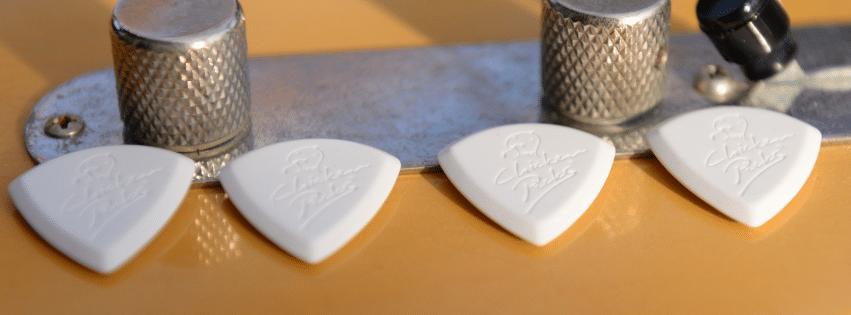
ChickenPicks Bermuda III Pointy premium thick guitar picks with beveled edges

Instead of the compact Jazz-style shape of BADAZZ III, it’s a triangular body with three usable pointy tips. Available in 2.1- and 2.7 mm.

The larger triangular body gives your thumb and index finger considerably more surface area while still providing the precise string contact of a pointed tip.

Therefore, BERMUDA III-P can be an excellent option for guitarists who like the accuracy of a pointy pick but prefer more pick in their hand.

The triangular design also gives you three tips to use. Rotate the pick and another useable point is immediately available.

Chicago Music Exchange describes the Bermuda III Pointy as combining Thermoset rigidity with beveled edges designed to help the pick glide on and off the strings.


Shop all ChickenPicks guitar picks models here

(click on Pick Dude)

Pick Dude buy now

Common problems people experience with standard / thin plastic picks

Standard thin guitar picks certainly have their place, particularly for players who deliberately want flexibility.
However, that flexibility can also create disadvantages when maximum picking precision is the goal.

Common issues can include pick flex, delayed string release, excessive pick movement, inconsistent attack and less positional feedback from the strings.

For example, during rapid alternate picking, a flexible pick continuously bends and returns to shape. The faster you play, the more noticeable that movement can become.

Thin picks can also travel relatively deeply between the strings if the player does not carefully control pick depth.

ChickenPicks takes a different approach. Instead of relying on flexibility, our picks combine:

  • substantial thickness;
  • very hard Thermoset material;
  • carefully beveled edges;
  • rigid construction;
  • durable tips;
  • and shapes designed around different playing techniques.

The objective is not to claim that every guitarist should abandon thin picks.
Rather, ChickenPicks provides an alternative for players looking for a more solid and direct connection between picking hand and strings as well as a fuller, articulate tone and a strong, percussive attack.


What makes ChickenPicks unique?

A pointy shape alone does not explain how a pick performs.

ChickenPicks are made from Thermoset, a very hard and rigid class of material. Unlike conventional thermoplastics, thermosetting materials undergo an irreversible curing process.

You can learn much more about the material on our dedicated guide: What is Thermoset? Discover the material behind ChickenPicks.

The hardness and rigidity of the material help the pick maintain its shape instead of flexing heavily during every picking stroke. Moreover, the material is highly wear resistant, helping the tip and edges remain consistent over extended use.

However, making a thick pick rigid is not enough.

A thick pick with blunt, square edges could feel cumbersome against the strings. Therefore, ChickenPicks combines thickness with carefully shaped beveled edges.

The bevel creates a much thinner effective string-contact area than the overall thickness of the pick might suggest. Consequently, you get the stability and mass of a thick pick without forcing the full thickness through the string.

This combination — thickness + hardness + bevel + tip geometry — is what gives ChickenPicks their characteristic playing feel.


What independent sources say about ChickenPicks

You do not have to take our word for it.

Independent Guitar Pick Reviews tested the ChickenPicks range and specifically commented on their accuracy, describing them as:

“extremely fast, accurate”

The reviewer also noted that the relatively thick picks feel thinner than their measurements might suggest and highlighted the surprising level of accuracy they provide.

Recording guitarist and educator Mark Marshall of Anatomy of Tone also tested ChickenPicks. He specifically highlighted the beveled edges and their ability to glide across the strings, and concluded that ChickenPicks can be particularly useful for applications requiring precise, fast picking.

ChickenPicks are also carried by major specialist music retailers. Musikhaus Thomann lists models including BADAZZ III and describes its extra-sharp tip and beveled edges as features for precise picking.

In the United States, Chicago Music Exchange carries ChickenPicks as well, including BADAZZ III and BERMUDA III Pointy models.

These independent reviews and established retailers provide useful third-party reference points for guitarists who are curious about trying a very different approach to the traditional thin guitar pick.


Pick Dude's Pro Tip

A pointy pick works especially well when only a small part of the tip extends beyond your fingers. Try reducing how deeply the pick travels between the strings.

Then practice alternate picking slowly and concentrate on making the smallest movement necessary to release each string.

Small tip + small movement + relaxed grip = a great starting point for precise picking.

Speed can come later. First develop accuracy and consistency.


Are pointy guitar picks only for shredding?

Definitely not.

Although sharp picks are often associated with shredding and technical lead guitar, precision is useful in almost every musical style.

Country players may appreciate them for rapid single-note runs. Rock players can use them for articulate riffs. Jazz and fusion guitarists may value their controlled attack, while metal players can benefit from precise rhythm and lead work.

Even slower playing can benefit because “precision” is not simply another word for “speed.”

It means putting the pick exactly where you want it, exactly when you want it there.


Want to explore how shape, size and thickness influence your playing?

Curious what a pointy, thick guitar pick actually feels like?

Reading about pick geometry can only tell you so much. Ultimately, the most important test happens between your fingers, your strings and your playing style.

Explore ChickenPicks and find your perfect pick

Try a different shape, thickness or tip and discover how surprisingly much the smallest part of your guitar setup can change the way your instrument feels.

Designed by guitarist Eppo Franken

Playing guitar since 1979.

Developing guitar picks since 1985.

Founder of ChickenPicks guitar picks since 2010.


Frequently Asked Question

Are pointy guitar picks better for precision?

They can be. A sharper tip creates a smaller, more defined point of contact with the string. For many guitarists, this makes controlling pick depth and executing small picking movements easier. However, precision ultimately depends on both pick design and playing technique.

Are thick guitar picks better for fast playing?

Many players prefer thick picks for fast playing because they flex less. A rigid pick can provide a more predictable relationship between your hand movement and string release. Combined with beveled edges and a pointy tip, this can be particularly useful for alternate picking, sweep picking and fast lead work.

Why do thick guitar picks feel more precise between the strings?

A thicker pick occupies more of the physical space between two adjacent strings. Therefore, there is effectively less free space around the pick when moving from one string toward the next. Some players experience this as closer contact with the strings and improved positional feedback.

Do thick guitar picks get stuck between the strings?

They can if they have thick, square edges or if too much of the pick is pushed between the strings. ChickenPicks uses beveled edges so the actual contact area near the edge is much thinner than the pick’s body. Using only a small amount of the tip can further improve string release.

What is the best ChickenPick for precise picking?

For maximum compactness and a sharp main tip, try the BADAZZ III. If you prefer a larger gripping surface combined with three pointy tips, consider the BERMUDA III-P. Both combine thickness, Thermoset rigidity and beveled edges, but the best choice ultimately depends on your hand, grip and playing technique.

Avoiding Hand Fatigue while Guitar Playing

Short summary

Hand fatigue can make long guitar sessions less comfortable and may affect control, speed and accuracy. Technique, posture, practice duration and unnecessary muscle tension can all play a role. However, your guitar pick may matter too.
Many players find that a thick, rigid pick requires less squeezing because it does not flex like a thin pick.
Learn more about how to hold a guitar pick and discover why some guitar picks sound too dull or even too bright.

Check the Medical disclaimer.

Why do your hands get tired while playing guitar?

Playing guitar involves thousands of small, repetitive movements.
During a long practice session, rehearsal or gig, even a little unnecessary tension can add up.

Some players unconsciously squeeze the guitar pick harder as they play—especially when the pick is flexible, rotates between the fingers or feels as though it might slip.

The result can be a picking hand that feels increasingly tired.

Importantly, the guitar pick is only one part of the equation.
Playing technique, posture, practice duration, guitar setup, physical conditioning and the amount of tension in your hands and arms can all influence playing comfort.

Hospital for Special Surgery advises musicians to warm up, use good body mechanics and take regular breaks. Their guidance recommends 10–15 minute breaks every hour to help relieve muscle tension and give muscles time to recover.

Therefore, reducing hand fatigue should always be approached as a combination of good playing habits and suitable equipment.

Can a thicker guitar pick help reduce hand fatigue?

For some guitarists, it can make a noticeable difference.

A thin guitar pick flexes every time it strikes the string.
Consequently, some players compensate by gripping it more firmly to maintain control.

A thick, rigid pick behaves differently.

Because it flexes very little, the player may discover that there is no need to squeeze it as tightly. Instead, the pick itself provides stability.

This does not mean that a thicker pick medically prevents hand fatigue.
However, many ChickenPicks users tell us that they can hold our thicker picks with a lighter, more relaxed grip.

And that is exactly what we want from a guitar pick: let the pick do more of the work, rather than your fingers.

More thickness can also mean more precision

There is another interesting advantage.

A thicker guitar pick can feel more precise because less of the pick sits between two adjacent strings.

The increased thickness effectively reduces the amount of pick movement needed between strings. Combined with a rigid construction and carefully beveled tip, this can create a very direct and controlled picking sensation.

For alternate picking, fast single-note passages and string-to-string movement, many players find this particularly useful.

Common problems people experience

Standard thin plastic guitar picks certainly have their place—especially for players who like flexibility when strumming. Nevertheless, some guitarists experience disadvantages when using them for precise or prolonged picking.

Common issues can include:

  • squeezing the pick too tightly to keep it under control;
  • pick rotation between the fingers;
  • excessive flex when the pick hits the string;
  • inconsistent attack caused by that flex;
  • gripping harder when playing faster;
  • unnecessary tension in the thumb and index finger;
  • difficulty maintaining the same picking depth between strings.

A ChickenPicks guitar pick approaches these issues differently.

Rather than relying on flexibility, ChickenPicks use thickness, rigidity, mass, grip and beveled edges to create control.

As a result, you may find that you can experiment with holding the pick more lightly while still maintaining a stable connection with the strings.

Our thickest ChickenPicks models

For players interested in maximum rigidity, we particularly recommend experimenting with the thickest versions of our main models.

Regular 2.6mm – familiar shape, very different feel

The Regular 2.6mm uses the familiar traditional 351-style outline, making it an excellent starting point for guitarists who want to try a substantially thicker pick without immediately changing to an unfamiliar shape.

At 2.6mm, it offers considerably more mass and rigidity than a conventional thin or medium pick. The beveled edges, however, make the tip feel much slimmer against the string than the overall thickness might suggest.

The result is a solid grip area combined with a fast, smooth release from the string.

Bermuda III 2.7mm – maximum gripping area

The Bermuda III 2.7mm offers a large triangular gripping surface. Therefore, it can be particularly interesting for players who dislike pinching a small pick tightly between thumb and finger.

Its substantial 2.7mm thickness creates a solid feel, while the triangular design provides plenty of material to hold.

For players experimenting with a more relaxed grip, that additional surface area can make the Bermuda III especially comfortable.

Bermuda III-P 2.7mm – grip plus pointy precision

Prefer the large gripping surface of the Bermuda but want a sharper attack?

The Bermuda III-P 2.7mm combines the substantial triangular body with three pointier picking tips.

This combination makes it particularly interesting for players who want both grip and precision. Because all three corners can be used, simply rotate the pick when you want another tip.

The substantial body provides stability between the fingers, while the pointed bevels make precise string contact possible.

Shredder 3.5mm – our thickest pick

At 3.5mm, the Shredder is currently our thickest guitar pick.

Despite that impressive number, don’t assume that 3.5mm means a huge blunt edge hitting the string. The carefully shaped bevel tapers toward the playing edge, giving the Shredder a surprisingly fast release.

Its smaller format also means that players who like compact picks can get substantial thickness and mass without holding a large pick.

For speed, alternate picking and controlled single-note playing, it is a very distinctive combination.

Badazz III 3.2mm – maximum rigidity for precision

The Badazz III 3.2mm combines a compact Jazz-style shape, substantial thickness and an extremely pointy tip.

Because it is small, very rigid and sharply tapered, very little material needs to extend beyond the fingers.

This can create an exceptionally direct connection between your picking movement and the string. Players who prefer small precision picks may therefore find the 3.2mm Badazz III surprisingly comfortable despite its thickness.

Which thickness should you choose?

There is no universal answer.

We see many players gravitating toward these thicker models, and many tell us that thicker picks help them play with a more relaxed picking hand.
Nevertheless, the right guitar pick always depends on personal preference, hand size, technique, musical style and the way you naturally hold a pick.

So don’t automatically choose the thickest pick, but do some experiment.
Your hands will tell you more than the number printed on the pick.

What makes ChickenPicks unique?

ChickenPicks are not simply ordinary guitar picks made thicker.

Their playing characteristics come from the combination of Thermoset material, thickness, mass, grip design and precision-beveled edges.

Extremely hard Thermoset material

ChickenPicks are made from a specially selected Thermoset material.

Unlike conventional thermoplastics, thermosetting materials permanently cure during manufacture. The resulting material can be extremely hard, rigid and resistant to wear.

Discover more about why we use Thermoset for ChickenPicks guitar picks.

This hardness is particularly important in a thick guitar pick.
Instead of bending backwards when it contacts the string, the pick remains extremely stable.

Thick where you hold it, thin where it matters

This is one of the most important characteristics of ChickenPicks.

Although the body of the featured picks may measure between 2.6 and 3.5mm, the precision-beveled edges taper toward the tip.

Consequently, you get a thick, substantial surface between your fingers while the part that actually releases from the string feels much slimmer and faster.

This helps explain why ChickenPicks can produce a snappy, immediate attack rather than the dull or cumbersome response sometimes associated with thick, flat-edged picks.

Grip without excessive squeezing

ChickenPicks also incorporate raised grip structures.

The intention is simple: the pick should remain stable without requiring excessive gripping pressure.

Ultimately, however, every guitarist’s hands and technique are different.
A ChickenPick should therefore be considered a tool worth experimenting with—not a medical solution.

GRIPPERZZ

While everyones hands are different and the need to grip onto guitar picks differs, there’s is another solution for more grip.

We designed adhesive grip stickers that can be glued on any guitar pick. So they’re actually not only made for ChickenPicks guitar picks. Each pack contains 16 adhesive stickers.

The ribs provided on these stickers are huge. Many people consider GRIPPERZZ as the ultimate grip solution.
When you need more information on GRIPPERZZ, please check them out here.

Check GRIPPERZZ out in the shop below.

Pick Dude buy now

What independent reviewers say about ChickenPicks.

You don’t have to take our word for it.

Independent guitar-pick specialist Guitar Pick Reviews tested ChickenPicks and rated them 8.2/10 – “Highly Recommended.” The reviewer specifically praised their speed, accuracy, feel and durability.

One particularly relevant observation was:

“They feel much thinner than they are.”

That is an important part of the ChickenPicks concept: substantial thickness in your hand combined with a carefully beveled playing edge.

Professional guitarist and recording engineer Mark Marshall at Anatomy of Guitar Tone also tested the range. Discussing the bevels, he wrote:

“This design facilitates a seamless glide of the strings.”

He also described ChickenPicks as a high-quality tool and particularly highlighted their usefulness for applications requiring precise, fast picking.

Moreover, ChickenPicks are stocked by internationally recognized guitar retailers including Musikhaus Thomann and Chicago Music Exchange.
This independent retail presence, together with specialist reviews, gives players several places to compare the products and read experiences from other guitarists.


Pick Dude's Pro Tip

When switching from a flexible pick to a thick ChickenPick, deliberately loosen your thumb and index finger.

Play something easy for a few minutes and experiment with the minimum amount of pressure required to keep the pick under control.

You might be surprised by how lightly a rigid pick can be held.

The goal isn’t to squeeze harder because the pick is thicker.
In fact, try exactly the opposite: relax your hand and let the rigidity, grip and bevel of the pick do their job.


Medical disclaimer – please take hand pain seriously

ChickenPicks is a guitar-pick manufacturer, not a medical organization, and we are not doctors or healthcare professionals.

This article discusses guitar-playing comfort and experiences reported by musicians.
It is not medical advice, and ChickenPicks guitar picks are not intended to diagnose, treat, cure or prevent medical conditions.

Fatigue after prolonged playing and persistent pain are not necessarily the same thing.

If you experience recurring or persistent pain, numbness, tingling, weakness or other hand, wrist or arm problems, please stop relying on equipment changes alone and consult a qualified doctor, physiotherapist or other appropriate healthcare professional.


Ready to find out what your picking hand prefers?

If you have always played thin or medium picks, a 2.6mm, 2.7mm, 3.2mm or even 3.5mm guitar pick may look extreme.

But don’t judge a ChickenPick by its thickness.

The combination of a thick grip area, extreme rigidity and carefully beveled playing edges creates a completely different experience from simply making an ordinary pick thicker.

Explore ChickenPicks and do the test on our home page


Buy now

Check all guitar picks out with Pee-Dee our Pick Dude here on the right.


Designed by guitarist Eppo Franken

Playing guitar since 1979.

Developing guitar picks since 1985.

Founder of ChickenPicks guitar picks since 2010.

Frequently Asked Questions

Can a thick guitar pick help with hand fatigue?

Some guitarists report that a thick, rigid pick allows them to use a lighter grip because the pick does not flex as much.
This may make playing feel more relaxed.
However, hand fatigue can have many causes, and a guitar pick should not be considered a medical treatment.

Are thick guitar picks harder to play?

They can feel unusual initially, particularly if you have always used thin flexible picks.
However, beveled edges can make a thick pick feel considerably slimmer at the point where it meets the string.
Many players adapt surprisingly quickly.

Why might a thick pick feel more precise between strings?

A thicker pick can effectively reduce the amount of pick sitting in the space between two adjacent strings.
Combined with minimal flex and a beveled tip, this can make string-to-string movements feel shorter, more controlled and precise.

Should I hold a thick guitar pick differently?

You may not need to change your basic grip, but try reducing unnecessary pressure.
Because a rigid pick does not need your fingers to stabilize its flex, you may discover that you can maintain control with a lighter grip.

What is the best ChickenPick for someone interested in maximum thickness?

Our thickest options include the Regular 2.6mm, Bermuda III 2.7mm, Bermuda III-P 2.7mm, Badazz III 3.2mm and Shredder 3.5mm.
The Shredder is the thickest, but thickness alone should not determine your choice.
Shape, tip, grip area and playing style are equally important.

Can a Guitar Pick Help Reduce Hand Fatigue?

Yes, the right guitar pick may help reduce picking-hand fatigue. A thicker, more rigid pick requires less flexing during string contact and can often be held with a lighter grip.
This may reduce unnecessary tension in the fingers and hand, especially during longer playing sessions.
Shape, grip, beveled edges and playing technique also matter.
Ultimately, comfort is personal, so experimenting with different pick thicknesses and shapes is the best way to find what works for you.

Guitar Picks Sounding Too Dull or Too Bright

Short summary:

If your guitar sounds too dull, harsh or overly bright, your guitar pick may be part of the reason.
Pick thickness, material hardness, mass, shape and edge design can influence attack, note definition and perceived tone. Before changing pickups, strings or amplifier settings, experiment with the point where your hand actually meets the strings. Learn more about how a guitar pick affects your guitar sound and explore our guide to thick guitar picks.

Can a Guitar Pick Make Your Guitar Sound Too Dull or Too Bright?

Yes. Although pickups, strings, amplifier settings, playing technique and the guitar itself all contribute to your final sound, the guitar pick is literally where your picking hand transfers energy to the string.

Consequently, changing the pick can alter the attack, brightness, fullness, articulation and overall character of a note.

A very flexible pick may create a bright, snappy attack because the material bends and releases against the string. Conversely, some picks can sound overly rounded or dull, especially when the tip becomes worn.

However, thickness alone does not determine tone. Material hardness, mass, tip shape, bevel and picking angle all interact. Therefore, two picks of exactly the same thickness can sound and feel surprisingly different.

Guitar World confirms the importance of experimenting with these variables:

“Thickness plays a huge role in how a pick feels.”

The publication also notes that thinner picks generally produce a brighter sound with less precise attack, while thicker picks can produce a fuller, warmer tone.

Too bright?

If your tone feels excessively bright, thin or “clicky,” listen particularly to the initial attack of each note.
A flexible or relatively thin pick can emphasize this transient.

Before reaching for the tone control on your guitar, try a thicker and more rigid pick and compare the result.

Too dull?

A dull tone can have many causes, including old strings, pickup settings and amplifier EQ.
Nevertheless, the pick is worth investigating.

A worn or very rounded picking edge can soften the attack. Changing the material, tip geometry or bevel may restore articulation without necessarily making the overall sound harsh.

Therefore, the goal is not simply bright versus warm. A more useful target is:

full tone + clear attack + controlled string release.


Why Thickness, Mass, Hardness and Beveled Edges Matter

ChickenPicks are deliberately much thicker than conventional flexible picks. However, thickness is only one part of the design.

Thickness and mass

A thick, rigid pick flexes considerably less when it strikes the string. As a result, there is less movement within the pick itself before the string is released.

Furthermore, the additional mass of a substantial pick can contribute to a solid physical interaction with the string. Many players perceive this as a fuller, stronger and more authoritative note.

Guitar World similarly observes that thicker picks tend to offer a fuller, warmer tone and that their stiffness can benefit players looking for speed and precision. We also hear a lot that our picks offer a more percussive attack with strong note definition.

Material hardness

Thickness without sufficient hardness can still produce unwanted flex.

Therefore, ChickenPicks are made from a particularly hard Thermoset material. The combination of thickness and hardness creates a highly rigid pick that transfers the player’s movement directly to the string.

Importantly, hard does not automatically mean painfully bright.

The final tone also depends on the shape and finish of the picking edge.

Beveled edges

This is where the ChickenPicks design becomes particularly interesting.

Rather than pushing a thick, blunt edge through the string, ChickenPicks use carefully shaped beveled edges. The bevel provides a smoother path for the string to leave the pick.

Consequently, you can combine the stability and mass of a thick pick with a controlled string release.

Independent retailer Thomann also describes ChickenPicks models as using exceptionally hard plastic and beveled edges for precise picking and excellent tone. Check the Musikhaus Thomann website out here.

Less pick between the strings

There is another advantage that is easily overlooked.
A thicker guitar pick can also feel more precise because less of the pick sits between two adjacent strings.

With a thick pick, your fingers naturally sit farther away from the picking tip.
Therefore, less of the pick needs to protrude beyond your fingers.
Many players find that this reduces the effective distance travelled between adjacent strings and makes alternate picking, string changes and precise single-note playing feel more controlled.

Common Problems People Experience

Standard thin plastic picks work perfectly well for many guitarists, especially for light strumming. However, depending on your technique, they can also introduce several problems:

  • Excessive flex – the pick bends before releasing the string, which can make the attack feel less immediate.
  • Thin or overly bright attack – particularly noticeable with clean guitar sounds and acoustic instruments.
  • Inconsistent note definition – flex can make single-note picking feel less predictable.
  • Worn edges – a changing tip gradually changes both feel and tone.
  • More pick movement – flexible picks can require additional movement during fast alternate picking.
  • Tighter gripping – some players compensate for flex or instability by squeezing the pick harder.
  • Unwanted pick noise – material and edge geometry can create audible scraping or chirping against the strings.

ChickenPicks guitar picks approaches these issues differently.
Their combination of thickness, rigidity, hard material and beveled edges is designed to create a direct attack while allowing the string to leave the pick smoothly.

That doesn’t mean a ChickenPick is automatically the right pick for every guitarist.
The best guitar pick always depends on personal preference, technique, instrument, strings and the sound you want.

Nevertheless, we see many players move toward our thicker designs once they discover how much influence the pick can have on both tone and control.


What Makes ChickenPicks Unique?

ChickenPicks are not simply conventional guitar picks made thicker.

At the heart of every model is a carefully selected Thermoset material.
Unlike common flexible pick materials, this material provides the hardness and rigidity required for the characteristic ChickenPicks response.

You can learn much more about the material in our guide: What is Thermoset and why do we use it for guitar picks?

Combined with substantial thickness and precisely shaped bevels, the material helps create:

immediate attack → controlled string release → strong note definition → fuller perceived tone.

Additionally, the hardness contributes to excellent wear resistance.
Therefore, the shape of the picking edge can remain consistent for considerably longer than with many softer materials.

This matters because a consistent edge helps create a consistent response.

Independent reviews provide useful confirmation.

GuitarPickReviews described the picks as:

“extremely fast, accurate, and have a great tone.”

The reviewer also rated ChickenPicks 8/10 for sound, 8.5/10 for feel and 9/10 for durability.

Meanwhile, Anatomy of Guitar Tone found the tonal balance particularly interesting, describing ChickenPicks as having:

“a round and warm bass presence.”

The reviewer also found the overall EQ character warm and balanced and specifically noted reduced pick chirp compared with other thick picks.

These observations support an important point: a hard and thick pick does not necessarily have to sound excessively bright or harsh. Edge geometry, material and the player’s technique matter too.

Pick Dude's Pro Tip

Before changing your pickups, pedals or amplifier EQ, change your pick.

Play the same riff with several picks while leaving every other part of your setup unchanged.
Better still, record the examples.

Listen separately for:

attack → brightness → body → note separation → pick noise → sustain

You may be surprised how much tonal variation starts at the very first point of contact with the string.

Also experiment with your picking angle. Even with exactly the same pick, changing the angle and position of your picking hand can noticeably alter the attack and brightness.
Guitar World highlights this principle in its discussion of pick technique and tone, including how the way and location at which a guitarist picks can change the resulting sound.


Which ChickenPick Is Right for Your Tone?

Although every ChickenPick shares the same basic philosophy — hard Thermoset material, substantial thickness, rigidity and carefully designed beveled edges — shape, size, tip design and thickness give each model its own character.

Therefore, choosing between them isn’t simply about finding the “best” pick.

It is about finding the combination of attack, fullness, precision, grip and string release that feels and sounds right to you.

Light 2.2mm – Versatile and Easy to Get Used To

The Light 2.2mm combines the familiar standard 351-style shape with the thickness, hardness and beveled edges of a ChickenPick.
This makes it an excellent starting point for players moving from conventional picks.
Despite its 2.2mm body, the bevel creates a relatively thin contact area at the tip, helping produce a quick, snappy and articulate attack rather than the dull response sometimes associated with thick, blunt-edged picks.
Its moderate mass provides body and stability without feeling excessive.
Consequently, the Light works particularly well as an all-round pick for rhythm, lead, acoustic and electric guitar when you want a balanced combination of clarity, fullness and versatility.

Regular 2.6mm – More Mass and a Bigger Attack

The Regular 2.6mm has essentially the same familiar overall shape as the Light 2.2mm but adds thickness and mass.
That extra substance gives the pick a stronger, bigger-feeling attack while retaining a fast string release through its beveled edges.

Because the material itself is extremely rigid, very little energy is lost through pick flex.
Nevertheless, the carefully shaped bevel prevents the 2.6mm body from feeling like a blunt piece of plastic hitting the string. The result is a substantial yet articulate response.
For players who like the versatility of a traditional-shaped pick but want more authority, fuller tone and a solid connection with the strings, the Regular is a natural choice.

Badazz III – Sharp Tip for Maximum Precision

Available in 2.0, 2.5 and 3.2mm, the BADAZZ III combines a compact Jazz III-style format with an exceptionally sharp picking tip. That geometry gives it a very immediate feel and makes small, accurate picking movements possible.
The pointed tip provides clear note separation and a precise, focused attack, while increasing thickness adds mass and substance without sacrificing the characteristic accuracy of the design.

Because less pick needs to protrude beyond your fingers, many players find it especially controllable for alternate picking, fast lead playing and detailed phrasing.
The three thicknesses also let you fine-tune the balance between agility and mass while retaining the BADAZZ III’s distinctive sharp, articulate response.

Shredder – Speed with a Rounder Tip

The Shredder 2.4 and 3.5mm is also compact, but unlike the extremely sharp BADAZZ III, it uses a more rounded tip. This creates a different interaction with the string. The rounded geometry can make the transition across strings feel exceptionally smooth, while the bevel helps the string slide quickly away from the pick.
Therefore, the Shredder combines speed and precision with a somewhat rounder attack character.

The 2.4mm version offers a lighter balance between mass and agility, while the substantial 3.5mm version provides maximum rigidity and stability.
It is particularly interesting for players who want fast picking and effortless string release without the extremely pointed feel of the BADAZZ III.

Bermuda III – Three Tips, Extra Grip and Balanced Attack

The Bermuda III 2.1 and 2.7mm takes a very different approach with its larger triangular design and three identical rounded playing tips.
The increased gripping surface provides plenty of room for the thumb and index finger, making it comfortable for players who prefer more pick in their hand.
Tonally, its rounded tips provide a smooth, controlled interaction with the string, while the beveled edges preserve clarity and prevent the thick body from creating an unnecessarily dull attack.
Additionally, having three usable tips effectively gives you three playing edges in one pick.

The Bermuda III is particularly attractive when you want grip, stability, fullness and smooth articulation in one versatile design.

Bermuda III-P – Triangle Grip with Pointed Precision

The Bermuda III-P 2.1 and 2.7mm combines the comfortable triangular format of the Bermuda III with three pointed tips.
Consequently, it bridges two worlds: the larger gripping surface and stability of a triangle pick together with the accuracy and definition associated with a sharper tip.
The point creates a more focused contact area with the string, producing a crisp, articulate attack that works especially well for precise single-note playing, alternate picking and lead work.

Meanwhile, the beveled edges allow the string to release smoothly instead of encountering the full thickness of the pick.
It is an excellent option for players who want extra grip without giving up precision, speed or note definition.

Bermuda III-XL 2.1mm (The Bass Pick) – Maximum Grip and a Substantial Feel

Originally developed with bass players in mind, the Bermuda III-XL 2.1mm is the largest ChickenPick and provides the most generous gripping area.
However, it is by no means limited to bass: many players also use it for electric and acoustic guitar.
Its larger triangular body offers excellent stability and can be especially comfortable for players who simply prefer having more material between their fingers.

Despite its size, the 2.1mm thickness and beveled playing edges maintain a controlled, responsive string release.
On bass, the rigid Thermoset construction can help produce clear definition and a solid attack, while guitarists may appreciate its combination of large grip, stability and surprisingly precise feel.


The Important Difference: Shape Changes the Experience

Ultimately, thickness is only one part of choosing a guitar pick.
A Badazz III 2.0mm and Bermuda III 2.1mm are almost identical in thickness, yet they feel and respond very differently because of their size and tip geometry.
Likewise, the Shredder and BADAZZ III are both compact picks, but their rounded versus pointed tips create noticeably different picking experiences.

Therefore, if your current pick sounds too dull, too bright, too thin or too aggressive, don’t experiment with thickness alone.
Try changing shape, tip geometry, mass and bevel as well.
Sometimes the tone you are looking for is hiding in a surprisingly small change at the point where pick meets string.

Therefore, rather than asking “Which ChickenPick sounds best?”, a better question is:

“Which combination of attack, warmth, articulation and playing feel works best for me?”

Experimenting remains the most reliable way to find out.

No jagged edges means less pick noise

Because ChickenPicks’ Thermoset material is extremely hard and wear-resistant, the picking edges stay smooth for a long time instead of quickly developing jagged or rough edges.
This matters for tone: uneven, worn edges can scrape against the strings and create unwanted pick noise, while smooth edges promote a cleaner release.

Thick Body, Thin Beveled Tip

Although ChickenPicks are considerably thicker than standard guitar picks, the beveled edges create a relatively thin contact point at the tip.

Therefore, the string does not have to travel across the full thickness of the pick.
This can make the pick feel surprisingly fast and responsive, while producing a snappy, articulate attack rather than a dull one.
At the same time, the thicker body provides mass, rigidity and stability. In contrast, a thick pick without a well-designed bevel may present a broader edge to the string, potentially creating a rounder, less immediate attack.
This balance is an important part of the ChickenPicks design.

Independent Reviews & Trusted Guitar Stores

ChickenPicks are also available through established international guitar retailers and have been independently reviewed by specialist guitar websites.

Explore ChickenPicks at Musikhaus Thomann, where several ChickenPicks models have accumulated strong customer ratings. Thomann currently describes models such as the Shredder as using extremely hard, long-lasting material with beveled edges for precise picking and tone.

ChickenPicks are also listed by Chicago Music Exchange, while independent opinions can be found in the GuitarPickReviews ChickenPicks review and the in-depth Anatomy of Guitar Tone ChickenPicks review. These independent sources are useful because they allow players to compare our own explanations with experiences outside ChickenPicks.


Want to go deeper into guitar pick tone and technique?

Ready to hear what changing only your guitar pick can do?

Instead of changing your strings, pickups or amplifier settings again:
Start with the smallest — and easiest — part of your signal chain.

Discover all ChickenPicks – Find the pick for your tone →

Pick Dude buy now

Designed by guitarist Eppo Franken

Playing guitar since 1979.

Developing guitar picks since 1985.

Founder of ChickenPicks guitar picks since 2010.

Frequently Asked Questions

Do thicker guitar picks sound different?

Yes. Pick thickness affects flexibility, attack and the physical interaction between pick and string.
Thicker picks flex less and are commonly associated with a more solid attack and fuller tone.
However, material, bevel, tip shape and picking technique also influence the result.

Do thick guitar picks sound warmer?

They can. Guitar World notes that thicker picks can produce a fuller, warmer tone, while thinner picks commonly produce a brighter response.
However, thickness alone does not determine brightness.
A hard material, sharp tip and picking angle can all increase articulation and high-frequency attack.

Are thick guitar picks better for precise picking?

Many players find them more precise because a rigid pick flexes less.
Furthermore, with a thicker pick your fingers can sit closer to the tip, leaving less pick protruding between adjacent strings. This can make string-to-string movements feel smaller and more controlled.

Can changing my guitar pick fix a dull guitar tone?

Sometimes. A dull sound can also come from old strings, pickup settings, amplifier EQ or technique.
Nevertheless, changing pick material, thickness, tip shape or bevel can noticeably alter attack and articulation. Therefore, testing another pick is one of the quickest and least expensive tone experiments you can make.

What guitar pick should I use if my tone is too bright?

Don’t automatically assume that you simply need the thickest pick available.
Instead, experiment with thickness, material, tip shape, bevel and picking angle together.
The goal is not necessarily to remove treble.
Find a combination that retains clear articulation while adding the body and warmth needed.
Ultimately, the right guitar pick remains a matter of personal preference.

Best Guitar Picks for Eric Johnson Style Guitar Playing

Looking for the best guitar picks for Eric Johnson style guitar playing?

Short summary

Eric Johnson’s playing combines precision, articulate lead lines, dynamic picking and a highly controlled attack. His signature Jazz III is famous for its compact shape and pointed tip.

For guitarists who enjoy this style but want to explore a thicker, more rigid pick, we often recommend trying the ChickenPicks Badazz III 2.0, 2.5 or 3.2mm.
Many guitarists using this type of guitar and playing style choose the Badazz III, although the best guitar pick always depends on your technique, grip and personal tonal preference.

For more information, see our guide to the Best Guitar Picks for Jazz, Best Guitar Picks for Rock or Best Guitar Picks for Stratocaster players.


What Makes an Eric Johnson Style So Distinctive?

Eric Johnson is renowned for an exceptionally controlled and articulate approach to guitar playing. His sound combines blues, rock, jazz and country influences, while his picking technique places considerable emphasis on tone and precision.

Interestingly, Johnson himself has spoken about how important the pick is to the final sound. In a 2026 interview, he described pick material and picking mechanics as fundamental parts of guitar tone.

His official signature pick remains the Eric Johnson Custom Nylon Jazz III 1.38mm, developed with a custom nylon blend and a refined pointed tip.

That makes the Jazz III concept particularly interesting for players who want:

  • precise note separation
  • a pointed picking tip
  • controlled alternate picking
  • a consistent attack
  • excellent maneuverability during lead playing

However, there is another direction worth exploring: substantially thicker and more rigid picks.

That is where the Badazz III becomes interesting.


Why Many Players Choose the Badazz III

We see many guitarists using the Badazz III when looking for a compact pick with considerably more thickness, rigidity and mass than a conventional Jazz III-style pick.

The Badazz III is available in three thicknesses:

Badazz III 2.0mm

The 2.0mm version is a natural starting point for guitarists who normally use a medium or Jazz-style pick but want to move toward a thicker design.

ChickenPicks Badazz III premium guitar picks with beveled edges

It provides substantially more rigidity than a thin plastic pick while remaining relatively easy to adapt to.
The pointed tip is particularly useful for precise lead playing and controlled string contact.

For players exploring thick picks for the first time, this is often the least dramatic step.

Badazz III 2.5mm

ChickenPicks Badazz III premium guitar picks with beveled edges

The 2.5mm version provides an excellent balance between rigidity, control and playing comfort.

Because there is very little flex, the player gets a more direct relationship between hand movement and string contact.
That can be especially appealing for alternate picking, fast lead passages and players who want a very defined attack.

For many players, 2.5mm can be the sweet spot of the Badazz III range.

Badazz III 3.2mm

The 3.2mm version takes the concept considerably further.

Its substantial mass and rigidity create an exceptionally stable picking platform, while its carefully shaped bevel helps the pick move smoothly across the string.

ChickenPicks Badazz III premium thick guitar picks with beveled edges

For experienced players who already enjoy thick picks, the 3.2mm version can be particularly attractive for highly controlled lead work, articulate picking and players seeking a very solid attack.

ChickenPicks describes the Badazz III as combining substantial thickness, beveled edges and a highly rigid Thermoset material.


Common Problems People Experience with Standard / Thin Plastic Picks

Thin plastic picks work perfectly well for millions of guitarists. Nevertheless, some players discover limitations when they start playing faster or demand greater precision from their picking hand.

Pick flex

A flexible pick bends when it contacts the string.

As a result, part of the movement from your picking hand is absorbed by the pick itself. For players looking for an extremely immediate attack, this can feel less controlled.

A thicker, rigid pick greatly reduces this flex.

Changes caused by wear

The edge of a conventional pick can gradually change as it interacts with the strings.

Once the edge becomes uneven or develops wear, the way the pick releases the string can also change.

That matters particularly for players who rely on a very consistent attack.

More pick movement

A thin pick may require a firmer grip to maintain control during energetic or highly precise playing.

Consequently, some players find that a more rigid pick allows them to relax their grip rather than constantly compensating for pick movement.

Less definition for some playing styles

This is subjective, but many players looking for precise lead playing prefer the more substantial feel and attack of a thicker pick.

ChickenPicks are designed specifically around this idea: substantial thickness + rigidity + beveled edges.

That does not mean a thick pick is automatically better. Rather, it gives players another tool for achieving the response they are looking for.


What Makes ChickenPicks Unique?

The most important difference is not simply thickness.

It is the combination of material, mass, geometry and edge design.

Thermoset material

ChickenPicks are manufactured from a specialized Thermoset material, rather than the conventional thermoplastic materials commonly used for guitar picks.

Thermosetting polymers form a permanently cross-linked structure during curing. Unlike thermoplastics, a cured Thermoset cannot simply be melted and reshaped. This type of molecular structure can provide high rigidity, dimensional stability and wear resistance.

For a guitar pick, this is particularly interesting.

The material’s rigidity works together with the substantial thickness of the Badazz III. Consequently, the pick flexes far less than a thin conventional pick, helping create a more immediate and controlled connection between your hand and the string.

You can read the full explanation here: What Is Thermoset? Understanding the Material Behind ChickenPicks.

Beveled edges

The edge of a guitar pick is constantly interacting with the string.

A carefully engineered bevel can help the pick transition smoothly across the string instead of presenting a large flat edge.

Combined with the rigidity of Thermoset, this is one reason ChickenPicks are designed for players who value smooth string release and precise articulation.

Make thicker picks precise picking easier?

Many people say that a thicker guitar pick can also feel more precise because less of the pick sits between two adjacent strings.
This reduces the space the pick has to travel when changing strings, which many players find helpful for accurate alternate picking, string skipping and fast, controlled passages.

More mass

A 2.0mm, 2.5mm or 3.2mm pick obviously contains more material than a thin pick.

That additional mass changes the physical feel of the pick and can contribute to the perception of a fuller, more substantial attack.

Therefore, ChickenPicks are not simply “thicker versions” of ordinary picks. The goal is to combine mass, rigidity and edge geometry into one playing system.


What the Experts and Guitar Community Say

There is useful independent evidence that pick design and material matter.

MusicRadar noted that the Jazz III’s “pointed tip and rounded edge” were central to Eric Johnson’s choice, reflecting the importance of shape and string interaction in his playing.

Jim Dunlop likewise states that Johnson adopted the Jazz III as an important part of his setup and describes his signature pick as having a refined tip and a material chosen specifically for its tonal characteristics.

And this isn’t only theoretical. Independent guitar-pick specialist Guitar Pick Reviews has published a dedicated review of ChickenPicks, while Anatomy of Tone has also examined ChickenPicks in the context of guitar and bass pick development.

ChickenPicks are also stocked by established retailers including Musikhaus Thomann and Chicago Music Exchange. Thomann currently lists all models including Badazz III 2.0mm, 2.5mm and 3.2mm models among its Chicken Picks range.


Discover more about the world of thick and precision guitar picks:

Best Guitar Picks for Jazz
Explore why many jazz and precision-oriented guitarists prefer rigid, articulate picks.

Badazz III Guitar Picks
Read the complete Badazz III specifications, design philosophy and playing characteristics.

What Is Thermoset?
Discover why the material behind ChickenPicks is so different from conventional guitar-pick plastics.

Ready to try the Badazz III?

Explore the Badazz III 2.0 + 2.5 + 3.2mm Variety Pack in the ChickenPicks Store

Trying all three thicknesses is one of the easiest ways to discover which level of rigidity and mass fits your own playing.


Pick Dude's Pro Tip

Don’t try to copy Eric Johnson’s setup exactly — copy what you like about his approach.

Eric Johnson’s signature pick is a relatively thin 1.38mm Jazz III.

However, if what you love is the precision, pointed attack and controlled articulation of that style, a much thicker pick can be a fascinating experiment.

Start with the Badazz III 2.0mm. Then try the 2.5mm and finally the 3.2mm.

You may discover that the extra rigidity lets you relax your grip while giving you the controlled attack you’ve been looking for.

And remember: the best guitar pick is ultimately the one that feels and sounds right to you.


Designed by guitarist Eppo Franken

Playing guitar since 1979.

Developing guitar picks since 1985.

Founder of ChickenPicks guitar picks since 2010.

Frequently Asked Questions

Are thick guitar picks better for lead guitar?

Not necessarily.
However, many players like thick picks because they offer less flex, greater stability and a very direct picking response. Whether that is better depends on your technique and personal preference.

What thickness guitar pick is best for fast picking?

There is no universal answer. Many fast players prefer picks around 1.5–3.0mm because they provide greater rigidity. The Badazz III 2.0mm and 2.5mm are good starting points, while the 3.2mm is intended for players who want maximum rigidity.

Does a thicker guitar pick change tone?

Yes, it can. Pick thickness, material, shape and edge geometry all influence how the string is attacked. A thicker, more rigid pick can produce a different attack and feel compared with a thin flexible pick.

Are thick guitar picks difficult to play?

They can feel unusual at first, especially if you have always used thin picks. Nevertheless, many players adapt surprisingly quickly because a rigid pick does not flex in the same way as a thin pick.

What is the thickest ChickenPicks Badazz III?

The Badazz III 3.2mm is the thickest Badazz III version. It is designed for players who want maximum stability, substantial mass and a highly controlled picking response.