Many people, new to bass guitar, ask me: What is the best pick for bass guitar? Choosing a bass guitar pick (or plectrum) depends on different factors, such as material, thickness, shape, and texture, to find the best fit for your playing style and sound preference.
The guitar pick is the most multifunctional product in music industry. Although, it is for guitar related products. Whether you play rhythm or solo, acoustic, electric- or bass guitar, you may choose any pick model, thickness or material.
Is there no difference between picks?
Of course, there are several differences in picks, like extremely pointy tips opposed to rounded tips and differences in thickness and material.
In general, you might want a rounder tip for bass guitar, because you need more mass to let the strings fully ring out. Extremely pointy picks provide less volume and for bass you need a lot of power. In general, not too pointy and it needs to be rigid in a good way. The pick shouldn’t bend too much, because it will affect the heavy bass strings not to let ring out the way you want.
Better grip using pick grippers
Regardless the brand or shape of the pick, it remains important that your pick stays stable and does not slip or turn between your fingers. Gripperzz are specially designed for the best grip on your guitar pick. Gripperzz are small soft rubber grip stickers in the shape of a guitar pick.
Beveled- or straight edge?
Whatever you like in a pick, for bass guitar you may also want to choose the edge that fits your needs. In general, there are 2 ways to go.
Straight edge: Mostly with thinner picks [<2.0mm].
Thicker picks bring strings closer to each other
The distance between the strings on a bass is much wider than with (6 string-)guitars in general. For picking the strings more precisely, you need to minimize the distance between the strings.
According to the above-mentioned minimizing string distance, you will feel more relaxed in your picking hand and forearm. This might also help avoiding hand fatigue, which is a problem many guitar playing people deal with.
Where to pick bass strings
A bass guitar produces extremely low bottom-end tones, so picking towards the bridge will be better. It will help in getting more punchy tones with a clear and bright sound. Finally, this may sound better in the mix when playing with a band. Of course, this depends on the music that you play and which other instruments are in the band. Usually there is no good or bad point of picking with bass guitar strings.
In general, we advise to hold it between your thumb and index finger. Hold it loose with your fingers bent at the middle knuckle. It should be pointing out at a right angle to the thumb.
Best guitar picks for beginners
When you’re new to guitar, you might want to know what is the best guitar pick for beginners; In another blog we wrote, you may find all things that are interesting for starters and especially which ones are the best guitar picks for beginners.
The rougher the music, the cleaner the bass guitar
Where guitars may sound dirty or clean with a nice edge, bass guitars in most cases sound very clean. Just listen to several hard rock bands and you will notice a fairly clean bass sound. Of course, there always are exceptions like the late Lemmy from Motörhead 🙂
Pick noise caused by cheap and flimsy picks
While the bass guitar sounds clean in most “musical” situations, you definitely want to avoid any form of picking noise. Pick noise can have several causes, such as jagged pick edges. Especially with bass guitar, softer pick materials may wear fast. The edges of your guitar pick must stay glossy during its life time, avoiding unwanted chirps.
Jagged edges occur with picks made out of softer materials. This causes unwanted noises called chirp.
ChickenPicks guitar picks definitely don’t get chipped- or jagged edges because the material is extremely hard.
The hardest material available
ChickenPicks guitar picks are made of the hardest material available called “Thermoset”. This is a thermosetting plastic which is used a lot in electronic devices and aerospace. For more information about this unique product in music industry read our about page.
ChickenPicks guitar picks definitely won’t chip because this material is almost as hard as steel.
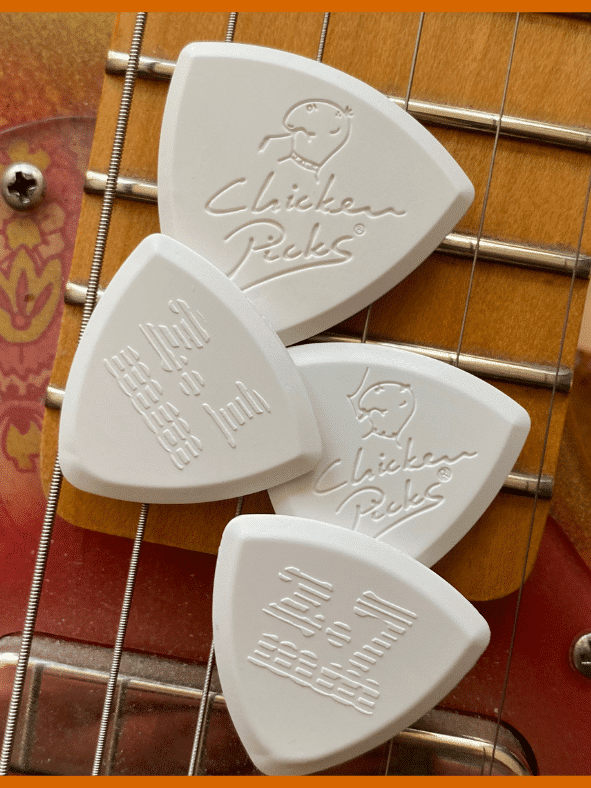
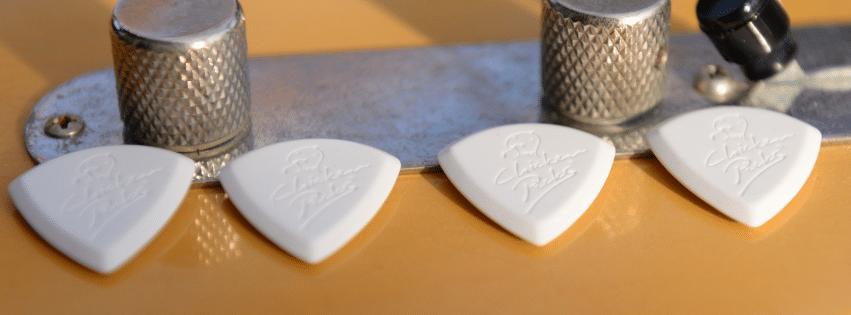
The model that came up to me was the old Fender large triangle pick in the thickness- and typical features of our unique picks. The pick is called the Bermuda III-XL 2.1.
It is 2.1mm thick and has beveled edges all over. This model is identical to our Bermuda III 2.1mm, but larger.
Perfect for bass, perfect for guitar as well
Although I designed the Bermuda III-XL 2.1as a bass guitar pick, we see many people using this it for electric- and acoustic guitars as well.
So finally, is this one a specific “and only” bass guitar pick? The answer, in my opinion should be: “No”.
Which ChickenPicks guitar picks are perfect for bass?
You may also like to check the measurements of all picks at the guitar pick sizes chart. Click on image for more information.
How to hold a guitar pick
Place the guitar pick on top of your index finger with a little less than let’s say 6mm sticking out past the fingertip. The pick is sandwiched between the thumb and the side of the index finger. The index finger should be behind read more…
Summary
Finally, there is no good or bad pick for bass guitar. Finding out what works best for you means that you just have to check different models, -brands and -sizes.
Usually people start with thinner (cheap) picks, but you should check out thicker picks as well as they have several benefits in relation to thin picks.
For the most comfort, a thicker pick with beveled edges will do the job perfectly, also for bass guitar.
Go for harder materials in case to avoid jagged edges, avoiding pick noise.
In guitar essentials we write about interesting things every guitarist should know a bit of, especially when you’re new to (electric) guitar. We definitely don’t dig deep into theories or technical aspects. You will find many scientific documents about anything somewhere on the internet.
About the author
Hi, my name is Eppo Franken and I started to make my own picks in the mid ’80’s. In 2010 my wife Jolanda and I started ChickenPicks guitar picks, because we’d like to see if others would enjoy them as well.
I play guitar since 1980 and my favorite style is country chicken picking and some kinds of rockabilly. Send us an e-mail and let’s talk about guitar tone and picks
Choosing the best guitar picks for acoustic guitar and the thickness of it, depends on personal preference, the material of the strings and the type of music you play. However, there are some general guidelines that can help you make a decision in choosing the right pick for your acoustic guitar.
Better grip using pick grippers
Regardless the brand or shape of the pick, it remains important that your pick stays stable and does not slip or turn between your fingers. Gripperzz are specially designed for the best grip on your guitar pick. Gripperzz are small soft rubber grip stickers in the shape of a guitar pick.
Which type of acoustic guitar
First of all, let’s check what kind of acoustic guitar do you have, or do you want to buy. That might be anything between (nylon stringed) classical, or Spanish guitar, a Western acoustic (Dreadnought, OM, Parlor etc.). You might also think of a Flamenco guitar, a modern (hybrid) crossover, an Archtop, Django Reinhardt style jazz guitar and even a Resonator acoustic, etc. etc.
Steel strings vs nylon strings
We won’t explain all the differences between these guitars here, but it would be best if we, for now, split the guitars in steel string vs nylon stringed instruments. Please check this website with all the types of acoustic guitars.
In general acoustic guitars should be categorized in steel string vs. nylon stringed, as said before.
Nylon
Nylon strings tend to sound warmer and rounded. The sound of nylon strings lends itself well to classical and fingerstyle playing. Classical guitarists mostly play without a guitar pick.
Steel strings
Steel strings sound, in relation to nylon strings, bright and more articulate and the have much more sustain and volume. Sustain is the time a note rings out after plucked. Steel strings also stay in tune longer than nylon strings.
Most used steel strings
For acoustic guitars we see mostly the next 3 kinds of strings made out of steel.
Bronze
These strings mostly consist of 80% copper and 20% zinc. These strings provide a bright sound in the first few weeks and it will mellow over time. This makes them great for meshing with other musicians in a band, but they lack more complex overtones when playing solo. They are popular for most acoustic guitar music styles.
Phosphor bronze
Phosphor bronze strings, or 92/8 phosphor bronze guitar strings, are like 80/20 bronze strings but with an added phosphor element that increases the string’s life. The higher amount of copper provides a warmer tone. Great for band musicians who want a balanced and consistent tone. Even after playing several shows with the same strings.
Steel & silk
These strings have a steel center, surrounded with silk or nylon and wind metal around it. Silk and steel acoustic strings offer a full and balanced sound with lower tension for lighter braced instruments. Guitar players also find these to be easier to fret and they are smoother overall.
Most used for non-steel stringed guitars
Nylon strings
Nylon is a soft, smooth material that is easy on the fingers. It delivers a mellow tone with a signature “plucking” sound. They’re an excellent choice for classical, flamenco, and folk styles of music. Some nylon strings are wrapped in a metal composite. They offer a pronounced brightness, but they may be a bit harsher on the fingertips than plain nylon strings.
High quality guitar picks
Guitar picks definitely have impact on guitar tone, whether you play electric or acoustic guitar. And maybe more important; they have to fit your needs in playability and comfort.
You can choose between cheap standard picks like Fender mediums or Dunlop or any other flimsy guitar picks. Or you could focus on high quality guitar picks such as boutique plectrums. These, in most cases, are thicker than the average standard pick.
Best guitar picks for beginners
When you’re new to guitar, you might want to know what is the best guitar pick for beginners; In another blog we wrote, you may find all things that are interesting for starters and especially which ones are the best guitar picks for beginners.
Great guitar, but no high quality guitar pick
People buy expensive guitars from let’s say $1,000 – $5,000 and much more. But they might not buy the best guitar pick for acoustic and it may not cost more than just $1.00. In my opinion it’s like cheap tires on a $100 – $200k sportscar.
It’s worth checking out different high quality guitar picks and thicknesses on your beautiful guitar, as they can really get you a better sound and instant playing pleasure.
Of course, use what you think feels and sounds best to you. Here’s a short list of materials used for the main guitar picks on the market.
Factors to consider
Material: Picks are made from various materials; each offering a different tone and feel.
Celluloid: Warm tone, traditional feel.
Nylon: Flexible, good for strumming.
Tortex: Durable, balanced tone.
Ultem: Bright tone, more durable.
Thermoset: Bright and balanced tone with more bottom-end, extremely durable
Thickness: The thickness of the pick affects both the sound and playability.
Thin (0.45mm – 0.70mm): Bright tone, good for strumming. Minimal sustain. Bad for hand fatigue.
Medium (0.70mm – 0.85mm): Versatile, good for both strumming and picking. But bad for hand fatigue
Heavy (0.85mm – 1.8mm): Warm tone, good for precise picking. Mostly feels unbalanced and requires more effort to play with when using standard heavy picks.
Extra Heavy (2.0mm and above): Very warm tone, great for lead playing. Better grip because of the thickness and less hand fatigue.
Shape: Different shapes provide different comfort levels and playing techniques
Jazz: Smaller, pointed tip for precision. Perfect for more advanced guitar players
Standard 351: Most common, versatile and ergonomic grip
Teardrop: Smaller than standard, good for more complex playing styles
Triangular: Larger, easy to grip, offers multiple playing tips
Recommendations
For beginners: Although you could start with a standard medium thickness pick, why not start with something that will improve your playing from the start. My advice may be a standard shaped (351 model) pick with a 2.0 – 2.5mm thickness.
For strumming: You may go for a thinner pick (0.45mm – 0.70mm), when you just like to strum and sing with friends. It will provide a bright tone and be more forgiving when strumming chords. But if you’d like to be more precise and get some more volume out of your guitar, you could check for a thick guitar pick.
For solo and precision: Use a heavier pick (2.0mm and above). It provides more control and produces a warmer tone. The better- and looser grip helps avoiding hand fatigue.
ChickenPicks guitar picks for acoustic
In fact, there is no specific guitar pick for electric- or acoustic guitar. ChickenPicks guitar picks provides several picks that are perfect for electric- and acoustic guitar as well.
They’re made out of a thermosetting plastic called “Thermoset” which, in combination with the thickness of at least 2.0mm, provides more mass to the pick. More mass means more tone (mid & bottom-end) on the one hand and easy to grip on the other hand.
Less fatigue
As said, thicker and heavier picks allow you to grip less firmly. As a result, there is less tension in the forearm of your picking hand, which also allows you to play faster with less effort.
Thick guitar picks have a larger gripping surface, so checking out some heavy picks, may help in finding the right pick for your needs. To know more about the benefits of thicker guitar picks, please check the 9 reasons to consider thick guitar picks blog. You may also be interested in how to make your guitar sound better in general.
Beveled edges
The thicker the pick, the more you will see beveled edges. These help you gliding off of the strings very easily. The sharp edges provide articulate- and accurate picking. We have a blog about these beveled edges, which will make it easy to understand the importance and benefits of beveled edges in general.
The best pick thickness for acoustic
You may think that guitar picks have to be flexible. But for a number of reasons we say: the best pick thickness for acoustic is quite thick. The reason; the pick has to be more rigid for better tone and control. Depending on the material, thicker picks usually are more rigid than thin picks in general.
Reasons why not to use flexible guitar picks
Flexible guitar picks cause delay to your playing. That should be ok with just strumming, but with playing single note lines, you don’t want that.
When your pick bends, you will not be able to control the movements of the pick itself. You cannot pick the notes accurately enough, especially when you play single note lines or solos.
A rigid pick allows you to better control the picking hand, because you control the pick and you have to grip not too tightly. Gripping less firmly may have the same effect as a flexible pick, but now you are able to control it with the pressure of your fingers. Read more about why most high quality guitar picks are thick and rigid.
Place the guitar pick on top of your index finger with a little less than let’s say 6mm sticking out past the fingertip. The pick is sandwiched between the thumb and the side of the index finger. The index finger should be behind read more…
Summary: best high quality guitar picks for acoustic
You may see the above guidelines for helping you on your way to find a good pick for acoustic guitar.best But ultimately, the best pick is the one that feels most comfortable and sounds best to you.
It might be helpful to buy a variety pack with different materials, thicknesses, and shapes to experiment and find your perfect match.
You may always send me an email if you have any further questions about it.
In guitar essentials we write about interesting things every guitarist should know a bit of, especially when you’re new to (electric) guitar. We definitely don’t dig deep into theories or technical aspects. You will find many scientific documents about anything somewhere on the internet.
About the author
Hi, my name is Eppo Franken and I started to make my own picks in the mid ’80’s. In 2010 my wife Jolanda and I started ChickenPicks guitar picks, because we’d like to see if others would enjoy them as well. I play guitar since 1980 and my favorite style is country chicken picking and some kinds of rockabilly. Send us an e-mail and let’s talk about guitar tone and picks 🙂
https://www.chickenpicks.com/wp-content/uploads/chickenpicks-logo-1.png00chickenphttps://www.chickenpicks.com/wp-content/uploads/chickenpicks-logo-1.pngchickenp2024-06-11 15:28:052025-01-03 21:10:46Best guitar picks for acoustic
Are small picks better? You can’t say that, as guitar picks have always to fit someone’s preferences in terms of control, articulation, size and other aspects. You like it, or you don’t. In fact, there are no bad or wrong shapes of plectrums.
Small plectrums seem to appear in a special place in the plectrum world. That is a fact. Many people love the original 351 shaped pick models or regular triangle picks.
But why should you use a pick that you can barely see between your fingers? We asked some small plectrum fans and the answers we received were absolutely interesting, with mixed perspectives.
In short, the highlights
Precision and Control: Smaller plectrums allow for more precise control over individual strings, making them ideal for playing lead guitar, soloing, and fast shredding. The reduced size means less material gets in the way. This enables quicker and more accurate string contact.
Speed: For guitarists who play fast, such as metal players, small ones can help increase speed. The shorter distance between the thumb and the tip of the pick reduces the time it takes to move between strings. The movement of the pick is equal to the movement of your picking hand. You could say that a longer (standard-) guitar plectrum has some kind of leverage between your fingers and the tip of the pick.
Comfort: Some players find smaller picks more comfortable to hold. The compact size can fit more snugly between the fingers, reducing hand fatigue during long playing sessions.
Articulation: Small guitar plectrums can provide a brighter and more articulate sound, especially useful in genres where clarity and note definition are crucial. Remarkable is that the main styles of guitar playing people use small guitar plectrums, are Jazz and metal.
Versatility, preference and style
While small picks are often associated with specific styles, they can be used across various genres, offering versatility to the player who might switch between rhythm and lead parts frequently.
Ultimately, the choice of pick size is highly personal and depends on the player’s style and preference. Some guitarists simply feel more connected to their instrument and more in control with a smaller pick.
Small plectrums at ChickenPicks guitar picks
When you finally found your favorite small sized guitar plectrum shape, check what we have to offer. And all of our products can be used as bass guitar- and mandolin picks as well.
Shredder
The Shredder is one of our smallest with beveled edges and a rounded tip. The are available in a 2.4 & 3.5mm thickness, which you might find too thick at a first glance.
Please note that all Shredder users were Dunlop Jazz II and small teardrop guitar plectrums users before they discovered the ChickenPicks guitar picks Shredder 2.4 or 3.5mm. Our picks are extremely easy to play with and you will be amazed by how easy it is to play fast single note runs.
The Badazz III picks are our small picks with an extremely sharp tip and beveled edges all around. These Badazz III picks are available in 2.0, 2.5 & 3.2mm. There’s a good variety of thicknesses available.
Beveled edges
The beveled edges allow you to glide off of the strings very easily without the need of slanting the pick in a certain way. The extremely sharp edges deliver a crips and clear bright tone with tons of bottom-end and nice mid.
When you’re new to guitar, you might want to know what is the best guitar pick for beginners. And when playing electric guitar, you might be interested in how to create better guitar tones by placing your guitar effects pedals in the right position on your pedalboard. That said, the guitar effects pedal order on your pedalboard is important for creating the sound you like most. Read our blog about “the right pedal order”.
Better grip using pick grippers
Regardless the brand or shape of the pick, it remains important that your pick stays stable and does not slip or turn between your fingers. Gripperzz are specially designed for the best grip on your guitar pick. Gripperzz are small soft rubber grip stickers in the shape of a guitar pick.
Although acoustic guitars are different to electric guitar at some point, there is no specific guitar pick for acoustic guitars. Finding out what the best ones for acoustic are for you, means that you have to check out different models, thicknesses and materials. In another Guitar Essentials we wrote some useful guidelines for choosing the best picks for acoustic.
You might also like to read the following blogs about guitar picks
Also learn what kinds of pick noise there are and how to get rid of it, by changing settings on guitar or amp. Or even when using different guitar picks, like boutique guitar picks that are manufactured to solve problems that standard plectrums offer.
Place the guitar pick on top of your index finger with a little less than let’s say 6mm sticking out past the fingertip. The pick is sandwiched between the thumb and the side of the index finger. The index finger should be behind read more…
Different guitarists have different preferences, and what works well for one player might not suit another.
The choice of pick, including its size, thickness, and material, is a crucial part of a guitarist’s personal setup. Just try different styles of picks and find out what suits you best.
About the author
Hi, my name is Eppo Franken and I started to make my own picks in the mid ’80’s. In 2010 my wife Jolanda and I started ChickenPicks guitar picks, because we’d like to see if others would enjoy them as well.
I play guitar since 1980 and my favorite style is country chicken picking and some kinds of rockabilly. Send us an e-mail and let’s talk about guitar tone and picks
Beveled guitar picks are (mostly) thicker guitar picks (plectrums) designed with a shape that narrows at one end, as opposed to a traditional flat edge. In some cases, only the tip is beveled, but many picks have beveled edge all over. Another word for beveled may be tapered.
Slanted angle picking
Slanted means that the pick is turned slightly clockwise or even counter-clockwise. This helps the pick moving flawless on- and off the strings. This prevents the pick from kind of snagging to the strings and slow down the picking.
You might have noticed that many guitar players, while using standard flat picks, play with a slanted angle, when playing fast single note lines. With standard flat picks I mean Dunlop or Fender medium guitar picks or any other brand of course.
Built in slanted edge
With beveled edge picks, you don’t have to turn the pick for slanting. The bevel is some kind of built in slanted edge. This is one of the reasons these picks play easier than thin rigid picks.
At least 2.0mm thick
Already said, beveled edges will be featured with thicker than usual picks. Let’s say with at least 2.0mm thick boutique picks. This beveling can be applied to one or more sides of the pick. The main purpose of the bevel is to make it easier to glide on and off the strings making it easier for you to play guitar.
Boutique picks
As we are talking about thicker- and special created picks, most picks classify for boutique picks. Most of them are hand made or hand finished and made out of a special material, other than standard plastic. We wrote a blog about boutique guitar picks, with the pros & cons. Of course all the products classify for bass guitar picks as well as mandolin picks as well.
More comfortable than you might think
A beveled guitar pick feels very comfortable, even when we’re talking about small picks or even significant larger picks. At a first glance, especially when you are familiar with thin and cheap plastic picks it might feel weird. But within 5 minutes you don’t want to get back to the cheap flappy guitar picks.
Best guitar picks for acoustic guitar
Although acoustic guitars are different to electric guitar at some point, there is no specific guitar pick for acoustic guitars. Finding out what the best guitar picks for acoustic are for you, means that you have to check out different models, thicknesses and materials. In another Guitar Essentials we wrote some useful guidelines for choosing the best picks for acoustic.
The pros
Improved Speed and Control: The beveled edge allows the pick to glide more smoothly across the strings, reducing resistance and making it easier to play fast single note lines and even strum funky and rocking rhythms.
Better Tone: Boutique beveled guitar picks produce a cleaner, more defined attack on the strings with less pick noise. They produce a pronounced loud and bright tone with lot of bottom-end, of course depending on the materials
Variety of Bevels: Guitar pick bevels can be customized to suit different playing styles. For instance, a right-handed player might prefer a different bevel angle than a left-handed player, and some picks may feature bevels designed for specific techniques like sweep picking or strumming.
Standard for both left- and right-handed guitarists At ChickenPicks guitar picks we only have identical beveled edges, usable for both right- and left-handed guitar players and whatever playing style/techniques.
Made from different materials
Boutique picks can be made from various materials, including plastic, nylon, acrylic, and even metals and wood. Each contributing to the overall feel and sound. Usually most of the boutique picks are made of acrylic or some other synthetic material.
ChickenPicks guitar picks
ChickenPicks guitar picks are unique in the world of picks, because they are made of a thermosetting plastic called “Thermoset”. This is the hardest kind of plastic you can imagine, which makes it longer lasting.
ChickenPicks guitar picks Bermuda III picks
My story on beveled guitar picks
When I was 17 or 18 years old in the mid ‘80’s I wanted to play a heavier pick for better sound. I played a nylon 0.6mm Scotty’s pick until then. But the heavy picks back then were no good boutique picks. Only a 2.0mm Dunlop (the purple one) and it did not fit my needs in terms of comfort. And it sounded dull as well. Read my full story here. Actually at this moment it is the Regular 2.6 in the ChickenPicks guitar picks range.
Best guitar picks for beginners
When you’re new to guitar, you might want to know what is the best guitar pick for beginners; In another blog we wrote, you may find all things that are interesting for starters and especially which ones are the best guitar picks for beginners.
Better grip using pick grippers
Regardless the brand or shape of the pick, it remains important that your pick stays stable and does not slip or turn between your fingers. Gripperzz are specially designed for the best grip on your guitar pick. Gripperzz are small soft rubber grip stickers in the shape of a guitar pick.
How to hold a guitar pick correctly
Place the guitar pick on top of your index finger with a little less than let’s say 6mm sticking out past the fingertip. The pick is sandwiched between the thumb and the side of the index finger. The index finger should be behind read more…
Better tone
These picks deliver a pronounced loud and bright tone with lots of clear bottom-end, because of the higher mass of the material in combination with the thickness. The sound of ChickenPicks guitar picks is clear and bright and it works well on how to make your guitar sound better.
Besides the a guitar pick, you may need a good distortion pedal (a.k.a. fuzz pedal) for getting the right edge on your sound. Some guitar amps may sound too clean for several kinds of music. According to many people, one of the best distortion pedals could be the EHX Big Muff from Electro Harmonix. When you amp is too loud for certain venues or at home, you may need to use an attenuator to mute some volume.
Perfect bass guitar picks
ChickenPicks guitar picks are all perfect bass guitar picks. Check the guitar picks size chart for your best fit. The thickness and material will let the strings sound great on bass guitars. Bermuda III-XL(alias The Bass Pick) officially was developed as a bass guitar pick, but many electric- and acoustic guitar player use it as their favorite guitar pick.
Less hand fatigue / less effort for fast single note runs
Because you don’t have to grip too firmly, there’s less forearm tension. When playing with thin picks for many hours, it may cause hand fatigue. With thicker and heavier picks this won’t happen. And because of less forearm tension, it is easier to play fast riffs with less effort. You will be amazed how easy it is to shred and how good it sounds.
Check our Google reviews and add one if you’re happy with our products.
Guitar essentials
In guitar essentials we write about interesting things every guitarist should know a bit of, especially when you’re new to (electric) guitar. We definitely don’t dig deep into theories or technical aspects. You will find many scientific documents about anything somewhere on the internet.
About the author
Hi, my name is Eppo Franken and I started to make my own picks in the mid ’80’s. In 2010 my wife Jolanda and I thought that it may be interesting to look if other people also would like my idea of picks. I play guitar since 1980 and my favorite style is country chicken picking and some kinds of rockabilly. Send us an e-mail and let’s talk about guitar tone and picks 🙂
When you are new to guitar, you might be overwhelmed by the amount of different guitar picks. Should you choose a thin or thick guitar pick? Even though you are a beginner at guitar. In this blog we’ll let you know 9 reasons to consider thick guitar picks.
You will see both names and both mean the same. “Guitar pick” has its origin in the American English language. Plectrum comes from British English. But in general, we speak about picks.
The word plectrum is found in early papers around the 15th century.
Best guitar picks for beginners
When you’re new to guitar, you might want to know what is the best guitar pick for beginners; In another blog we wrote, you may find all things that are interesting for starters and especially which ones are the best guitar picks for beginners.
Heavy but still flexible
1.2mm – 1.5mm are so-called Heavy picks. But they may still be kind of flexible, no matter what material they’re made of.
Standard thick guitar picks: very uncomfortable
A standard 351 model Heavy pick for instance, may not feel very comfortable for many people. This is due to the fact that they are sturdy and do not feel well balanced.
Using standard Heavy picks may give you the feeling that you have to work harder.
The image shows the beveled edges of a thicker guitar pick (i.e. Badazz III). These allow you to let the pick glide on and off the strings extremely easy. The sharp edge get you that amazing attack and control. Besides that pick noise is reduced with these beveled edges. And because it is extremely sharp, it does not feel too far from home when you are used to thinner picks.
Pick slanting may help, but you might have to change your playing technique
We already said it, to glide on and off the strings effortlessly, it helps to do some pick slanting. By turning your picking hand slightly clockwise or counter-clockwise, the edges of the pick will touch the string.
Better grip using pick grippers
Regardless the brand or shape of the pick, it remains important that your pick stays stable and does not slip or turn between your fingers. Gripperzz are specially designed for the best grip on your guitar pick. Gripperzz are small soft rubber grip stickers in the shape of a guitar pick.
Upward- and downward slanting
Upward in this case means that the side edge of the pick nearest to the fretboard, points to your face. Downward slanting of course, is the opposite of that.
With rounded- and pointy tips as well, this may help the pick roll off of the strings easier.
Beveled edges are some kinds of built-in pick slants
Thicker picks with beveled edges give you the feel of pick slanting, but you don’t have to work on your slanting technique. This is the reason why these picks play so easy. Once you try some, you will immediately feel the difference and ergonomic way of playing.
This is my story on making my favorite thick guitar picks
The uncomfortable feel of standard Heavy picks for me was the reason to create something that suited my needs. From that moment in 1986, I made my own picks in 2.6mm, just for my own use.
Read more about my guitar pick journey that led to start ChickenPicks guitar picks in 2010.
Materials used
In stores you may see mainstream plectrums. All of them are made from different materials, whether these are light-, medium- or (extra-) heavy etcetera. Here are a few to mention.
Celluloid guitar picks
This material was invented in the 1800’s. but in use for modern guitar picks since 1922 by Luigi D’Andrea. The history of guitar picks is interesting.
Real celluloid picks are still available, but mostly replaced by one of the next materials.
Celluloid picks
Celluloid picks are quite flexible because of the structure of the material.
Nylon
Still used a lot, but extremely flexible and slippery. Guitar tone with Nylon picks does not have a lot of body and sustain.
Delrin
Popular for cheap guitar picks and a lot more rigid related to Nylon and celluloid. But still bendy and tone wise it misses bottom-end.
Acrylic
Popular for thicker picks and much more rigid. Tone wise, these picks deliver a wide variety of the tone spectrum. These picks are more expensive than mainstream thin picks, but the lifespan is longer. Although the material is rigid, it is not extremely hard. As a result, these picks wear fast when used with metal strings. They also may become jagged, which causes pick noise.
Ultem
This material is comparable to Delrin, but stiffer and it may last longer.
Thermoset
This is an extremely hard material that lasts for months or even years when used for guitar picks. Thermoset is the name for a thermosetting plastic. Contrary to regular plastic this is a ceramic material. It is baked, instead of solidified after melting. This makes it heat resistant and Thermoset picks absolutely don’t bend. The tone of these picks is different because of the higher mass. Which means more tone within the whole tone spectrum. Picks made out of Thermoset are perfect for guitar, but also for bass guitar and mandolin as well.
Other materials (boutique guitar picks)
More different materials are used for guitar picks, especially for boutique guitar picks. Think of stone, bone, glass and wood. You should check them on the internet as most brick & mortar stores will not carry them. Picks made of these materials are some kind of super nice knickknackery.
Place the guitar pick on top of your index finger with a little less than let’s say 6mm sticking out past the fingertip. The pick is sandwiched between the thumb and the side of the index finger. Your index finger should be behind read more…
9 benefits of using thick guitar picks
Increased Control: Heavy picks provide greater stability and control over your strumming and picking technique. This can be especially advantageous for intricate passages or fast-paced playing styles.
Durability: Heavy picks often last longer. This is because they’re mostly made from denser materials. This make them more durable than lighter picks. These picks are less prone to bending or breaking while played aggressively. They will last longer.
Reduced hand fatigue: While heavy picks require less effort to play, they may reduce muscle fatigue. More mass means less force is needed. Heavier picks produce more volume out of the strings.
Versatility: Heavy picks are versatile and suitable for various playing styles and genres, from heavy metal to jazz. They offer a balance between the warmth and precision of thicker picks and the flexibility of thinner picks.
Articulation: The extra weight of a heavy pick can improve articulation and attack on single-note lines or lead playing and strumming as well. This may help notes to stand out more clearly.
Adaptability and grip: Heavy picks are great for different playing styles by adjusting grip. This allows you to fine-tune your sound. And thicker picks may have beveled edges, which makes it easier to glide on and off the strings.
Less string breakage Although you expect having more string breakage with heavy pick then as with light picks, that is not true. Fact is, with thick guitar picks your guitar delivers more volume out of the strings. So, you should pick less hard by gripping less firmly. This also is a benefit in prevention of hand fatigue.
Less picking delay With thin and flexible guitar picks, there’s always some kind of delay because the pick bends. With heavy or thick guitar picks you will eliminate this. We wrote an interesting article about why guitar picks should not be flexible.
Best guitar picks for acoustic guitar
Although acoustic guitars are different to electric guitar at some point, there is no specific guitar pick for acoustic guitars. Finding out what the best guitar picks for acoustic are for you, means that you have to check out different models, thicknesses and materials. In another Guitar Essentials we wrote some useful guidelines for choosing the best picks for acoustic.
Why do jazz guitarists use thick and small guitar picks?
Jazz guitarists often use very heavy gauge small guitar picks (>2.0mm), because they typically play faster single note lines, but they also need slightly more mellow tones. Most jazz guitarists like to use small guitar picks with mostly sharp tips, called “jazz shaped picks”. Most famous models are the Dunlop Jazz III and ChickenPicks Badazz III
Why do bass guitarists use thick picks?
As bass guitars have extremely thick strings in relation to electric guitars, more mass in a pick is needed to let the strings ring fully out. With thin picks and even with flexible picks the full tone of bass strings won’t be heard. So, with thicker bass picks the sound will be better and as an additional benefit thicker picks seem to lessen the distance between bass strings. It makes it easier to pick the strings more precisely.
What do metal guitarists use?
The thicker picks will also tend to be more rigid, which will help with accuracy & control, resulting in more nuanced playing. Advised thickness for metal at least is 2.0mm and thicker. Most of our customers use 2.5 – 3.5 mm small guitar picks for playing metal.
What picks do funk guitarists use?
On the other end of the spectrum, guitarists playing funky styles of music often use heavy gauge picks and somehow larger picks. This allows them to strike their strings hard producing a more biting and aggressive but clear funky tone. The heavier the pick the more mid- and bottom-end tones, allowing them a higher level of clarity in their playing.
Why do rock guitarists use thick picks?
Heavy picks are great for lead guitar playing. The thickness prevents for pick drag, which gives you greater control and precision to hit the notes you need. These picks also give your playing greater clarity and a wider dynamic range. This means a wider reach in the tonal spectrum with clear bright- mid- and bottom-end tone.
The verdict: guitar picks thin vs thick
Ultimately, whether a heavy guitar pick is suitable for you, depends on your playing style, personal preferences, and the sound you want to achieve.
Experimenting with different pick thicknesses and materials can help you find the perfect match for your playing needs.
Regarding tone, playability, durability and versatility, thick guitar picks will always deliver more benefits than thin picks. And this is the reason why pros in most cases use thicker guitar picks.
Why ChickenPicks guitar picks ?
In the world of boutique guitar picks, ChickenPicks guitar picks is unique because of the use of “Thermoset”. This is a thermosetting plastic which is used in aerospace and medical equipment because of its high-quality isolating characteristics.
Hi, my name is Eppo Franken and I started to make my own picks in the mid ’80’s. In 2010 my wife Jolanda and I thought that it may be interesting to look if other people also would like my idea of picks. I play guitar since 1980 and my favorite style is country chicken picking and some kinds of rockabilly. Send us an e-mail and let’s talk about guitar tone and picks 🙂
We have all experienced some kind of noise when picking the strings of your guitar. These scratchy sounds, called pick noise or string picking noise, is what some love, some hate.
But what causes this high frequency scratching noise and how to get rid of it? In this blog we’ll tell you the ins and outs of this so-called pick noise.
11 ways to get rid of pick noise
1: Pick farther from the bridge
2: Change to new on a regularly base when using cheap and soft picks
3: Switch to mid- or neck pickup instead of using the bridge pickup
4: Improve your picking techniques: (pick slanting, economy picking)
5: Try different picks, including some boutique guitar picks made of different materials
6: Try different strings
7: Adjust tone setting on your guitar first, followed by amp settings
8: Use a compressor
9: Practice synchronization between picking- and fretting hand.
10: Don’t grip too firmly
11: Try picks with sharp tips vs. round tips; try to find out what works best for you.
2 different reasons, 2 different sounds of scratchy noises
First of all, it is important to know what exactly you are hearing when you experience picking noise.
Regarding this, know that there may be:
Sound of the string bouncing against the pick, before actually picking the string.
The string gliding off of the plectrum, while the plectrum surface is damaged or a bit jagged. This increases so-called “pick chirp”.
String bouncing against the pick
The reason for a string to sound is the fact that it vibrates in a variety of frequencies or Hertz (Hz) per second. The frequency rate determines the pitch of a sound wave.
In fact, the A (5th pos. on the high E-string) usually has a rate of 440 Hz. One octave higher (high E-string 17th fret) the frequency increases up to ca. 880 Hz and so on and on.
So, in this case you will never be fast enough hitting the string without the string slapping back against the pick a few times. The only thing you can do is lessen the sound it creates.
Best guitar picks for beginners
When you’re new to guitar, you might want to know what is the best guitar pick for beginners; In another blog we wrote, you may find all things that are interesting for starters and especially which ones are the best guitar picks for beginners.
Bouncing against the string and pick material
While the string may vibrate up to 1 – 2 kHz (and even more), the string may bounce a few times against the guitar pick, before finally “picking” the string. As a result of this, the guitar pickup will also amplify the sound of the string slapping back against the plectrum. Especially when picking fast while keeping the plectrum very close to the strings. No matter if the plectrum is made out of a softer or harder material.
(un-) wanted under- & over tones
Besides the vibrations of a certain tone, the string has also different vibrations which gives the tone “color”. As a result of this, there are under- and overtones as well. For now, it is unimportant if these are pleasant or not. Read about this at: Change the picking position up and down the neck.
Jagged pick surface causing pick noise
Here we’ll talk about the other scratching noise you may experience.
Especially guitar picks made out of softer materials like celluloid, acrylic, nylon or tortex, may be damaged by the extremely harder material of the metal strings. Especially when the picks have been abusively played, like shredding metal riffs etc.
Although you might not see immediately,
but the surface may have been jagged on a microscopic level. See image on the right. This jagged surface will produce a pronounced scratching sound with the thinner unwound strings and in this case the guitar pickups will amplify this sound as well.
Buy new picks more often when using cheap picks
Using already used picks will produce more noises, since they get a jagged edge. Referring to this, using cheaper guitar picks may become more expensive than using a higher quality guitar pick, which might be made out of a harder or dense material.
In most cases high quality guitar picks often are made of a harder material. Harder materials result in less wear and a glossier surface.
Better grip using pick grippers
Regardless the brand or shape of the pick, it remains important that your pick stays stable and does not slip or turn between your fingers. Gripperzz are specially designed for the best grip on your guitar pick. Gripperzz are small soft rubber grip stickers in the shape of a guitar pick.
The closer to the bridge, the louder the picking noise
We already spoke about the high frequencies, which amplify the plectrum noise the most.
Closer to the bridge and using the bridge pickup, the picking noise has a strong presence in the overall guitar tone. And the more distortion or (natural) overdrive has been used, the pick noise will be heard more clearly. The reason for this is that high gain tones have more high frequencies. These have more presence than mid- and bass tones in the overall sound.
How to hold a guitar pick
Place the guitar pick on top of your index finger with a little less than let’s say 6mm sticking out past the fingertip. The pick is sandwiched between the thumb and the side of the index finger. Your index finger should be behind read more…
Is pick noise always unwanted?
No, but that is totally up to anybody’s preference. In many cases it gives kind of personality to your tone, when not sounds like overkill.
Just a small amount of picking noise may sound very nice. That said, when there is absolutely no picking sound, the guitar sounds too flat in most situations. In my opinion a nice percussive pick attack sounds very nice when strumming and playing solos. For instance, Yngwie Malmsteen plays with a lot of pick attack and in my opinion that does not sound bad at all.
Pick noise can add texture and character to a guitar’s sound, contributing to the overall tone and feel of a performance. Some guitarists embrace pick noise as part of their playing style, others may want to minimize it. Some boutique picks create a very pleasant kinda pick noise.
Boutique guitar picks in general
All of our picks classify for boutique guitar picks, which is a term for picks with a certain shape and/or made out of special materials. The sound of these picks is clear and bright and it works well on how to make your guitar sound better.
Upon checking guitar forums on the internet, many people explain what the reason is for that scratchy noise. And they all know how to solve the problem. The problem is, that actually there’s not one reason that causes the noise and so there is not one way to solve the “problem”. To reduce the scratchy noise made by a guitar pick, you can try several techniques.
Work on your picking technique:
To avoid the scratching noise using a flat pick, there are some different techniques that may help. Pick slanting in different ways may help playing faster, but it might not always be the way to solve the problem of picking noise. I.e., using pick slanting wit softer material picks, cause more jagged edges to these picks. ChickenPicks guitar picks are made of the hardest plastic material available. This makes them very adaptive to pick slanting.
You might also want to try different pick shapes and sizes to see if different picks makes your picking technique easier. There definitely is a difference in this, between large- and small guitar picks and the way to hold on to them.
Use your mid- and/or neck pickup instead of the bridge pickup:
This instantly will lessen the chirp or pick noise, because the bridge pickup will amplify the higher frequencies more than the other pickups.
When playing solos in the higher regions of the fretboard many of the professional guitar players switch to the neck pickup to avoid high frequency scratchy tones.
Switching to the neck pickup, the high notes will sound rounder instead of very aggressive and unpleasantly loud.
Not only the tones in the high positions will sound more pleasant. Also the scratchy picking noise may be tamed a bit.
You might also think of reducing the volume on your guitar. But again, these techniques will affect your tone immensely. You may wonder if this is desirable for the tone you’re looking for.
Pick slanting: Trailing edge picking vs Leading edge picking
Angling the downward or upward and the force applied, gives a smaller point of contact with the strings. With this technique only the edge contacts the strings, instead of the large flat surface.
This might be a well working way to pick strings faster with less effort. This means that you are picking with an angled pick position.
Trailing edge picking means that the side of the pick closer to the bridge hits the strings first.
Leading edge (also reverse slant) picking is the opposite; you hit the strings first with the side of the pick that is closer to the neck of the guitar.
Using both Leading- or Trailing edge picking might create more picking noise on wound strings. So, use less “edge” picking on lower strings.
Change the picking position up and down the neck
To stop the scratching noise, try to pick your strings farther from the bridge. Playing this way may get you little fewer high frequencies in picking attack.
In other words, when you pick your strings closer to the “neck pickup”, there might be no picking noise anyway.
Harmonics: nodes and Antinodes
You will notice different sounding picking noises every few millimeters you pick up and down the strings near the bridge. This is caused as strings vibrate as a sinusoidal wave. They’re moving in almost infinite patterns, called harmonics.
The resulted sound depends on the placement of the pickups along the vibration pattern of the string (scale).
The points where the strings do not move are nodes. The peaks and valleys are “antinodes”.
Each successive partial harmonic is a progressive mathematical set of the fundamental note. The second harmonic, for example, is nothing more than the fundamental divided into two parts that correspond to the first octave. This has a node in the center of the string (the harmonic that we normally use to tune the octaves). That said, the string has many nodes (and antinodes) near the bridge and much of the noise created may be just harmonics.
It is important to understand that the sound of that string is not only made by the fundamental. Also all the subsequent partial harmonics that vibrate at the same time determine part of the tone. (image courtesy: www.frudua.com/how-guitar-string-vibrate.htm)
Economy picking vs alternate picking
Some people think that the key to prevent from picking noises could be reached by changing the picking style. In other words, economy picking might cause less noise in relation to just using alternate picking. Economy picking could be subscribed as less alternated picking over different strings.
Imagine a certain riff played as follows: DOWN-UP, DOWN-DOWN-UP, DOWN-DOWN-UP, DOWN-UP etc. etc…
But these kinds of techniques may be very difficult to become the standard of your playing, especially when you already play in your own style for many years not using this technique.
Try different picks:
Different shapes, a variety of thicknesses and different materials may differ the way you play. And as a result, your sound may be changing as well. This may attribute to less picking noise as the materials and shapes of guitar picks all affect your tone. You might think that a guitar may not be important to the overall tone of your guitar, but the opposite is true.
Thickness and material of the pick determine which tones of your strings will ring the most. In this case high- midrange- or lower bottom-end tones.
Usually, the best guitar tones have a nice combination of all these tones together. In other words, a nice distribution of the total tonal spectrum will ring out when hitting the strings.
You will find the right pick for you at ChickenPicks guitar picks. These picks won’t disappoint you in terms of pick noise.
.
Pick abrasion to avoid pick noise or chirp
Some higher quality picks provide an A-symmetrical wear pattern added during production. This gives you already flattened pick edges in one way.
This might help you lessen picking noise while playing lower strings. The edges are not as sharp as usual.
On the other hand, you might have a problem with these picks when you are playing in slanted positions.
ChickenPicks guitar picks always have abrased sides all over. So, slanting the pick in any way won’t be a problem and you won’t have these annoying pick noises. At ChickenPicks guitar picks, we these symmetrical kind of wear patters “beveled edges”.
Explore pick alternatives to lessen picking noises
Most guitar players use flat picks, but you might consider other ways of playing guitar. Think about finger style playing or thumb picks to avoid picking noise.
Using other strings, or thicker strings may help a bit, but in most cases it’s not the strings that cause the problem. So go and check some other variables as well.
Adjust tone setting on your guitar:
Especially when using the bridge pick a lot of brightness may cause increased unwanted overtones. Drop some midrange in the EQ and you will lessen the pick attack. After dropping down the tone knob on your guitar, you might consider turning up the highs on your amp. Most of the pick scratching and snapping sounds are high frequency, so it lessens them quite a bit by not letting them into signal chain in the first place. This works better than compensate for them afterwards.
As a result, your tone alters with it. So, if this won’t solve the problem, please check other suggestions that may help avoiding scratching pick sounds.
Use a compressor:
Electric guitars in particular create a very dynamic sound, especially when playing loud with clean tones. A compressor will flatten the peaks and valleys in the tone spectrum. So, it might help using a compressor to push extreme picking noises to the back as well.
But as for many of the answers, this might not solve your problem. This is because a compressor may change the tone of your guitar into something you do not want.
Scratching noise due to the plectrum surface:
Make sure your pick is in good condition, because picks will always wear. As a result, wear creates a rough texture. Rougher surfaces increase pick noise or so-called chirp. Some playing styles cause picks to wear very fast, others not as much, of course. And referring to this, when using extended techniques like pick slides or scrapes, your picks can become very damaged almost immediately.
Practice synchronization between both hands:
A lot of inconsistency and extraneous noise often attributed to “picking hand technique” actually is an issue of synchronization between both the left- and right hand.
If your fretting-hand finger is not making it to the note early enough, you will get a “clack” from the right hand if it leaves the note too soon. In this situation you’ll might get extraneous noise as well.
Practicing you legato slowly and make it feel effortless, may solve this problem.
More ways to avoid guitar pick noise:
You might try to hold your guitar picks with less tension. To make this happen easily, you need a thicker plectrum with more mass. Otherwise, with a thin pick holding it loose, the pick may slip out of your hands. And you’re missing midrange and bottom-end tone this way as well.
Hi, my name is Eppo Franken and I started to make my own picks in the mid ’80’s. In 2010 my wife Jolanda and I started ChickenPicks guitar picks. I play guitar since 1980 and my favorite style is country chicken picking and some kinds of rockabilly. Send us an e-mail and let’s talk about guitar tone and picks 🙂
https://www.chickenpicks.com/wp-content/uploads/chickenpicks-logo-1.png00chickenphttps://www.chickenpicks.com/wp-content/uploads/chickenpicks-logo-1.pngchickenp2024-04-12 16:31:442025-01-03 21:23:32Pick noise and how to avoid
https://www.chickenpicks.com/wp-content/uploads/chickenpicks-logo-1.png00chickenphttps://www.chickenpicks.com/wp-content/uploads/chickenpicks-logo-1.pngchickenp2024-03-24 20:05:492025-04-24 11:33:30Would you prefer an open- or closed back cabinet?