
Thick guitar picks: 9 reasons why
Guitar picks thin vs thick:
Short summary
Thick guitar picks can improve tone, control, comfort and durability, making them a popular choice for players in many genres. Their extra mass and reduced flex provide a more direct attack, while beveled edges help the pick glide smoothly across the strings.
This guide explains “nine reasons why many guitarists prefer thicker picks“, including better precision, less hand fatigue and greater versatility.
You’ll also discover how pick thickness affects guitar tone, why many professionals choose thicker picks, and what makes boutique guitar picks—especially those made from Thermoset—different from ordinary plastic picks.
Table of contents
Why you should consider thick guitar picks
When you are new to guitar, you might be overwhelmed by the amount of different guitar picks.
Should you choose a thin or thick guitar pick?
Even though you are a beginner at guitar. In this blog we’ll let you know 9 reasons to consider thick guitar picks.
Thick guitar picks have several benefits, you don’t find in thin and flexible picks, even when you’re not a pro.
These benefits in tone, playability, durability and versatility are also published by Berklee instructor Thaddeus Hogarth.
Berklee’s discussion supports several ideas commonly associated with thicker picks:
- Players should experiment rather than assume one thickness is universally best.
- Pick choice influences tone.
- Different pick materials and gauges create different sounds.
- Heavier picks can produce a more pronounced attack and feel.
When is a guitar pick heavy or light?
Guitar pick thickness, also known as gauge is measured in millimeters (mm).
In general guitar picks gauges are classified in certain groups.
- < – 0.6mm may be called Light. And in my opinion “Extremely Light”.
- 0.6 – 0.9 mm medium picks
- 0.9 – 1.4 mm Heavy picks
- 1.2 mm and thicker will be Extra Heavy
At ChickenPicks guitar picks we start at 2.0mm, which we call Light; check the guitar pick size chart for all models.
Guitar plectrum or guitar pick?
You will see both names and both mean the same. “Guitar pick” has its origin in the American English language.
Plectrum comes from British English. But generally we speak about picks.
The word plectrum is found in early papers around the 15th century. If you want to know more, you could read about guitar picks and their history.
Best guitar picks for beginners
When you’re new to guitar, you might want to know what is the best guitar pick for beginners;
In several other blogs we wrote all kinds of things that are interesting for starters, including information about which amps to choose, or how to mic your amp in a good way and many other interesting info blogs for the beginner guitarplayers.
Heavy but still flexible
1.2mm – 1.5mm are so-called Heavy picks according to most other guitar pick companies like D’Addario and Fender.
They may still be kind of flexible, no matter what material they’re made of.
Standard thick guitar picks: very uncomfortable
A standard 351 model Heavy pick for instance, may not feel very comfortable for many people. This is due to the fact that they are sturdy and do not feel well balanced in my opinion.
Using standard Heavy picks may give you the feeling that you have to work harder, although your tone may sound better than with using thinner picks.
High-end thick guitar picks: very comfortable
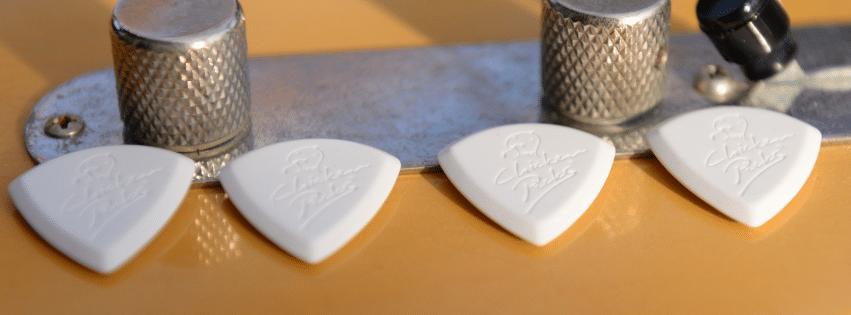
Some thick boutique kind of guitar picks have beveled edges, which allow you to glide of off the strings very easily. When you are new to guitar, a high-end guitar pick may not come up in your mind immediately, but it may help you a lot.
Check this article about how easy these picks play.

The image shows the beveled edges of a thicker guitar pick (i.e. Badazz III). These allow you to let the pick glide on and off the strings extremely easy. According to research published by guitar pick reviews.com, beveled edges help to lower the string resistance and soften the release.
The sharp edge will get you an amazing attack and control of the pick.
Besides that pick noise is reduced with ChickenPicks guitar picks’ beveled edges because of the extremely hard Thermoset material, which ensures no jagged edges.
And because it is extremely sharp, it does not feel too far from home when you are used to play thinner picks.
Pick slanting may help, but you might have to change your playing technique
We already said it, to glide on and off the strings effortlessly, it helps to do some pick slanting with standard (thinner) picks.
By turning your picking hand slightly clock- or counter-clockwise, the edges of the pick will touch the string.
With beveled edges you won’t have to do much pick slanting, because the edges already are tapered.
Upward- and downward slanting
Upward in this case means that the side edge of the pick nearest to the fretboard, points to your face. Downward slanting of course, is the opposite of that.
With rounded- and pointy tips as well, this may help the pick roll off of the strings easier.
Beveled edges are some kinds of built-in pick slants
Thicker picks with beveled edges give you the feel of pick slanting, but you don’t have to work on your slanting technique. This is the reason why these picks play so easy. Once you try some, you will immediately feel the difference and ergonomic way of playing.
Better grip using pick grip stickers
Regardless the brand or shape of the pick, it remains important that your pick stays stable and does not slip or turn between your fingers. Gripperzz are specially designed for the best grip on your guitar pick. Gripperzz are small soft rubber grip stickers in the shape of a guitar pick.
This is my story on making my favorite thick guitar picks
The uncomfortable feel of standard Heavy picks for me was the reason to create something that suited my needs.
From that moment in 1986, I made my own picks in 2.6mm, just for my own use.
Read more about my guitar pick journey that led to start ChickenPicks guitar picks in 2010.

Materials used
In stores you may see mainstream plectrums made of Celluloid, followed closely by Nylon and Delrin, which you may see at many different authoritative websites like Fender.
All of them are made from different materials, whether these are light-, medium- or (extra-) heavy etcetera.
Here are a few to mention.
Celluloid guitar picks
This material was invented in the 1800’s. but in use for modern guitar picks since 1922 by Luigi D’Andrea.
The history of guitar picks is interesting.
Real celluloid picks are still available, but mostly replaced by one of the next materials.
Celluloid picks
As stated in magazines like Premier Guitar, celluloid was one of the earliest plastics to transform guitar-pick manufacturing and remains associated with the classic feel of vintage-style picks.
Celluloid picks are quite flexible because of the structure of the material.
Nylon
Still used a lot, but extremely flexible and slippery. Guitar tone with Nylon picks does not have a lot of body and sustain.
Delrin
Popular for cheap guitar picks and a lot more rigid related to Nylon and celluloid. But still bendy and tone wise it misses bottom-end.
Tortex
Tortex was first introduced in 1981 as a synthetic alternative to tortoiseshell. At Jim Dunlop’s website you can find that it was developed to combine durability, flexibility, grip and a distinctive picking response. It uses a Delrin-based material together with a surface treatment designed to enhance its grip.
Acrylic
Popular for thicker picks and much more rigid. Tone wise, these picks deliver a wide variety of the tone spectrum. These picks are more expensive than mainstream thin picks, but the lifespan is longer.
Although the material is rigid, it is not extremely hard. As a result, these picks wear fast when used with metal strings.
They also may become jagged, which causes pick noise.
Ultex
This material is comparable to Delrin, but stiffer and it may last longer. Jim Dunlop Manufacturing’s standard description for Ultex picks is: They’re complement the advanced technique of today’s highly skilled players with crystal clear tones and incredible durability
Thermoset
This is an extremely hard material that lasts for months or even years when used for guitar picks. Thermoset is the name for a thermosetting plastic. According to Britannica thermosets do not melt upon reheating and can remain dimensionally stable up to the temperature at which chemical degradation begins.
The hardness of Thermoset classifies for Shore D hardness. ASTM D2240 describes standardized durometer methods for measuring indentation hardness, including Shore D measurements.
More about Thermoset and their relative hardness can be found here.
Contrary to regular plastic Thermoset is a ceramic material.
This makes it heat resistant and thicker Thermoset picks absolutely don’t bend.
The tone of these picks is different because of the higher mass. Which means more tone within the whole tone spectrum.
Picks made out of Thermoset are popular for guitar, but also for bass guitar and mandolin as well.
Other materials (boutique guitar picks)
A variety of materials are used for (boutique) guitar picks. Think of stone, bone, glass and wood.
You should check them on the internet as most brick & mortar stores will not carry them.
Picks made of these materials are some kind of super nice knickknackery.
We wrote an interesting article about boutique guitar picks in general, and if you still have questions about it, please send an e-mail to us.
How to hold a guitar pick properly
Place the guitar pick on top of your index finger with a little less than let’s say 6mm sticking out past the fingertip.
The pick is best hold between the thumb and the index finger.
Your index finger should be behind read more…
9 benefits of using thick guitar picks
- Increased Control: Heavy picks provide greater stability and control over your strumming and picking technique. This can be especially advantageous for intricate passages or fast-paced playing styles.
- Better Tone: Heavy picks produce a fuller, richer tone compared to lighter picks. The more mass brings more energy to the strings, resulting in a fatter sound.
- Durability: Heavy picks often last longer. This is because they’re mostly made from denser materials. This make them more durable than lighter picks. These picks are less prone to bending or breaking while played aggressively. They will last longer.
- Reduced hand fatigue: While heavy picks require less effort to play, they may reduce muscle fatigue.
More mass means less force is needed. Heavier picks produce more volume out of the strings. - Versatility: Heavy picks are versatile and suitable for various playing styles and genres, from heavy metal to jazz. They offer a balance between the warmth and precision of thicker picks and the flexibility of thinner picks.
- Articulation: The extra weight of a heavy pick can improve articulation and attack on single-note lines or lead playing and strumming as well. This may help notes to stand out more clearly.
- Adaptability and grip: Heavy picks are great for different playing styles by adjusting grip. This allows you to fine-tune your sound. And thicker picks may have beveled edges, which makes it easier to glide on and off the strings.
- Less string breakage
Although you expect having more string breakage with heavy pick then as with light picks, that is not true. Fact is, with thick guitar picks your guitar delivers more volume out of the strings. So, you should pick less hard by gripping less firmly. This also is a benefit in prevention of hand fatigue. - Less picking delay
With thin and flexible guitar picks, there’s always some kind of delay because the pick bends. With heavy or thick guitar picks you will eliminate this. We wrote an interesting article about why guitar picks should not be flexible.

Best guitar picks for acoustic guitar
Although acoustic guitars are different to electric guitar at some point, there is no specific guitar pick for acoustic guitars.
Finding out what the best guitar picks for acoustic are for you, means that you have to check out different models, thicknesses and materials.
In another Guitar Essentials we wrote some useful guidelines for choosing the best picks for acoustic.
Why do jazz guitarists use thick and small guitar picks?
Jazz guitarists often use very heavy gauge small guitar picks (>2.0mm), because they typically play faster single note lines, but they also need slightly more mellow tones.
Most jazz guitarists like to use small guitar picks with mostly sharp tips, called “jazz shaped picks”.
Most famous models are the Dunlop Jazz III and ChickenPicks Badazz III
Why do bass guitarists use thick picks?
The extremely thick bass strings require more mass in a pick to let the strings ring out.
So, with thicker bass picks the sound will be better and as an additional benefit thicker picks seem to lessen the distance between bass strings. It makes it easier to pick the strings more precisely.
What do metal guitarists use?
The thicker picks will also tend to be more rigid, which will help with accuracy & control, resulting in more nuanced playing. Advised thickness for metal at least is 2.0mm and thicker. Most of our customers use 2.5 – 3.5 mm small guitar picks for playing metal.
What picks do funk guitarists use?
On the other end of the spectrum, guitarists playing funky styles of music often use heavy gauge picks and somehow larger picks.
This allows them to strike their strings hard producing a more biting and aggressive but clear funky tone. The heavier the pick the more mid- and bottom-end tones, allowing them a higher level of clarity in their playing.
Why do rock guitarists use thick picks?
Heavy picks are great for lead guitar playing. The thickness prevents for pick drag, which gives you greater control and precision to hit the notes you need.
These picks also give your playing greater clarity and a wider dynamic range. This means a wider reach in the tonal spectrum with clear bright- mid- and bottom-end tone.
The verdict: guitar picks thin vs thick
Ultimately, whether a heavy guitar pick is suitable for you, depends on your playing style, personal preferences, and the sound you want to achieve.
Experimenting with different pick thicknesses and materials can help you find the perfect match for your playing needs.
Regarding tone, playability, durability and versatility, thick guitar picks will always deliver more benefits than thin picks. And this is the reason why pros in most cases use thicker guitar picks.
Why ChickenPicks guitar picks ?
In the world of boutique guitar picks, ChickenPicks guitar picks is unique because of the use of “Thermoset”, their thickness and beveled edges. As said before, these 3 characteristics provide clarity to your tone, ergonomic playability, durability of the pick and less pick noise.
Key Takeaways
- Thick guitar picks improve tone, playability, and durability, making them a favorite among guitarists.
- Heavier picks offer advantages like better control, reduced hand fatigue, and increased versatility across genres.
- Guitar pick thickness affects sound; generally, thicker picks produce a fuller tone and articulate playing.
- Jazz and metal guitarists often prefer small, heavy picks for precision and clarity in their sound.
- Choosing thick guitar picks can lead to a better overall playing experience and improved musical performance.
F.A.Q.
Thick guitar picks offer more control, a fuller tone, greater durability, and less pick flex than thin picks. While the best choice depends on your playing style, many guitarists prefer thicker picks for improved precision, articulation, and consistency.
Many professional guitarists use thick picks because they provide better control, faster response, and a more consistent attack. Thick picks do flex less, so more of the player’s motion is transferred directly to the strings, improving accuracy and note definition.
Thick guitar picks can produce a fuller and richer tone because their greater mass transfers more energy into the strings. This often results in stronger fundamentals, improved sustain, and clearer note articulation compared to thinner picks.
Yes, thick guitar picks can be a good choice for beginners. They provide more control, reduce picking delay caused by flexing, and can help new players develop a more consistent picking technique. Experimenting with different pick thicknesses is still recommended to find the most comfortable option.
Many guitarists find that thick picks with beveled edges glide more smoothly across the strings than standard thick picks. The beveled edge reduces resistance, improves comfort, and can make fast picking and strumming feel more effortless.


What others say about ChickenPicks guitar picks
ChickenPicks guitar essentials
In guitar essentials we write about interesting things every guitarist should know a bit of, especially when you’re new to (electric) guitar.
We definitely don’t dig deep into theories or technical aspects.
You will find many scientific documents about anything somewhere on the internet.

About the author
Hi, my name is Eppo Franken and I started to make my own picks in the mid ’80’s. In 2010 my wife Jolanda and I thought that it may be interesting to look if other people also would like my idea of picks.
I play guitar since 1980 and my favorite style is country chicken picking and some kinds of rockabilly.
Send us an e-mail and let’s talk about guitar tone and picks 🙂
Leave a Reply
Want to join the discussion?Feel free to contribute!